On this page
How to identify it
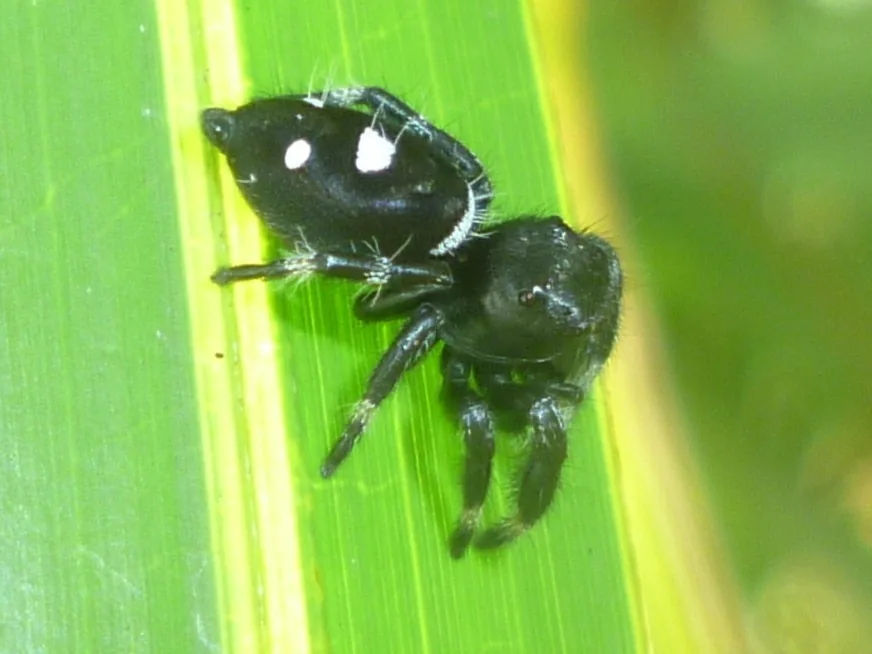
- Males are always black, with a white band at the front of the abdomen, a white central triangle and a pair of oval white spots toward the rear, plus black-and-white fringes on the front legs. Their large fangs are iridescent green-blue-violet.[1]
- Females usually have the black areas covered with gray, tan, brown or orange scales; all-orange females occur mostly in the southern two-thirds of Florida and the Greater Antilles.[1]
- FDACS gives males an average of 12 mm (range 6-18 mm) and females 15 mm (range 7-22 mm). The Journal of Arachnology paper records a maximum body length of 2.2 cm for females and 1.8 cm for males.[1][2]
- Like other jumping spiders it has two large eyes in the middle of the front row; Phidippus are the largest, hairiest jumping spiders in the region, with conspicuous iridescent fangs.[1]
Look-alikes
| Look-alike | How to tell them apart |
|---|---|
| Bold jumping spider | Its rear pair of white abdominal spots are lines rather than ovals, and it has four pairs of dull black square spots on the abdomen.[1] |
| Phidippus otiosus | Its rear abdominal spots are orange and squarish rather than white.[1] |
| Black widow | People often mistake a big black hairy regal jumper for a black widow, but the widow is round, shiny black and hardly hairy, with long thin legs.[1] |
Where it lives
It occurs in the southeastern U.S., the Greater Antilles and the Bahamas and is most common in peninsular Florida. The World Spider Catalog lists the USA and the Caribbean, with an introduction to Easter Island.[1][3]
Biology and life cycle
It lives in fields and open woodland but not mature hardwood forest. Young spiders stay low in herbs; older ones favor palms and palmettos, or shrubs and trees where palms are absent, and adults are often found on building walls.[1][2]
It hunts by sight and catches prey by jumping on it, trailing a silk safety line. Silk retreats open at both ends serve for resting at night, molting and laying eggs, often along the midrib of a palm frond.[1]
Small young eat many flies; older spiders take grasshoppers and katydids, true bugs, and caterpillars and moths.[1][2]
Females lay up to 4 batches of eggs in thick silk nests under bark, especially oak and pine, or in cracks of old houses and barns. The first batch averages 183 eggs.[1]
Health risk
FDACS calls jumping spiders harmless. A large one like this can bite if held tightly, causing a sharp sting that fades in a few minutes. MedlinePlus notes that most spider bites are harmless; wash a bite with soap and water and apply wrapped ice, and call 911 for trouble breathing or swelling of the face or mouth.[1][4]
Control
Prevention
No control is needed. Jumping spiders are harmless and beneficial predators; one male was even found eating an adult Diaprepes abbreviatus, a pest of citrus and sugarcane.[1]
More from the research literature
A 2017 paper in the Journal of Arachnology documented female and male regal jumping spiders eating small tree frogs, including Cuban tree frogs, and anole lizards, with eight such events seen in seven Florida counties. It was the first report of a jumping spider preying on vertebrates; otherwise the species eats almost only insects and spiders.[2]
Common questions
- Is the big jumping spider on my wall dangerous?
- No. Jumping spiders are harmless; a big one bites only if held tightly, and the sting fades within minutes.[1]
- Why do regal jumping spiders look so different?
- Males are black and white; females are usually covered with gray, tan, brown or orange scales.[1]
- Is it a black widow?
- No. The regal jumper is hairy and stout; a black widow is round, shiny and nearly hairless with long thin legs.[1]
Sources
- Florida Department of Agriculture and Consumer Services, Division of Plant Industry, “The regal jumping spider, Phidippus regius (Entomology Circular 223, G. B. Edwards, 1981).” www.thefsca.org/wp-content/uploads/2025/01/ent223.pdf (accessed 2026-11-11)
- Peer-reviewed literature (Journal of Arachnology), “A vertebrate-eating jumping spider (Araneae: Salticidae) from Florida, USA (Journal of Arachnology 45:238-241, 2017).” www.conservation.unibas.ch/team/nyffeler/pdf/nyffeler2017joa1.pdf (accessed 2026-11-11)
- World Spider Catalog, Natural History Museum Bern, “Phidippus regius C. L. Koch, 1846 (World Spider Catalog).” wsc.nmbe.ch/lsid/urn:lsid:nmbe.ch:spidersp:035492 (accessed 2026-11-11)
- MedlinePlus, U.S. National Library of Medicine, “Insect bites and stings (Medical Encyclopedia).” medlineplus.gov/ency/article/000033.htm (accessed 2026-11-11)
- iNaturalist, “Phidippus regius taxon page (order and family).” www.inaturalist.org/taxa/179749 (accessed 2026-10-06)