On this page
How to identify it
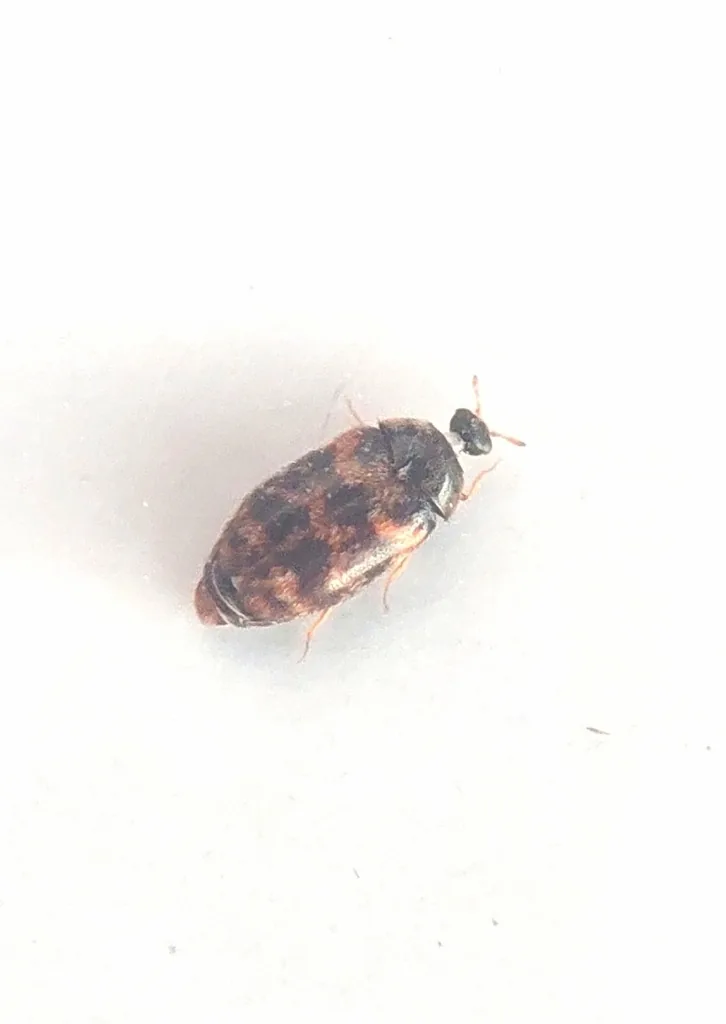
- Adults are oval beetles about 1/8 inch long (2 to 4.6 millimeters, females larger than males), usually dark with a brown and yellowish or reddish pattern of wavy bands or faint patches on the wing covers.[1][2][5]
- Larvae grow to about 1/4 inch. They start whitish yellow and darken with age, but stay lighter than many other dermestid larvae.[2][1][5]
- The last few abdominal segments of the larva carry dense tufts of stiff hairs growing from dark plates, and a tail of long, thin hairs trails from the tip.[1][5]
- Cast larval skins are the most readily identifiable sign of an infestation.[5]
Look-alikes
| Look-alike | How to tell them apart |
|---|---|
| Carpet beetles | Household carpet beetles mostly feed on animal materials like lint, hair, wool and dead insects, while warehouse beetle larvae usually develop in stored plant foods.[2] |
| Cigarette beetle | About the same size but cylindrical and uniformly light brown, without the mottled pattern; its grubs are covered in long, silky hairs rather than spear-tipped tufts.[1] |
| Khapra beetle | One of several similar Trogoderma beetles; the Canadian Grain Commission lists other Trogoderma species, along with Anthrenus carpet beetles, as the warehouse beetle's look-alikes, so a close match needs expert identification.[5] |
Where it lives
Found worldwide in homes, flour and feed mills, processing plants, feed warehouses, dried milk factories and stored grain. It is one of the dermestids most often found in Colorado homes, and UC IPM lists it among the beetles that commonly attack pantry foods.[2][1][5]
Biology and life cycle
Females lay up to about 90 eggs, scattered loosely on or in dried plant or animal material, including infested food.[1][5]
Development from egg to adult takes about 30 to 45 days on average, as little as 45 days in warm conditions by UC IPM's figure, and the species develops continuously, with more than one generation a year.[1][2][5]
Larvae can enter diapause, a dormant state, when conditions for development are unsuitable.[5]
The larval stage is highly resistant to cold, and in USDA laboratory selection experiments warehouse beetle populations adapted to cold stress quickly.[6]
Larvae are very active and wander off to find new food sources, which spreads an infestation to other packages.[1]
Adults feed on nectar and pollen; only the larvae damage stored products. Outdoors it is also a pest in alfalfa leafcutter bee nests.[5]
Damage and signs
- Reported foods include cereals, flour, cornmeal, pasta, candy, cocoa, cookies, potato chips, nuts, dried peas and beans, spices, pet food, fish meal, stored seed, barley, wheat, canola, animal feed, dead insects and dead animals.[1][5]
- In stored seed, larvae damage every part of the kernel except the shell, and they can get into bagged grain and processed, packaged food.[5]
- Pantry pests foul food with their bodies, hairs and droppings, and may bring in microbes that spoil food in warm, humid storage.[1]
Health risk
Warehouse beetle hairs shed into food can irritate the mouth, throat and digestive tract if eaten, so throw out any food found infested with this beetle.[1]
Control
Prevention
For several months afterward, keep susceptible foods in containers with tight-fitting lids or in the refrigerator or freezer; plastic bags aren't enough.[1]
Remove rodent and insect nests near the home and replace old rodent baits, since pantry insects can breed in them.[1][2]
Sanitation
Find and get rid of every infested item; check opened and forgotten packages, pet food, bird seed and decorative items, and seal and remove infested packages from the house.[1][3]
Vacuum shelves with a crevice attachment and wash them with soap and water before putting clean food back.[1][3]
Traps and physical control
Items you want to keep can be frozen at 0 degrees Fahrenheit for several days or heated to kill all life stages; large items need longer to penetrate.[2][3]
Use multi-species pantry pheromone traps that attract warehouse beetles to catch leftovers after cleanup, and re-inspect food whenever new beetles turn up.[1]
Pesticides
UC IPM does not recommend insecticides for pantry pests, and Colorado State notes sprays alone don't control dermestids without a thorough cleanout.[1][2]
Common questions
- Can I eat food that had warehouse beetles in it?
- No. Their shed hairs can irritate your mouth, throat and digestive tract, so UC IPM advises throwing out any food infested with this beetle.[1]
- Why do warehouse beetles keep coming back after I clean?
- Wandering larvae may have spread to other packages, and larvae can go dormant when conditions are poor, so keep inspecting and use sealed storage for months.[1][5]
- What are the little brown shells I keep finding in my pantry?
- Probably shed larval skins. Warehouse beetle larvae molt as they grow, and the cast skins are the most readily identifiable sign of an infestation.[5]
Sources
- University of California Statewide IPM Program, “Pest Notes: Pantry Pests, Publication 7452.” ipm.ucanr.edu/home-and-landscape/pantry-pests/ (accessed 2026-11-12)
- Colorado State University, Department of Agricultural Biology, “Dermestid beetles.” agsci.colostate.edu/agbio/ipm-pests/dermestid-beetles/ (accessed 2026-11-12)
- University of Kentucky Entomology, “ENTFACT-612: Stored Product Pests in the Pantry.” entomology.mgcafe.uky.edu/ef612 (accessed 2026-11-12)
- iNaturalist, “Trogoderma variabile taxon page (order and family).” www.inaturalist.org/taxa/233048 (accessed 2026-11-12)
- Canadian Grain Commission (Government of Canada), “Warehouse beetle (Trogoderma variabile): insect identification.” www.canada.ca/en/grain-commission/services/grain-quality/manage-stored-grain/identify-insect/secondary-insect-pests/warehouse-beetle.html (accessed 2026-11-12)
- Gerken et al., Environmental Entomology 2020 (via PubMed), “Artificial Selection to a Nonlethal Cold Stress in Trogoderma variabile Shows Associations With Chronic Cold Stress and Body Size (abstract).” pubmed.ncbi.nlm.nih.gov/31913443/ (accessed 2026-11-12)