On this page
How to identify it
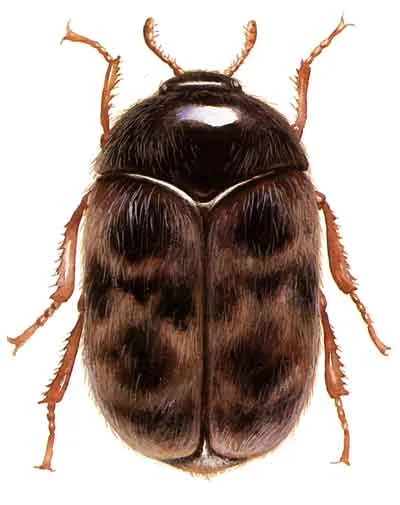
- Adults are small, about 1/14 to 1/8 inch long, and females are often twice the size of males. UF/IFAS gives adults as about 1.6 to 3.0 mm long and 0.9 to 1.7 mm wide, oblong-oval and covered with hairs; males are brown to black with indistinct reddish brown markings on the wing covers, and females are slightly larger and lighter.[4][3]
- They are pale red-brown to dark brown or black, with wing covers that are plain or carry faint red-brown markings. The body hairs often rub off, which gives the beetle a slick look.[4]
- Larvae do almost all the feeding. Their hairy cast skins in grain or food are a sign of an active infestation.[2]
- Kansas State notes the khapra beetle is hard to tell from related species; APHIS identifiers confirm suspect specimens, and domestic finds require molecular confirmation.[4][2]
- UF/IFAS says the head is small and bent down, with short 11-segmented antennae ending in a club of three to five segments that fits into a groove in the side of the thorax.[3]
- Eggs are milky white turning pale yellowish, cylindrical and about 0.7 by 0.25 mm, rounded at one end and pointed with spine-like projections at the other.[3]
- UF/IFAS says newly hatched larvae are about 1.6 to 1.8 mm long, more than half of it a tail of hairs on the last segment, and yellowish white with brown hairs. They turn golden or reddish brown and hairier as they grow, the tail gets proportionally shorter, and mature larvae are about 6 mm long and 1.5 mm wide.[3]
Look-alikes
| Look-alike | How to tell them apart |
|---|---|
| Warehouse beetle and other Trogoderma beetles | Several other Trogoderma species live in the United States and are easily confused with the khapra beetle. A USDA-recognized specialist must confirm any suspect specimen, and a result of 'Trogoderma species, not granarium' counts as negative. The warehouse beetle is a strong flyer; the khapra beetle does not fly.[5][2] |
| Carpet beetles | USDA's stored-grain handbook notes that Trogoderma beetles are sometimes confused with carpet beetles (Anthrenus), which are not grain pests, so a small hairy beetle or larva in food can't be named khapra by eye. UF/IFAS says the larvae look very similar to those of other, relatively unimportant Trogoderma species and some carpet beetles, and that larvae and adults are best identified under a microscope.[5][3] |
Where it lives
Native to the Indian subcontinent, it has spread into other parts of Asia, Africa and Europe and has been reported from more than 60 countries. It is not known to occur in the United States. It was found in Tulare County, California, in 1953 and had already spread to other parts of California, Arizona, New Mexico, Texas and Baja California; a federal quarantine followed in 1955, and active infestations were eliminated by 1961. Sources differ on how long it had been present before discovery: USDA's handbook says since 1939, Kansas State says since 1946. UF/IFAS gives the endemic zone as Burma to western Africa, bounded by the 35th parallel to the north and the equator to the south, and says it was introduced as early as 1946 to a warehouse in Fresno and possibly present in the San Joaquin Valley since 1939. It was later found in a New Jersey warehouse in 1968 and in isolated infestations from 1980 to 1983 in California, Maryland, Michigan, New Jersey, New York, Pennsylvania and Texas, and all U.S. infestations found so far have been eradicated. UF/IFAS cites USDA-APHIS estimates that 67% of the continental U.S. would have a suitable climate.[2][6][5][4][1][3]
Biology and life cycle
Females lay up to 100 eggs, which hatch in 3 to 10 days. In good conditions the larval stage lasts 20 to 40 days, the pupal stage 4 to 6 days, and adults live only one to two weeks. Development can take as little as 26 days, and there may be one to ten generations a year.[2]
Crowding, cold, poor food or no food push late-stage larvae into a dormant state (diapause) in which they barely feed. Without food, diapausing larvae have survived for several years.[2]
It is best suited to hot, dry climates but tolerates both extreme heat and cold. It develops best around 30 degrees C (86 degrees F) and stops developing below 20 or above 35 degrees C (68 or 95 degrees F). A 2026 genome study describes the larvae's resistance to extreme cold as exceptional.[2][7]
Adults do not fly and larvae move only short distances, so it spreads mainly through people moving infested goods in trade, household moves and personal baggage.[2][5]
Larvae crowd into cracks and crevices in bins, buildings and shipping containers, where contact insecticides are hard to get at them, and dormant larvae are less affected by fumigation.[2][5]
UF/IFAS says mating takes place about five days after emergence. Egg laying starts almost at once at 40 degrees C (104 degrees F) and one to three days later at cooler temperatures, but no eggs are produced at 20 degrees C (68 degrees F). Mated females live four to seven days, unmated females 20 to 30 days and males seven to 12 days.[3]
UF/IFAS says larvae may enter diapause if it stays below 25 degrees C (77 degrees F) for a time or if they are very crowded. In diapause they can molt but are inactive and may stay that way for many years, and they can survive temperatures below -8 degrees C (17.6 degrees F).[3]
It can develop at a relative humidity as low as 2%, and UF/IFAS says high humidity may be what limits the survival of introduced beetles.[3]
Damage and signs
- Larvae feed on grains such as wheat, barley, rice and sorghum, on peanuts and cowpeas, on processed foods such as pasta, dried fruit, cereal and dog food, and on animal products such as powdered milk and fish meal. It prefers dried plant material but will attack almost any of these. UF/IFAS lists oats, rye, corn, flour, bran, malt, many seeds, beans and lentils, noodles, coconut, powdered yeast and dried blood among recorded foods. UF's stored-product gallery adds pollen and dead insects, and says young larvae feed on damaged kernels while older larvae eat whole kernels and seeds.[2][5][3][8]
- It is a 'dirty feeder' that damages more grain than it eats and contaminates what is left with body parts and hairs. Under good conditions it breeds so fast that larvae crowd the top layer of binned grain.[1][5]
- Finding it in a new area sets off surveys to map the infestation and a USDA-led eradication effort, as happened in California in the 1950s. UF/IFAS says a find in an uninfested area usually leads to an immediate quarantine of suspected goods.[2][5][3]
Health risk
USDA says hairs and cast skins from the larvae are known allergens and a respiratory hazard, and CBP notes that contaminated food can cause stomach and intestinal irritation and especially sickens infants.[2][1]
Control
Prevention
The beetle and its host material are regulated by USDA under 7 CFR 319.75. When CBP found khapra beetle larvae in rice in a traveler's bag at Washington Dulles, it seized the rice and had it destroyed by incineration. Travelers should declare all food and plant products to a CBP officer at the first port of entry.[2][1][9]
Pesticides
Eradicating a khapra beetle find is the job of USDA's Plant Protection and Quarantine program, which confirms the identification before any control starts; hidden, dormant larvae resist both contact sprays and fumigation. UF/IFAS says USDA-APHIS inspection looks in cracks and crevices, behind wall paneling and under timbers, tanks and shelves. The beetle is more resistant to fumigants than most stored-product pests, so high fumigant concentrations have to be held long enough to reach every crack, and eradication programs combine fumigants and surface sprays with sanitation and exclusion.[2][3]
When to call a professional
APHIS asks people to report suspected invasive pests to their county extension agent or State Plant Health Director, and suspect specimens are confirmed by federal identifiers, with results reported to state and federal plant health officials. UF/IFAS likewise says any possible adult or larva found in the U.S. should be reported immediately to your state regulatory service.[9][2][3][8]
Why one beetle gets a federal response
CBP says the khapra beetle is the only insect it takes regulatory action against even when the insect is dead.[1]
The larvae can live a long time without food, tolerate insecticides and fumigants, and hide deep in cracks, so an established infestation is very hard to wipe out.[1][2]
A 2025 modeling study by USDA and university researchers projects more land with highly suitable climate for the beetle over coming decades, mainly in North America and Europe, and calls for more surveillance.[6]
That is why the main defense is at the border, through inspection of cargo, mail and baggage, backed by trapping surveys around high-risk sites such as importers of grain, spices and goods packed in burlap.[2]
Where the sources disagree
Native range: USDA's manual says the Indian subcontinent; UF/IFAS gives an endemic zone from Burma to western Africa.[2][3]
Eggs: USDA's manual says females lay up to 100 eggs that hatch in 3 to 10 days; UF/IFAS gives an average of 50 to 90 eggs hatching in 3 to 14 days, and UF's stored-product gallery an average of 35 eggs laid over 3 to 12 days.[2][3][8]
Temperature: USDA's manual says it develops best around 30 degrees C (86 degrees F) and stops above 35 degrees C (95 degrees F); UF/IFAS gives 35 degrees C (95 degrees F) as the optimum.[2][3]
Size difference between sexes: Kansas State says females are often twice the size of males; UF/IFAS says females are slightly larger.[4][3]
Development time: USDA's manual says it can take as little as 26 days; UF/IFAS gives 26 to 220 days depending on temperature, and UF's gallery says the life cycle can be completed in 30 days under favorable conditions.[2][3][8]
Common questions
- What should I do if I think I found a khapra beetle?
- Contact your county extension office or your State Plant Health Director, as APHIS advises for suspected invasive pests. Only a USDA-recognized specialist can confirm the identification.[9][2]
- Is the khapra beetle established in the United States?
- No. USDA says it is not known to occur in the U.S. The 1950s infestation in the Southwest was eliminated by 1961, though port interceptions remain common.[2][5]
- Can I bring rice or grain home from overseas?
- Rice, wheat and other khapra host foods are regulated by USDA, and CBP has found live khapra beetles in rice carried by air travelers. Declare all food at the first port of entry.[2][1][9]
- Can khapra beetles fly?
- UF/IFAS says adults have wings but have never been observed to fly and feed very little, so the beetle spreads in infested goods or containers, possibly while larvae are in diapause.[3]
- When are khapra larvae easiest to spot?
- UF/IFAS says larvae and their cast skins are the obvious signs, and larvae are most likely to be seen just before dusk, when they are more active.[3]
Sources
- U.S. Customs and Border Protection, “CBP Discovers Live Khapra Beetle in Rice at Washington Dulles International Airport (August 2024).” www.cbp.gov/newsroom/local-media-release/dulles-cbp-finds-destructive-pest-passenger-baggage (accessed 2026-11-13)
- USDA Animal and Plant Health Inspection Service, Plant Protection and Quarantine, “Khapra Beetle Program Manual (new edition, April 2025).” www.aphis.usda.gov/sites/default/files/khapra-beetle.pdf (accessed 2026-11-13)
- University of Florida IFAS Extension (EDIS), “Khapra Beetle, Trogoderma granarium Everts, EENY-372/IN667 (D. L. Harris; Featured Creatures).” ask.ifas.ufl.edu/publication/IN667 (accessed 2026-11-14)
- Kansas State University Research and Extension, “Stored Products Pest Control (Pesticide Application Training, Category 7B, S-16).” bookstore.ksre.ksu.edu/download/stored-products-pest-control-7b_S16 (accessed 2026-11-11)
- USDA Agricultural Research Service, “Stored-Grain Insects (Agriculture Handbook No. 500).” www.ars.usda.gov/ARSUserFiles/2863/pdfdocuments/StoredGrainInsects.pdf (accessed 2026-11-11)
- Scientific Reports, via PubMed, “Increasing global risk of khapra beetle invasion forecasted under projected environmental conditions (Harman et al. 2025).” pubmed.ncbi.nlm.nih.gov/40681685/ (accessed 2026-11-11)
- BMC Biology, via PubMed, “Functional genomics reveals key gene families and molecular pathways for extreme cold survival in the khapra beetle (Zeng et al. 2026).” pubmed.ncbi.nlm.nih.gov/41731469/ (accessed 2026-11-11)
- University of Florida, Entomology and Nematology Department, “Khapra beetle, Trogoderma granarium (UF/IFAS Stored Product Pests Photographs CD-ROM).” entnemdept.ufl.edu/projex/gallery/dl/stored_product_pests/text/khapra_beetle.htm (accessed 2026-11-14)
- USDA Animal and Plant Health Inspection Service (APHIS), “How To Stop Invasive Pests (Hungry Pests).” www.aphis.usda.gov/plant-pests-diseases/hungry-pests/how-stop-them (accessed 2026-11-13)
- iNaturalist, “Trogoderma granarium taxon page (order and family).” www.inaturalist.org/taxa/209160 (accessed 2026-10-06)