On this page
How to identify it
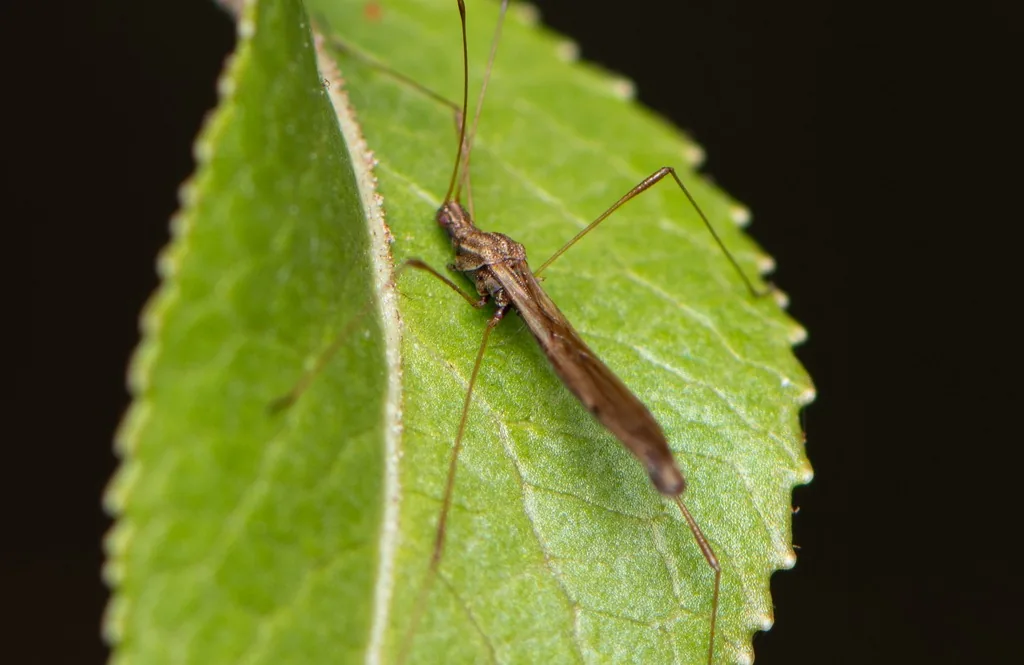
- Adults are about 1/4 to 1/3 inch (7-9 mm), brown to brick red, with very thin bodies and long legs and antennae; the last antenna segment is enlarged.[1][2]
- Nymphs are yellowish green to green and smaller.[1]
- Eggs are white to yellow, oval and about 1 mm long.[1]
- Fun fact: its long legs let it walk over sticky plant hairs that trap most insects, and it can lever itself off sticky surfaces, much like a spider walking on its web.[1]
Look-alikes
| Look-alike | How to tell them apart |
|---|---|
| Jalysus spinosus | A similar stilt bug, Jalysus spinosus, prefers grasses and is limited to eastern North America, while the spined stilt bug lives on hairy, sticky-leaved plants. J. spinosus has also been collected as a likely natural enemy in Southeast US sesame fields.[1][5] |
Where it lives
Found across North America from Canada to Mexico and recorded in almost every continental U.S. state.[1][2]
Biology and life cycle
Adults overwinter under grasses and leaves and lay eggs on weeds and other plants in spring; nymphs pass through five stages and need both plant and animal food.[1]
In North Carolina there are typically two generations a year.[1]
Nymphs eat up to 12 hornworm and 80 budworm eggs a day, adults about 2 hornworm and 10 budworm eggs a day, and over its 80-day lifespan one stilt bug could prevent up to 2000 budworms and 1000 hornworms.[1]
It also eats other beneficial insects, including parasitoid wasps, which can limit its value as a helper.[2]
Fun fact: stilt bugs pick up a gut bacterium, Burkholderia, from their surroundings. In lab tests, Jalysus wickhami raised without it developed more slowly and laid fewer eggs.[4]
Damage and signs
Health risk
NC State and Penn State describe it only as a plant feeder and predator of insects and list no risk to people or pets.[1][2]
Control
Prevention
Penn State notes that control in tomatoes hasn't been studied; NC State says most of the insecticide toxicity information for stilt bugs is outdated and covers insecticides no longer used, so there is no current tested recommendation for gardens.[2][1]
Biological control
It is a beneficial predator in tobacco; Bt sprays for caterpillars don't harm it.[1]
To encourage them, NC State reports that non-crop plants such as alyssum planted next to crops like tomatoes can increase stilt bug numbers.[1]
Where sources disagree
Diet: NC State says nymphs need both animal and plant food to develop, while Penn State says stilt bugs can survive on plants alone but live longer and lay more eggs when they also eat insects.[1][2]
Name: NC State and Penn State call Jalysus wickhami the spined stilt bug; a 2020 study calls J. wickhami Wickham's stilt bug and gives the name spined stilt bug to its sister species, J. spinosus.[1][2][4]
Common questions
- What is the very skinny, long-legged bug on my tomato plants?
- Likely a spined stilt bug.[1][2]
- Is the spined stilt bug good or bad?
- Both: it eats caterpillar eggs but can damage tomato flowers and fruit.[1][2]
- Why do my tomatoes have white blotches?
- Stilt bug feeding on unripe fruit is one cause of white blotches under the skin.[2]
- Will Bt or imidacloprid sprays hurt stilt bugs?
- NC State says Bacillus thuringiensis sprays for caterpillars are not toxic to the spined stilt bug, and foliar and systemic imidacloprid showed relatively low toxicity to it and did not disrupt its control of caterpillars in tobacco.[1]
Sources
- NC State Extension, “Spined Stilt Bug in Tobacco (PDIC Factsheet).” content.ces.ncsu.edu/spined-stilt-bug-in-tobacco (accessed 2026-11-12)
- Penn State Extension, “Spined Stilt Bug.” extension.psu.edu/spined-stilt-bug/ (accessed 2026-11-12)
- iNaturalist, “Jalysus wickhami taxon page (order and family).” www.inaturalist.org/taxa/416821 (accessed 2026-11-12)
- Frontiers in Microbiology (2020), via PubMed, “Continent-Scale Sampling Reveals Fine-Scale Turnover in a Beneficial Bug Symbiont.” pubmed.ncbi.nlm.nih.gov/32636818/ (accessed 2026-11-12). Cited from the PubMed abstract.
- Environmental Entomology (2026), via PubMed, “A survey of beneficial insects in Southeast USA sesame (Lamiales: Pedaliaceae) fields.” pubmed.ncbi.nlm.nih.gov/42046194/ (accessed 2026-11-12). Cited from the PubMed abstract.