On this page
How to identify it
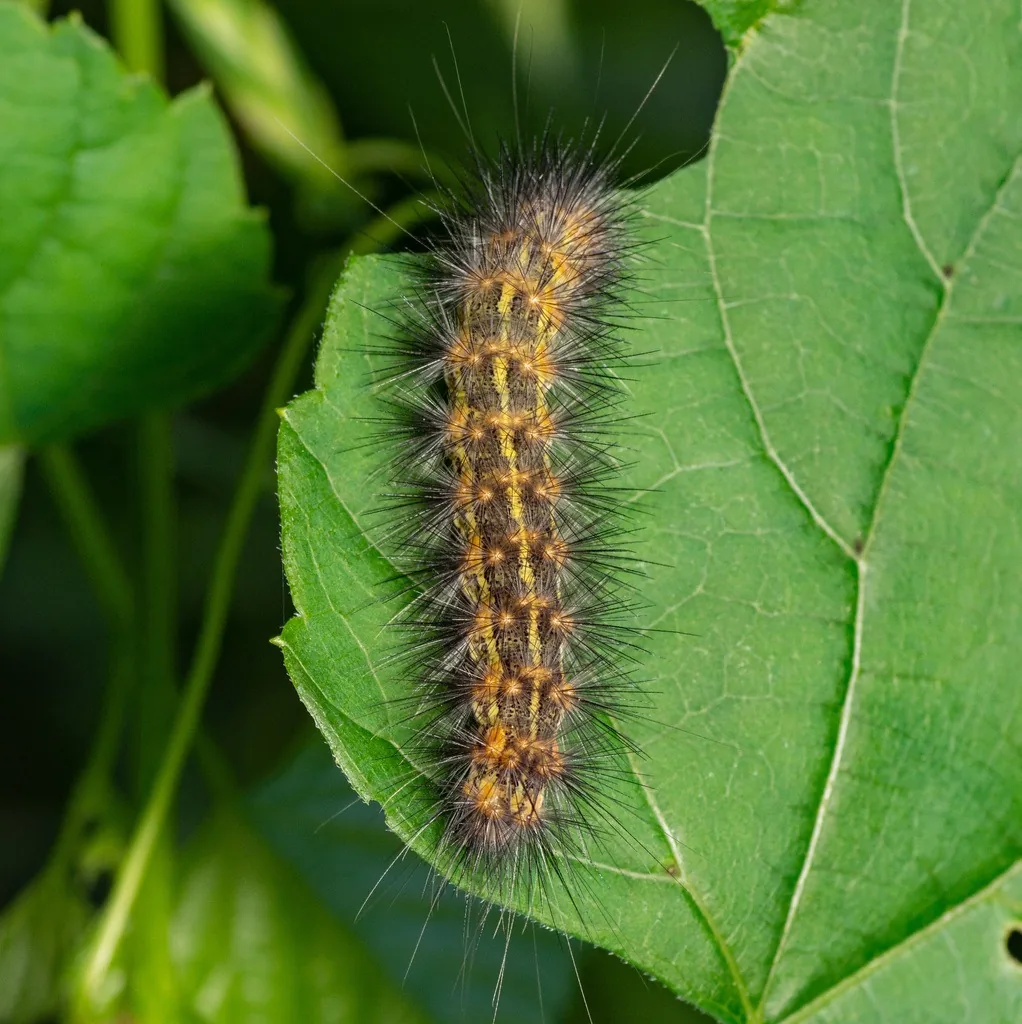
- Caterpillars carry long tufts of hair on colored bumps along every segment. Body color runs from blackish, brown or gray to orange, whitish or yellow, often in a mix, and some are striped.[1][2]
- Newly hatched caterpillars are about 1/12 inch (2 mm) long; full-grown ones reach about 2-1/4 inches and get hairier as they grow. UF/IFAS says newly hatched caterpillars are brown, second instars show brown, yellowish and white stripes, and grown caterpillars are usually dark but sometimes yellowish brown or straw colored.[1][8]
- The moth has white forewings with black spots, which vary and can be absent. The hindwings are orange-yellow in males and white in females, and the orange abdomen carries rows of black spots. UF/IFAS says most of the abdominal segments are yellow with a series of large black spots.[1][3][8]
- Eggs are round, about 1/50 inch (0.5 mm) across, yellow at first and later grayish or whitish, laid in clusters on leaf undersides.[1]
- Pupae sit in a thin dark-brown cocoon of silk and caterpillar hairs, about 1-1/4 inches long, in litter on the ground. UF/IFAS gives about 30 mm for the dark brown pupa and 12 to 14 days in the pupal stage.[1][8]
Look-alikes
| Look-alike | How to tell them apart |
|---|---|
| Yellow woollybear | Utah State lists the yellow woollybear as the look-alike for saltmarsh caterpillar; both are densely hairy caterpillars that can be yellow to orange. Texas A&M adds that saltmarsh caterpillars are often mistakenly called woollybears, the related caterpillars of the Isabella tiger moth. UF/IFAS notes that saltmarsh caterpillars are decidedly hairy, but the hairs are not as dense or as stiff as a woollybear's.[2][5][8] |
Where it lives
UC IPM treats it as a garden and field pest in California, Texas A&M describes it as a common sight in Texas gardens with multiple generations a year, and Utah State says it occurs in Utah, where it has not been found as a pest of hemp, though it has damaged hemp in neighboring states. BAMONA ranks it as globally secure, possibly rare at the edges of its range. UF/IFAS describes a native insect found throughout the United States, extending to Central America, that has damaged crops in Ontario and Quebec; as a pest it is most common in the southern U.S., particularly the Southwest.[1][5][2][3][8]
Biology and life cycle
Full-grown caterpillars spend the winter in cocoons in soil debris and become moths in early spring. Females lay eggs mostly on the undersides of leaves, and caterpillars pass through five to seven instars.[1][2]
One generation takes about 4 to 6 weeks. Caterpillars are scarce in spring; the fall generation is the biggest and does most of the damage, and Utah State marks late summer and early autumn as the time for concern.[1][2]
Late-stage caterpillars wander actively and can be seen moving quickly across lawns, landscape beds, sidewalks and roads into new feeding areas. They pupate in cocoons of silk and their own hairs in soil or leaf litter.[5][1]
Fun fact: male salt marsh moths gather in groups called leks and inflate scent organs (coremata) from their abdomens to attract females. Lab work found males fed plant alkaloids as caterpillars displayed these organs, while males raised without them rarely did.[6][7]
UF/IFAS says females commonly lay 400 to 1,000 eggs in one or more clusters, and a single cluster can hold 1,200; eggs hatch in four to five days. Moths mate the evening after they emerge and lay eggs the next evening, and females usually live only four to five days.[8]
Young caterpillars drop readily from plants when disturbed, spin a strand of silk and can be blown considerable distances by wind, UF/IFAS says, citing a 1931 report.[8]
A generation can be completed in 35 to 40 days under ideal conditions, though field reports suggest about six weeks. UF/IFAS says larval development took 24 to 37 days in Texas and 20 to 22 days in studies in Mexico and Colorado, with some studies reporting up to about 45 days.[8]
Damage and signs
- Young caterpillars feed in groups on leaf undersides, scraping tissue but leaving the veins and upper surface. Older caterpillars feed alone and chew right through leaves, leaving ragged, skeletonized or shredded foliage. UF/IFAS says the amount eaten at least doubles with each instar; one caterpillar ate over 400 sq cm (62 sq in) of bean foliage in its life, and one to 1.5 mature caterpillars per plant could cause 20% defoliation of beans, enough to cut yield.[1][2][8]
- Pigweeds (Amaranthus) are the most common host, but it feeds on many broadleaf plants. Garden crops attacked include beans, carrots, cole crops, grapes, lettuce and tomatoes; BAMONA's host list adds apple, clover, corn, cotton, peas, potato and tobacco. UF/IFAS adds asparagus, beet, cabbage, celery, onion, pea and turnip among vegetables, and alfalfa, soybean and sugarbeet among field crops. Despite the name, which comes from its first description as a pest of salt-grass hay near Boston, grasses are not particularly preferred.[1][5][3][8]
- Most crop damage happens at field margins, UF/IFAS says, when older caterpillars leave drying weeds or maturing cotton in autumn and move into irrigated crops, sometimes in large numbers. That makes fall-planted crops the most exposed.[8]
Health risk
It feeds on plants. Texas A&M says the hairs are mostly soft, are not venomous and do not sting, and suggests wearing gloves when hand-picking.[5][1]
Control
Sanitation
Keep the garden and its edges free of weeds, since pigweeds and other broadleaf weeds are its most common hosts.[2][1]
Traps and physical control
Hand-pick the caterpillars, wearing gloves; in backyard gardens this is usually a workable control. Start looking on leaves for eggs and caterpillars in late July.[2][5]
Steep-sided ditches or trenches can stop caterpillars moving into a crop, UF/IFAS says. It also notes that baits are not effective against them.[8]
Biological control
Tachinid fly maggots and an orange Ophion wasp parasitize the caterpillars. The parasitized pupae lie hidden in debris and topsoil, so this control is easy to miss. UF/IFAS says the larvae are frequently parasitized, especially by tachinid flies, with Exorista mellea and Leschenaultia adusta the most common in Arizona; lady beetles, soft-winged flower beetles and assassin bugs prey on them but aren't thought to regulate their numbers much.[1][8]
Pesticides
Only when caterpillars are intolerably abundant, spray the undersides of infested leaves thoroughly with Bacillus thuringiensis (Bt) or spinosad. Texas A&M notes that Bt kurstaki, spinosad or botanicals work on smaller caterpillars but will not kill the large late-stage ones. Spinosad is toxic to bees for at least several hours, so on blooming plants spray in the evening after honey bees stop flying. Read and follow the label.[1][5]
Where sources disagree
Generations: UC IPM counts 3 to 4 a year, Utah State 2 to 3 per growing season, BAMONA 2 broods of moths from May to August, and Texas A&M says only that there are multiple generations each year in Texas. UF/IFAS estimates one a year in the northern states to three to four in the south.[1][2][3][5][8]
Moth size: UC IPM gives a wingspan of about 1-1/2 to 2 inches, while BAMONA gives 4.5 to 6.8 cm. UF/IFAS gives 3.5 to 4.5 cm.[1][3][8]
Male hindwing color: UC IPM says orange; Texas A&M says peachy yellow. UF/IFAS says yellow.[1][5][8]
Egg size: UC IPM gives about 0.5 mm across; UF/IFAS gives about 0.6 mm in diameter.[1][8]
Common questions
- What is the very hairy caterpillar on my lettuce?
- Possibly a saltmarsh caterpillar, especially in late summer or fall. Look for long tufts of hair on colored bumps and a mix of colors; it often comes from nearby pigweed.[1][2]
- Do I need to treat?
- Usually not. It is a sporadic pest that uncommonly warrants control; weed control and hand-picking come first, with Bt or spinosad only for heavy infestations of smaller caterpillars.[1][2][5]
- Do saltmarsh caterpillars sting?
- No. Texas A&M says the hairs are mostly soft, not venomous and do not sting; gloves are still a good idea when you pick them off.[5]
- Why is it called the saltmarsh caterpillar?
- UF/IFAS says the name comes from its first description as a pest of salt-grass hay grown near Boston. That was an anomaly: its normal hosts are broadleaf weeds, and grasses are not particularly preferred.[8]
Sources
- University of California Statewide IPM Program, “Saltmarsh Caterpillar (Pests in Gardens and Landscapes).” ipm.ucanr.edu/PMG/GARDEN/VEGES/PESTS/saltmarshcater.html (accessed 2026-11-12)
- Utah State University Extension, “Saltmarsh Caterpillar (Hemp IPM).” extension.usu.edu/planthealth/ipm/notes_ag/hemp-salt-marsh-caterpillar (accessed 2026-11-12)
- Butterflies and Moths of North America, “Salt Marsh Moth or Acrea Moth, Estigmene acrea (species account).” www.butterfliesandmoths.org/species/Estigmene-acrea (accessed 2026-11-12)
- iNaturalist, “Estigmene acrea taxon page (order and family).” www.inaturalist.org/taxa/121612 (accessed 2026-11-12)
- Texas A&M AgriLife Extension, Travis County Urban Programs, “Saltmarsh Caterpillars.” travis-tx.tamu.edu/2024/05/13/saltmarsh-caterpillars/ (accessed 2026-11-12)
- Science (1982), via PubMed, “Male Lek Formation and Female Calling in a Population of the Arctiid Moth Estigmene acrea.” pubmed.ncbi.nlm.nih.gov/17753446/ (accessed 2026-11-12). Cited from the PubMed abstract.
- Journal of Insect Science (2005), via PubMed, “If you've got it, flaunt it: ingested alkaloids affect corematal display behavior in the salt marsh moth, Estigmene acrea.” pubmed.ncbi.nlm.nih.gov/16299591/ (accessed 2026-11-12). Cited from the PubMed abstract.
- University of Florida IFAS Extension, EDIS, “Saltmarsh Caterpillar, Estigmene acrea (Drury), EENY218/IN375 (Featured Creatures).” ask.ifas.ufl.edu/publication/IN375 (accessed 2026-11-14)