On this page
How to identify it
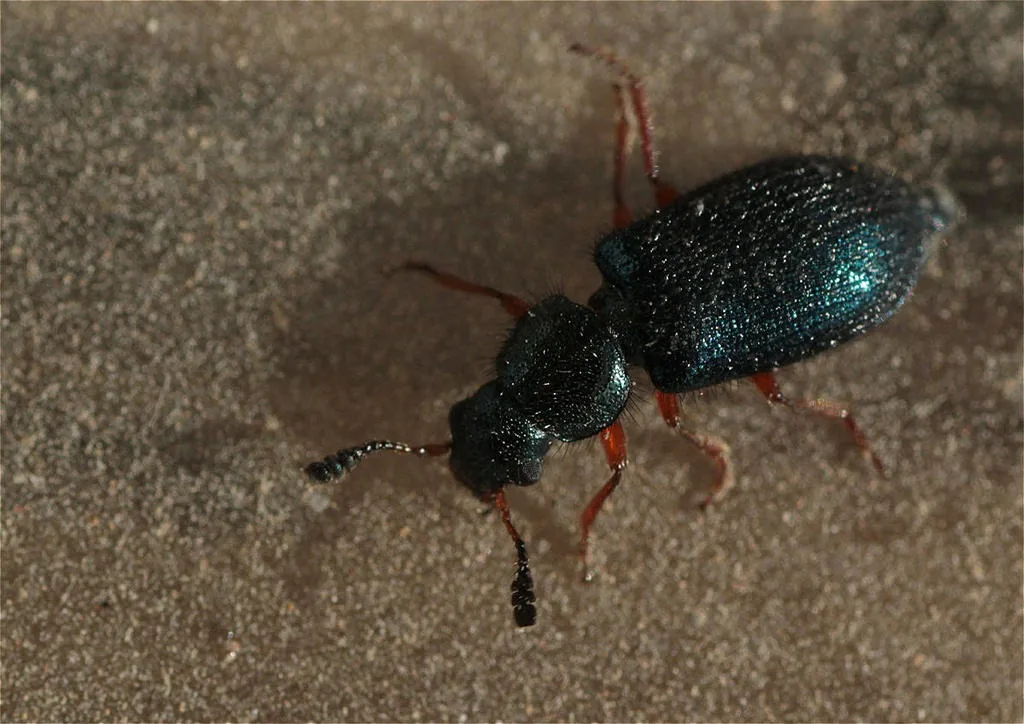
- Adults are greenish blue with red legs. University of Kentucky Extension gives a length of about 1/4 inch; a 2020 study gives a body length of 3.5 to 7 mm. Adults can fly. UF/IFAS gives a typical length of about 4.5 mm (about 3/16 inch) and describes red antennae with a black club on the last three segments, a rounded thorax narrower than the base of the wing covers, and an abdomen tip that shows beyond the wing covers.[4][1][5]
- Larvae are long, slender and purplish, about 1/4 inch long, and burrow into the meat. UF/IFAS describes larvae up to 10 mm long with a dark red-brown head, a tawny brown to dirty off-white body and a pair of small projections at the dark tip of the abdomen, and says they avoid light.[4][5]
- To pupate, the larva seals itself into a crevice with a frothy white secretion that forms a cocoon. It will also pupate inside empty fly pupal cases and shed beetle skins.[1][6]
- Eggs are about 1 mm long, translucent shiny white and shaped like a tiny grain of rice, UF/IFAS says; they are often laid in clusters in dry cracks near food.[5]
Look-alikes
| Look-alike | How to tell them apart |
|---|---|
| Larder beetle | Larder beetles also infest cured meat, but adults are 1/4 to 3/8 inch, dark brown, with a wide yellow band bearing six dark spots across the front third of the wing covers. Their larvae are covered with bristly hairs and have two curved spines at the tail end.[4] |
| Red-shouldered ham beetle | Necrobia ruficollis is sometimes confused with it, but UF/IFAS says it has a red head, thorax and base of the wing covers.[5] |
| Blue bone beetle | Another worldwide Necrobia beetle; UF/IFAS says its legs and antennae are black or bluish rather than red.[5] |
Where it lives
It occurs worldwide, with records from South, Central and North America, Europe, Asia and Oceania. It also turns up on animal carcasses and human remains; a 2023 case report gave its first record on human remains in Malaysia. UF/IFAS calls it cosmopolitan.[1][7][6][5]
Biology and life cycle
It has been recorded from more than 120 different stored commodities.[3]
In a 2022 laboratory study, populations grew fastest on dried pet food and slowest on copra. Larvae fed ham or flour beetle larvae grew heaviest, and adults lived longest on cheese.[2]
Development time depends on temperature. University of Kentucky Extension gives a life cycle of 1 to 3 months; in the 2022 study on pet food, the shortest egg-to-adult time was about 93 days, at 28°C, and 28 to 31°C was the most suitable range.[4][2]
It is partly predatory: it attacks other insects, which may be why it is rarely caught in general stored-product traps that hold several species. UF/IFAS says it eats other stored-product pests such as cheese skippers and hide beetles, is cannibalistic on its own eggs and larvae, and adults will even break into pupal chambers.[1][5]
Adults mate within days of emerging. UF/IFAS says a female may live up to 12 months and lay between 100 and 3,000 eggs in crevices near food. Eggs typically hatch in four to five days under ideal conditions, and new larvae eat their eggshells and any nearby eggs before burrowing into the food.[5]
Larvae molt two to three times. A study cited by UF/IFAS put the minimum temperature for larval development at 22°C (71.6°F) and the maximum at 39°C (102.2°F). The last larva can stay in its pupal chamber for days to weeks, even over winter, and the pupal stage typically lasts three to 14 days.[5]
In temperate regions adults usually overwinter in and around food, lay eggs when spring warms up, and may live 14 months, according to UF/IFAS.[5]
Damage and signs
- Larvae do most of the harm. They burrow into cured and dried smoked meats and seem to prefer the fat. Adults also feed on the meat but are less destructive. UF/IFAS also lists dried fish, cashews, palm kernel and other oil seeds, bone, taxidermy mounts, bone meal, dried figs and dried egg, and says significant damage happens only occasionally, when a large infestation builds up.[4][5]
- In pet food, both adults and larvae got into bags through the air vent valves on the bottom of the packaging. UF/IFAS says it has recently become an increasing problem for pet food makers and stores, that dog food is especially attractive, and that the beetles have been seen chewing through thin cardboard.[1][5]
Health risk
It is a food pest. None of the sources reviewed here reports bites, stings or disease in people; the concern is spoiled ham, cheese and pet food. UF/IFAS describes it as a pest of stored products and a beetle of interest in forensic entomology.[4][1][5]
Control
Prevention
Keep the curing area cool (55 to 60°F if practical) and dry, and inspect the meat at least once a month. UF/IFAS says the species needs temperatures above 60°F to survive, so cold storage helps.[4][5]
Because the beetle is large and conspicuous for a stored-product pest, UF/IFAS advises training staff to inspect incoming shipments and to find the step where products become infested. Traps for monitoring redlegged ham beetles are on the market.[5]
Keep them out
Seal cracks and crevices, make sure doors and windows close tightly and have 30-mesh or finer screens, and cover smoked meats completely in sacks or wrappers. UF/IFAS adds that damaged wrappings on cured ham can let beetles in, and that container air vents must be small enough to keep them out.[4][5]
Sanitation
Start with a clean storage area. Sweep and vacuum, use a crevice tool on cracks in shelves, walls and floors, and scrub surfaces with hot soapy water, because these pests can live on scraps, trimmings and grease. UF/IFAS stresses cleaning the dark cracks and crevices where it hides, and says most infested products will likely need to be thrown out.[4][5]
Traps and physical control
For pet food stores, a 2020 study found that mouse-type glue boards held the beetles, while many escaped cockroach-type glue boards.[1]
Pesticides
No insecticide can be applied to the meat, and none can be used while meat is in the room. University of Kentucky Extension limits treatment of an empty storage room to pyrethrins, after thorough cleaning; follow the label.[4]
When to call a professional
In storage and production facilities, UF/IFAS says large infestations may need professional fumigation after deep cleaning, and cracks and crevices may need a labeled residual insecticide if the beetles can't be kept out. Follow the label.[5]
Commercial ham plants and fumigation
U.S. ham-aging buildings were long fumigated with methyl bromide. U.S. production and import were phased out January 1, 2005, but dry cured pork producers were among EPA's 2016 critical use exemptions. In laboratory tests, the fumigants propylene oxide and ethyl formate controlled mixed life stages of the redlegged ham beetle and the ham mite; this is research on commercial facilities, not a home method.[3][8][9]
Where the sources disagree
Adult size: University of Kentucky Extension gives about 1/4 inch and a 2020 study 3.5 to 7 mm, while UF/IFAS gives a typical length of about 4.5 mm (3/16 inch).[4][1][5]
Larvae: University of Kentucky Extension describes them as purplish and about 1/4 inch long, while UF/IFAS describes a tawny brown to dirty off-white body up to 10 mm long.[4][5]
Common questions
- What are the tiny shiny blue beetles with red legs?
- Probably redlegged ham beetles: greenish-blue beetles about 1/4 inch long with red legs, found around cured meat, cheese or pet food.[4][1]
- Can they get into dog food?
- Yes. It is an emerging pest of pet food stores, and adults and larvae can enter bags through the air vent valves.[1][2]
- What should I do with infested ham?
- No insecticide can go on the meat. Clean and seal the storage area, keep it cool and dry, and keep hams wrapped or bagged and checked monthly.[4]
- Why is it called a ham beetle?
- UF/IFAS says it takes its name from infesting cured and dried meats such as ham; it is also called the copra beetle.[5]
Sources
- Peer-reviewed literature (PubMed Central), “Necrobia rufipes (De Geer) Infestation in Pet Food Packaging and Setup of a Monitoring Trap (Savoldelli S et al., Insects, 2020).” pmc.ncbi.nlm.nih.gov/articles/PMC7565875/ (accessed 2026-11-11)
- Environmental Entomology, via PubMed, “Effects of Diet and Temperature on the Life History of the Redlegged Ham Beetle (Hasan, Aikins, Mahroof and Phillips 2022).” pubmed.ncbi.nlm.nih.gov/34729594/ (accessed 2026-11-11)
- Insects, via PubMed Central, “Efficacy of the Fumigants Propylene Oxide and Ethyl Formate to Control Two Pest Species of Dry-Cured Hams (Maille, Schilling and Phillips 2023).” pmc.ncbi.nlm.nih.gov/articles/PMC10299606/ (accessed 2026-11-11)
- University of Kentucky Entomology (Cooperative Extension), “Protecting Home-Cured Meat from Insects and Mites (ENTFACT-638).” entomology.mgcafe.uky.edu/ef638 (accessed 2026-11-11)
- University of Florida IFAS Extension (EDIS), “Redlegged Ham Beetle, Copra Beetle, Necrobia rufipes (De Geer, 1775), EENY-811/IN1426 (I. Williams and M. Scharf; Featured Creatures).” ask.ifas.ufl.edu/publication/IN1426 (accessed 2026-11-14)
- Forensic Science International, via PubMed, “Hidden in plain sight: Cryptic pupation behavior of Necrobia rufipes and Dermestes maculatus (Singh, Gupta and Qamar 2026).” pubmed.ncbi.nlm.nih.gov/41855863/ (accessed 2026-11-11)
- Legal Medicine, via PubMed, “Reporting beetles in a mummified human corpse in Malaysia: Necrobia rufipes and Dermestes maculatus (Ivorra et al. 2023).” pubmed.ncbi.nlm.nih.gov/36913819/ (accessed 2026-11-11)
- U.S. Environmental Protection Agency, “Methyl Bromide (Phaseout of Ozone-Depleting Substances), January 19, 2017 web snapshot.” 19january2017snapshot.epa.gov/ods-phaseout/methyl-bromide_.html (accessed 2026-11-13)
- U.S. Environmental Protection Agency, “Methyl Bromide (Phaseout of Ozone-Depleting Substances; last updated March 10, 2026).” www.epa.gov/ods-phaseout/methyl-bromide (accessed 2026-11-13)
- iNaturalist, “Necrobia rufipes taxon page (order and family).” www.inaturalist.org/taxa/176817 (accessed 2026-10-06)