On this page
How to identify it
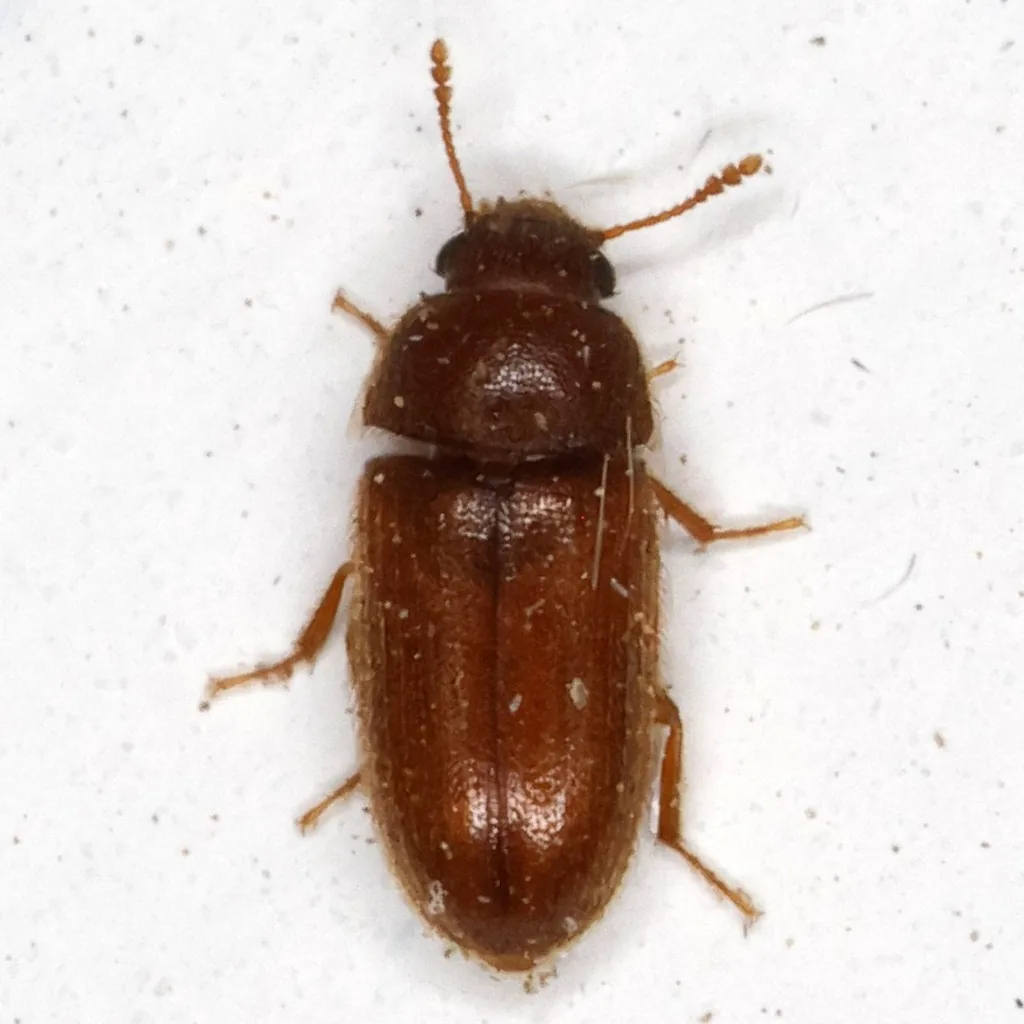
- Adults are uniformly light brown, oval and slightly flattened, 2 to 3 mm long; USDA puts them at about one-tenth of an inch.[7][8]
- Fine hairs cover the body and run in parallel lines down the wing covers, and the head is easy to see from above.[7][8]
- The antennae end in a club, which USDA says separates it from the similar drugstore beetle. Adults fly readily.[8][7]
- Larvae are whitish to yellowish, long and somewhat flattened, with well-developed legs and dark tail projections called urogomphi.[7]
Look-alikes
| Look-alike | How to tell them apart |
|---|---|
| Foreign grain beetle | Another small mold feeder of damp places. Kentucky describes it as about 1/16 inch and reddish brown with a knob at each front corner of the thorax, while Ohio State says camel-brown with a knob on all four corners. Kentucky says it is mainly a problem in new, damp houses.[4][3] |
| Confused flour beetle | Flour beetles also turn up in damp, moldy dried foods, but they feed on cracked, broken or milled grain itself, while the hairy fungus beetle is a fungus feeder.[5][7] |
| Mycetophagus punctatus | Ohio State Extension uses the name hairy fungus beetle for this different mold-feeding beetle, and the Canadian Grain Commission lists the related spotted hairy fungus beetle as a lookalike, so check the scientific name.[3][7] |
| Drugstore beetle | Looks much like the hairy fungus beetle but is larger, and its antennae are irregularly saw-toothed rather than clubbed.[8][7] |
Where it lives
Found worldwide and across Canada. USDA says it occurs in all parts of the United States, in homes, warehouses, stores, flour mills and granaries.[7][8]
Biology and life cycle
It is a secondary pest that feeds on fungi. A 2022 Purdue study calls it the most common species in fungus-infested grain storage and notes it completes its life cycle on Aspergillus, Eurotium and Penicillium molds.[7][1]
In feeding studies cited there, larvae developed faster and females laid more viable eggs on Aspergillus, and the beetle completed its life cycle even on high levels of Aspergillus flavus toxins.[1]
It is often found in cornfields, drawn to decaying kernels on exposed ears, and may be on hay and cereal crops before harvest.[8][7]
Adults are long-lived and fly readily. Females lay eggs at random through the stored commodity, and larvae move freely through it.[7]
In homes, fungus beetles go with damp conditions, and Ohio State says anything that dries out the damp spots supporting mold will greatly reduce or eliminate them.[3]
Damage and signs
- Shelled corn is often heavily infested, but USDA says there is little feeding on undamaged grain. The Canadian Grain Commission says its damage, by adults and larvae alike, is not distinctive.[8][7]
- Its real significance is as a warning sign: its presence in stored grain indicates poor storage conditions.[7]
Health risk
It doesn't bite. Eason and Mason describe it as a carrier of mycotoxin-producing fungi and note that Aspergillus flavus toxins harm people and animals; UC IPM says pantry pests might bring in microbes that produce mycotoxins, especially in warm, humid storage, and advises throwing out infested food.[1][2]
Control
Prevention
Keep stored grain and food dry. Ohio State says drying out damp areas greatly reduces or eliminates fungus beetles, and homes usually stop having them once heating and ventilation dry things out.[3]
Sanitation
Store dry foods in insect-proof glass, heavy plastic or metal containers, ideally with screw-type lids, rather than plastic bags.[3][2]
At home, throw away infested food, wash shelves and vacuum cracks, and store dry goods in containers with tight-fitting lids.[2]
Pesticides
Insecticides aren't recommended for pantry pests in homes, and Ohio State says bug bombs are usually ineffective against fungus beetles because the fumes rarely reach where they breed.[2][3]
Common questions
- What does it mean if I find hairy fungus beetles in my grain or feed?
- It means the grain or food is probably damp or moldy. The Canadian Grain Commission says the beetle's presence in stored grain indicates poor storage conditions.[7]
- Will spraying get rid of hairy fungus beetles?
- Usually not. UC IPM doesn't recommend insecticides for pantry pests and Ohio State says bug bombs usually fail against fungus beetles; drying things out is the main fix.[2][3]
Sources
- Eason and Mason, Purdue University (Insects), “Characterization of microbial communities from the alimentary canal of Typhaea stercorea. Insects 13(8):685 (2022), full text.” pmc.ncbi.nlm.nih.gov/articles/PMC9408915/ (accessed 2026-11-12)
- University of California Statewide IPM Program, “Pest Notes: Pantry Pests, Publication 7452.” ipm.ucanr.edu/home-and-landscape/pantry-pests/ (accessed 2026-11-12)
- Ohio State University Extension, “Fungus Beetles, HYG-2084.” ohioline.osu.edu/factsheet/HYG-2084-10 (accessed 2026-11-12)
- University of Kentucky College of Agriculture, Entomology, “ENTFACT-610: Foreign Grain Beetle (revised March 2026).” entomology.mgcafe.uky.edu/ef610 (accessed 2026-11-12)
- Virginia Cooperative Extension, Virginia Tech, “Darkling Beetles and Mealworms, ENTO-283NP (revised February 2023).” pubs.ext.vt.edu/ENTO/ENTO-283/ENTO-283.html (accessed 2026-11-12)
- iNaturalist, “Typhaea stercorea taxon page (order and family).” www.inaturalist.org/taxa/203380 (accessed 2026-11-12)
- Canadian Grain Commission, “Hairy fungus beetle.” www.grainscanada.gc.ca/en/grain-quality/manage/identify-an-insect/secondary-insect-pests/hairy-fungus-beetle.html (accessed 2026-11-12)
- USDA Agricultural Marketing Service, “Stored Grain Insect Reference (September 2016).” www.ams.usda.gov/sites/default/files/media/StoredGrainInsectsReference2017.pdf (accessed 2026-11-12)