On this page
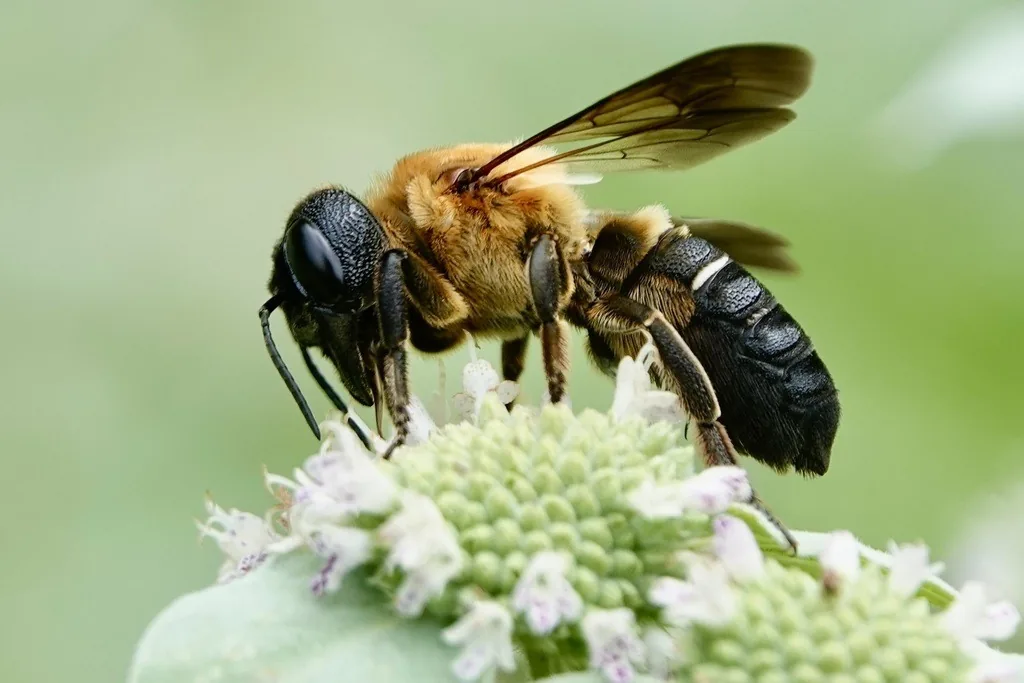
How to identify it
Look-alikes
| Look-alike | How to tell them apart |
|---|---|
| Other leafcutter bees | Most common leafcutter bees are about honey bee size, far smaller than a female giant resin bee, and in North America the giant resin bee is the only widely established member of its subgroup (Callomegachile).[9][2] |
| Carpenter bee | Female carpenter bees bore their own tunnels into wood, with a perfectly round entrance about the width of a little finger; the giant resin bee can't excavate and takes over existing holes, notably carpenter bee nests.[10][2] |
Where it lives
Native to East Asia, it was first collected in the U.S. in North Carolina in 1994 and spread quickly: Alabama by 1999, Canada by 2002, Wisconsin by 2004, and Maine and Kansas by 2008. A 2015 study by USDA-ARS scientists added Arkansas, Louisiana, Mississippi, Missouri and Texas, and the Minnesota Bee Atlas later recorded it in Minnesota. It is also established in France, Switzerland and Italy. GBIF's 1990-2026 U.S. records are concentrated in New York, Pennsylvania, North Carolina, Georgia, Virginia and Maryland.[2][3][7][8]
Biology and life cycle
It is a solitary bee with one generation a year, and males emerge before females. European studies give a nesting season from late June or early July to mid-September in Italy, and sightings from June 19 to September 10 in France.[4][3]
Females nest in existing cavities such as hollow stems, holes made by other insects, old trees and bee hotels, preferring shaded spots at least 0.5 m off the ground. In an Italian study, more than 95 percent of nest holes were 0.6 to 1.2 cm across.[2][3][5]
Brood cells and nest plugs are built from a mix of wood fibers, leaf bits, clay and resin.[4]
It visits many kinds of flowers, but most of its host-plant records are plants not native to North America, such as Pueraria lobata, Styphnolobium japonicum and Koelreuteria paniculata. University of Kentucky researchers found it significantly more abundant on non-native than native flowering woody landscape plants.[2][6]
In Bologna, Italy, the pollen stored in its cells came almost entirely from the ornamental Styphnolobium japonicum, and researchers estimated a female must visit about 180 flowers to stock one cell.[5]
Damage and signs
- It doesn't damage sound wood, because it can't bore into it; it only uses holes that already exist.[2][4]
- Its main impact is on other bees. Females have been seen aggressively evicting eastern carpenter bees from their nests in the U.S., and taking over Osmia and carpenter bee nests in France. In Italian trap nests, its cells were built in tunnels already holding mason bee (Osmia cornuta) brood, which may block those bees from emerging the next year.[2][3][4]
Health risk
It belongs to the leafcutter bee genus Megachile. Colorado State Extension says leafcutter bees aren't aggressive and sting only when handled, and that the sting is very mild, much less painful than a honey bee's or a yellowjacket's.[9][2]
Control
Keep them out
Since it relies on existing holes, fewer old carpenter bee tunnels means fewer nest sites. Kentucky Extension advises plugging carpenter bee entrance holes with a wooden dowel coated with carpenter's glue, or with putty, and painting bare wood, which carpenter bees usually won't tunnel into.[2][10]
If someone is stung
Wash the sting with soap and water. If a stinger is left in the skin, scrape it out with a fingernail, gauze or the edge of a card; don't squeeze it or use tweezers. Put ice wrapped in a cloth on the site to reduce swelling, and don't scratch.[11][12]
Have someone stay with the person to watch for an allergic reaction. Call 911 for trouble breathing or wheezing, swelling of the face or mouth, throat tightness or trouble swallowing, weakness, or turning blue.[11][12]
Common questions
- Is the giant resin bee damaging my wood?
- No. It can't bore into wood and uses holes that carpenter bees or other insects already made.[2][4]
- Why is a big bee pushing carpenter bees out of their holes?
- Giant resin bee females have been seen aggressively evicting carpenter bees and taking over their nests.[2][3]
- Will a giant resin bee sting me?
- Its leafcutter bee relatives aren't aggressive and sting only when handled, and Colorado State describes their sting as very mild.[9]
Sources
- iNaturalist, “Megachile sculpturalis taxon page (order and family).” www.inaturalist.org/taxa/52785 (accessed 2026-11-11)
- Biodiversity Data Journal, via PubMed Central, “Parys KA, Tripodi AD, Sampson BJ (2015), The giant resin bee, Megachile sculpturalis Smith: new distributional records for the mid- and Gulf-south USA, Biodiversity Data Journal 3:e6733 (USDA-ARS authors).” pmc.ncbi.nlm.nih.gov/articles/PMC4678803/ (accessed 2026-11-11). Cited from the open-access full text (PubMed 26696766).
- Ecology and Evolution, via PubMed Central, “Le Feon V, Aubert M, Genoud D, Andrieu-Ponel V, Westrich P, Geslin B (2018), Range expansion of the Asian native giant resin bee Megachile sculpturalis in France, Ecology and Evolution 8(3):1534-1542.” pmc.ncbi.nlm.nih.gov/articles/PMC5792562/ (accessed 2026-11-11). Cited from the open-access full text (PubMed 29435230).
- Insects (MDPI), via PubMed Central, “Diaz SS, Carisio L, Manino A, Biella P, Porporato M (2021), Nesting, sex ratio and natural enemies of the giant resin bee in relation to native species in Europe, Insects 12(6):545.” pmc.ncbi.nlm.nih.gov/articles/PMC8230627/ (accessed 2026-11-11). Cited from the open-access full text (PubMed 34208066).
- Bulletin of Entomological Research, via PubMed, “Bogo G, Fisogni A, Iannone A, Grillenzoni FV, Corvucci F, Bortolotti L (2024), Nesting biology and nest structure of the exotic bee Megachile sculpturalis, Bulletin of Entomological Research 114(1):67-76.” pubmed.ncbi.nlm.nih.gov/38179982/ (accessed 2026-11-11). Cited from the PubMed abstract.
- Insects (MDPI), via PubMed Central, “Potter DA, Mach BM (2022), Non-native non-Apis bees are more abundant on non-native versus native flowering woody landscape plants, Insects 13(3):238.” pmc.ncbi.nlm.nih.gov/articles/PMC8951211/ (accessed 2026-11-11). Cited from the open-access full text (PubMed 35323536).
- PeerJ, via PubMed Central, “Satyshur CD, Evans EC, Forsberg BM, Evans TA, Blair R (2023), Determining Minnesota bee species' distributions and phenologies with the help of participatory science, PeerJ 11:e16146.” pmc.ncbi.nlm.nih.gov/articles/PMC10656906/ (accessed 2026-11-11). Cited from the open-access full text (PubMed 38025759).
- Global Biodiversity Information Facility (GBIF), “Megachile sculpturalis (giant resin bee): occurrence records in the U.S., 1990-2026 (GBIF occurrence search).” api.gbif.org/v1/occurrence/search?taxonKey=1335213&country=US&hasGeospatialIssue=false&occurrenceStatus=PRESENT&year=1990%2C2026&facet=stateProvince&facetLimit=400&limit=0 (accessed 2026-11-11). State counts are records reported (iNaturalist research-grade, museum specimens, surveys), not abundance.
- Colorado State University Extension, “Leafcutter Bees (Fact Sheet 5.576).” extension.colostate.edu/topic-areas/insects/leafcutter-bees-5-576/ (accessed 2026-11-11)
- University of Kentucky Entomology, “Carpenter Bees (ENTFACT-611).” entomology.mgcafe.uky.edu/ef611 (accessed 2026-11-11)
- Centers for Disease Control and Prevention, NIOSH, “Insects and Scorpions at Work.” www.cdc.gov/niosh/outdoor-workers/about/insects-and-scorpions.html (accessed 2026-11-11)
- MedlinePlus, U.S. National Library of Medicine, “Insect bites and stings (Medical Encyclopedia 000033).” medlineplus.gov/ency/article/000033.htm (accessed 2026-11-11)