On this page
How to identify it
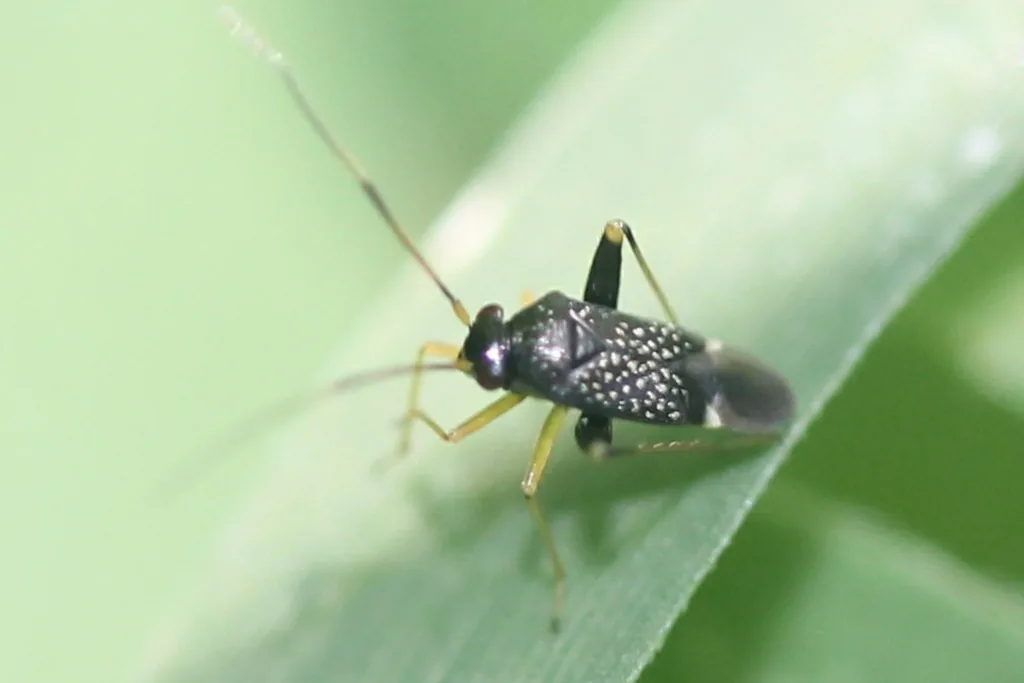
- Adults are black with long legs and antennae; the slender long-winged female is about 1/12 inch long.[1]
- A short-winged oval female form is the one most often mistaken for a flea beetle.[1]
- Nymphs are pale yellow to light green and feed on leaf undersides.[1]
- Arkansas gives the size as about 1.5 to 2.3 mm, shiny black with some yellow on the antennae and legs, with enlarged hind thighs; they hop when disturbed.[4]
Look-alikes
| Look-alike | How to tell them apart |
|---|---|
| Flea beetles | Flea beetles chew small holes and jump to another plant; fleahoppers suck sap and jump only two or three inches.[1] |
| Black aphids | Fleahoppers look like black aphids, but all stages jump readily when disturbed.[1] |
Where it lives
It occurs throughout the eastern and Midwestern United States, Central America, South America and the West Indies, on vegetables, weeds and ornamental plants.[4][1]
Biology and life cycle
Nymphs hatch in spring from overwintering eggs and feed 11 to 41 days before becoming adults.[1]
Females lay about 105 eggs inside stems and leaves over a 1 to 3 month life; eggs hatch 12 to 20 days later.[1]
Hosts include bean, beet, cabbage, celery, corn, cucumber, eggplant, lettuce, pea, pepper, potato, squash, sweet potato and tomato, plus many ornamentals, forage plants, weeds and even grasses.[2][4]
Infestations can get very large in alfalfa fields and spill over into nearby gardens.[4]
Parasitic wasps kill the moving stages and the eggs, which may explain why garden fleahopper numbers vary so much.[2]
Fun fact: in Purdue field tests that released blends of the scents plants give off when insects attack them, garden fleahoppers were repelled by most of the blends, in both soybean and corn fields.[5]
Damage and signs
Health risk
It feeds on plants; Kentucky, NC State and Arkansas list no risk to people or pets.[1][2][4]
Control
Prevention
Remove weedy hosts such as quickweed, clover and morning glory near the garden.[1]
Biological control
Parasitic wasps attack fleahopper eggs and moving stages and help keep numbers in check.[2]
Pesticides
Only for severe infestations, insecticides listed for aphids should work; a second application may be needed after eggs hatch.[1]
On ornamentals, NC State says infestations are typically sporadic, so one application may bring months or years of relief, and names pyrethroids, carbaryl (Sevin) or acephate (Orthene). Follow the label.[2]
More from NC State Extension
Eggs laid from August through September carry the species through winter and hatch in early spring, and North Carolina has at least five generations a year.[2]
Where sources disagree
Egg count and development: Kentucky says females lay about 105 eggs and nymphs feed 11 to 41 days before becoming adults; NC State says about 100 eggs and 11 to 35 days.[1][2]
Wings: Kentucky and NC State describe long-winged and short-winged females, while Arkansas says most females are wingless.[1][2][4]
Name: Kentucky and Arkansas call it Halticus bractatus; NC State lists it as Microtechnites bractatus.[1][4][2]
Common questions
- Are the tiny black jumping bugs on my beans flea beetles?
- They may be garden fleahoppers, which suck sap instead of chewing holes and jump only a few inches.[1]
- Why are my tomato leaves pale and speckled?
- Fleahopper feeding leaves pale stippling that looks like mite damage.[1]
- Where do garden fleahoppers come from?
- They overwinter as eggs in plant stems and leaves and hatch in spring. Big populations build up in alfalfa and on weeds such as quickweed, clover and morning glory, then move into nearby gardens.[2][4][1]
Sources
- University of Kentucky Entomology (ENTFACT), “Garden Fleahopper (ENTFACT-307).” entomology.mgcafe.uky.edu/ef307 (accessed 2026-11-12)
- NC State Extension, “Garden Fleahopper.” content.ces.ncsu.edu/garden-fleahopper-2 (accessed 2026-11-12)
- iNaturalist, “Microtechnites bractatus taxon page (order and family).” www.inaturalist.org/taxa/472457 (accessed 2026-11-12)
- University of Arkansas Arthropod Museum, “Garden Fleahopper.” arthropod.uark.edu/garden-fleahopper/ (accessed 2026-11-12)
- Journal of Chemical Ecology (2012), via PubMed, “Testing for phytochemical synergism: arthropod community responses to induced plant volatile blends across crops.” pubmed.ncbi.nlm.nih.gov/23090849/ (accessed 2026-11-12). Cited from the PubMed abstract.