On this page
How to identify it
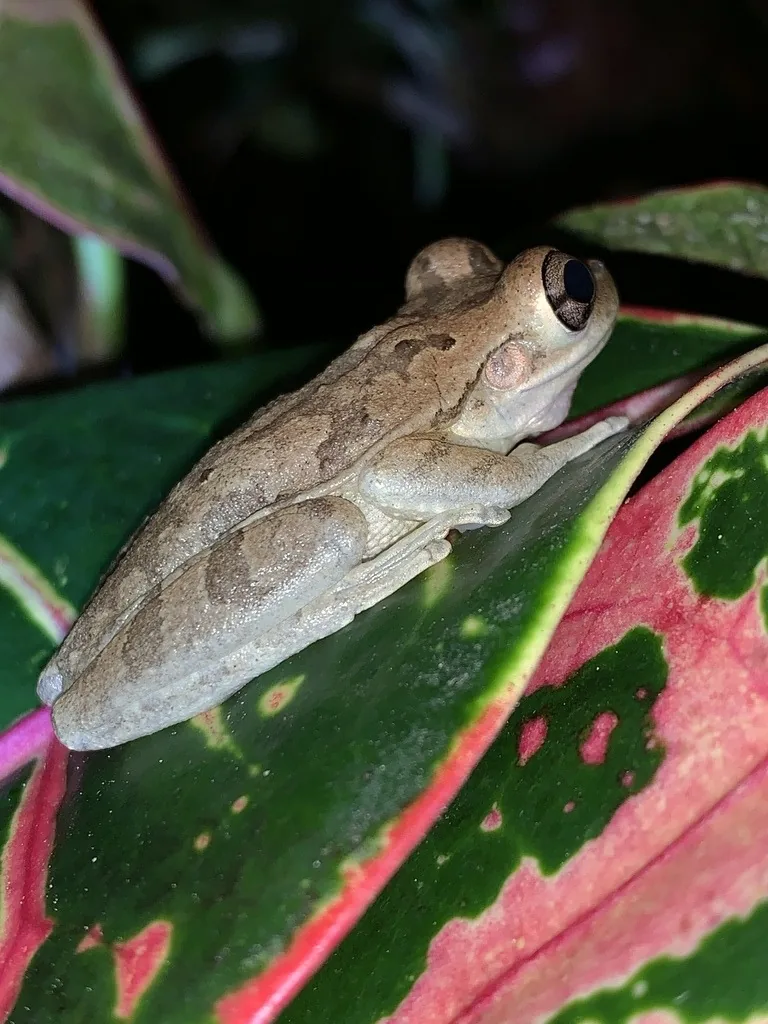
- It is the largest treefrog in the U.S.: adults average 1 to 4 inches long, some exceed 6 inches, and females are larger than males. UF/IFAS says most are 1.5 to 2.5 inches long, not counting outstretched legs, adult females may exceed 6 inches, and any treefrog in Florida longer than 3 inches is almost certainly a Cuban treefrog.[1][3]
- The toe pads are very large, about the size of the eardrum, and much larger than a native green treefrog's.[1]
- Color and pattern vary from frog to frog, from plain to heavily patterned and from gray, tan, brown or bronze to olive-green or blue-green. UF/IFAS says they are most often creamy white to light brown but can be green, gray, beige, yellow (breeding males) or dark brown, often with large wavy blotches on the back and stripes or bands on the legs.[1][3]
- In adults the skin on top of the head is fused to the skull, unlike any native U.S. treefrog; USGS calls this the defining feature of the species. UF/IFAS says the skin becomes tightly fused once the frog reaches a body length of about 1 inch.[1][3]
- Young frogs have few warts and little pattern, so they are harder to tell from natives, but they lack the light or dark side stripe some native treefrogs have, and their blue bones often show through the skin. UF/IFAS says newly metamorphosed frogs have a light, jagged line from the eye (not the lip) to the rear legs and usually reddish brown eyes; the blue leg bones show best when the frog is held up to a light.[1][3]
- Tadpoles are black or dark on top, with the coiled gut visible from below. UF/IFAS says they reach about 1.25 inches, have eyes on the sides of the head, and a tail muscle that is dark above and white or cream below; tadpoles like this in small, artificial water bodies within the frog's range are likely Cuban treefrogs.[1][3]
- UF/IFAS lists obvious bug eyes, prominent warts of varying sizes on the back but none on top of the head, and a yellowish wash where the front and rear legs join the body, which shows best when the legs are stretched out.[3]
- UF/IFAS says the eggs are laid as a film on the water surface, looking like small, evenly spaced, floating black spots, rather than in round masses or strings.[3]
Look-alikes
| Look-alike | How to tell them apart |
|---|---|
| Green treefrog (native) | Has much smaller toe pads, and its head skin is not fused to the skull. Male Cuban treefrogs sometimes try to mate with green treefrogs.[1] |
| Other native treefrogs | Some have a light or dark stripe along the side, which young Cuban treefrogs lack. Make sure of the identification before removing any frog; FWC stresses the same for the invasive cane toad. UF/IFAS names the barking treefrog and Cope's gray treefrog as the natives most likely to be confused with it; they are generally smaller, with smaller eyes and toe pads.[1][4][3] |
Where it lives
Native to Cuba, the Bahamas and the Cayman Islands. USGS reports it established throughout the Florida peninsula and Panhandle, along the Atlantic coast to Savannah, Georgia, and in New Orleans, and FWC says it was common through most of Florida by the 1970s. GBIF's 1990-2026 U.S. records (about 24,300) come from 4 states on the map, almost all from Florida, with far fewer from Georgia, Louisiana and Texas. UF/IFAS adds that as of 2023 it was established throughout the peninsula and in several areas of the Panhandle, with breeding populations documented in Georgia and Louisiana and isolated single frogs reported by citizen scientists from 29 additional states and several Canadian provinces.[1][2][5][3]
Biology and life cycle
Accounts of its arrival differ. FWC says it was introduced in 1931 in packing materials; USGS notes that some authors think it may have lived on Key West and the lower Keys since pre-Columbian times. A genetic study traced Florida's frogs to at least two sources in Cuba, with the Keys colonized first and people spreading it up the peninsula. UF/IFAS says the earliest confirmed U.S. records date to the 1920s in the Florida Keys, that the first frogs likely arrived as stowaways in shipping crates from the Caribbean, and that by the mid-1970s they had spread through most of southern Florida.[2][1][6][3]
It travels mainly in nursery shipments and plantings (palm trees especially), hidden in building materials, and by hitching rides on vehicles. UF/IFAS adds cars, trucks, campers and boats, and ornamental plants and trees shipped from southern Florida.[1][3]
It eats insects and other small animals, including other frogs and tadpoles (its own kind too) and lizards, and can take prey more than twice its size. UF/IFAS adds snails, millipedes, spiders and small snakes. Rat snakes, black racers, pygmy rattlesnakes and gartersnakes eat them, and owls, crows and wading birds have been seen feeding on them.[1][3]
In southern Florida breeding can go on through most of the year, usually in warm (around 80°F), humid or rainy weather. Clutches average about 4,000 to 5,000 eggs, laid in warm, shallow water without predatory fish, including man-made structures. UF/IFAS says breeding is mostly in spring and summer, prompted by rain, especially warm summer rains, and that an old ice chest, a child's wading pool or a 5-gallon bucket half full of rainwater can serve as a nursery.[1][3]
It tolerates salty water far better than native treefrogs, can be many times more numerous in towns than in natural areas, and survives short freezes.[1]
The male's call has been described as a high-pitched, snoring rasp. UF/IFAS describes a raspy call like a squeaking door, often peaking in the hours before dawn, and a daytime 'rain call' that light rain can trigger.[1][3]
UF/IFAS says it is most common near homes and buildings, gardens and landscape plants, and also in orange groves and plant nurseries. In natural areas it prefers densely forested woodlands over dry scrub and sandhills, perhaps because it dries out more easily than some native treefrogs.[3]
By day it shelters in tree cavities, between leaves and in tight spaces on buildings such as behind storm shutters and vinyl siding; it is most active on humid nights, UF/IFAS says.[3]
Damage and signs
- Where it moves in, native treefrogs decline, likely from predation and perhaps competition. Its tadpoles slow the growth of native tadpoles, and squirrel treefrog tadpole survival dropped by half, sometimes to zero, alongside them in studies. UF/IFAS says native squirrel treefrogs appear particularly vulnerable because of their small size, and that Cuban treefrog tadpoles even eat squirrel treefrog tadpoles in some situations.[1][2][3]
- It gets into homes and other structures, gathers in household pipes, and enters through small openings or plumbing. UF/IFAS says frogs that get into roof vent pipes usually end up in a bathroom, sometimes in the toilet, and have clogged sink drains; others jump through open doors or ride in on ornamental plants.[1][3]
- Frogs caught in electrical equipment have caused power outages. UF/IFAS says they invade transformer boxes and electrical switches, have interrupted power to some customers in central Florida, and may get into electric pump housings and AC compressor units.[1][3]
- UF/IFAS reports other harm to wildlife: eastern gartersnakes fed Cuban treefrogs gained half the weight of snakes fed native green treefrogs, the frogs are a likely source of nonnative parasites now found in native treefrogs, and they move into bird nest boxes.[3]
- On warm nights they wait near lights on walls and windows, leaving droppings that build up, and may jump onto people or into homes through open doors. Breeding choruses after heavy rain can disrupt sleep, UF/IFAS says.[3]
Health risk
Its skin has poison (serous) glands, and the secretion contains a mix of defensive peptides. A 2022 study found rat lungworm larvae in the leg muscle of Cuban treefrogs in Volusia County, the first report in this frog. The CDC says people get rat lungworm mainly by eating raw or undercooked snails or slugs, that eating infected frogs or other animals raw may also infect people, though that evidence is less clear, and advises against eating raw or undercooked frogs.[7][8][9][10]
Control
Prevention
Check potted plants (especially palms), building materials and vehicles before moving them out of Florida, since these are how the frog spreads.[1]
Before leaving an area where they live, check under the bow and stern of canoes, kayak cockpits and storage areas, and roll open camper awnings, UF/IFAS advises. Wear rubber gloves or other hand protection to catch them, and wash your hands thoroughly afterward.[3]
Keep them out
Cover the roof vent pipes, usually one for each bathroom and the kitchen, with store-bought covers or hardware cloth and cable ties so frogs can't get into the plumbing. UF/IFAS also suggests turning off unnecessary outdoor lights and using yellow bug lights so fewer insects gather.[3]
Sanitation
Eggs go into warm, shallow, fish-free water, including man-made structures, so emptying buckets and other standing water removes places to breed.[1]
In ornamental ponds, scoop floating egg films with a small-mesh aquarium net on mornings after rain, and remove Cuban treefrog tadpoles; in buckets and bird baths, simply dump the water and tadpoles on the ground. Keep pools properly maintained, UF/IFAS says.[3]
Traps and physical control
For handling invasive amphibians, FWC advises eye and skin protection and latex, rubber or nitrile gloves (its cane toad guidance).[4]
UF/IFAS describes capturing frogs with a plastic grocery bag used as a glove and tying it shut, or attracting them to roughly three-foot sections of 1.5-inch thin-walled PVC pipe pushed 3 to 4 inches into the ground near plants. Check each frog's identity and put native frogs back.[3]
UF/IFAS recommends humanely euthanizing confirmed Cuban treefrogs: put the bagged frog in a refrigerator for 3 to 4 hours, then in a freezer for 24 hours, or apply a benzocaine ointment to its back before freezing. There are no university or government removal programs, so it is up to each homeowner.[3]
When to call a professional
Report sightings of nonnative species to FWC through the IveGot1 app, the IveGot1.org web form or the hotline, 888-483-4681. A useful report has a sharp photo, the location and the date. UF/IFAS also asks people to report Cuban treefrog sightings at EDDMapS, especially from the Panhandle and outside Florida.[11][3]
What not to do
Don't release a captured frog somewhere else: releasing nonnative wildlife is illegal in Florida, and FWC says captured cane toads may not be relocated and released.[12][4]
Don't eat frogs raw or undercooked; frogs are among the animals found carrying rat lungworm.[10][9]
Don't use bug spray, suntan lotion, insecticide, bleach spray or other household chemicals to kill the frogs, and never put a live, bagged frog in the trash, UF/IFAS says.[3]
Don't 'rescue' tadpoles from buckets and other artificial water around the home; UF/IFAS says this often just adds to the Cuban treefrog population.[3]
Where the sources disagree
Arrival: UF/IFAS dates the earliest confirmed U.S. records to the 1920s in the Florida Keys, FWC says it was introduced in 1931 in packing materials, and USGS notes some authors think it may have lived in the lower Keys since pre-Columbian times.[3][2][1]
Typical size: USGS says adults average 1 to 4 inches, while UF/IFAS says most are 1.5 to 2.5 inches; both say some exceed 6 inches.[1][3]
Common questions
- Why is there a frog in my toilet?
- In Florida, Cuban treefrogs are known to gather in household pipes and enter homes through plumbing and small openings.[1]
- Can Cuban treefrogs carry rat lungworm?
- Yes. Rat lungworm larvae were found in Cuban treefrogs in central Florida in 2022. The CDC's advice is not to eat raw or undercooked frogs; people are infected mainly by eating infected snails or slugs.[9][10]
- Do Cuban treefrogs harm native frogs?
- Yes. They eat native tree frogs, native treefrog numbers drop where they move in, and their tadpoles hurt the growth and survival of native tadpoles.[2][1]
- How do I keep Cuban treefrogs out of my toilet?
- Cover the roof vent pipes with vent covers or hardware cloth. UF/IFAS says frogs that get into the plumbing through those vents usually end up in a bathroom.[3]
- Should I save tadpoles I find in a bucket?
- Not in Cuban treefrog country. UF/IFAS says tadpoles in buckets, bird baths and similar containers are best dumped onto the ground with the water, which mimics a pond drying out.[3]
Sources
- U.S. Geological Survey, “Cuban Treefrog (Osteopilus septentrionalis) species profile, Nonindigenous Aquatic Species database.” nas.er.usgs.gov/queries/FactSheet.aspx?speciesID=57 (accessed 2026-11-11). Federal agency (USGS) species profile.
- Florida Fish and Wildlife Conservation Commission, “Nonnative Species Information.” myfwc.com/wildlifehabitats/nonnatives/exotic-information/ (accessed 2026-11-11)
- University of Florida IFAS Extension (EDIS), “The Cuban Treefrog in Florida, WEC218/UW259 (S. A. Johnson).” ask.ifas.ufl.edu/publication/UW259 (accessed 2026-11-14)
- Florida Fish and Wildlife Conservation Commission, “Cane Toad (species profile).” myfwc.com/wildlifehabitats/profiles/amphibians/cane-toad/ (accessed 2026-11-11)
- Global Biodiversity Information Facility (GBIF), “Osteopilus septentrionalis (Cuban treefrog): occurrence records in the U.S., 1990-2026 (GBIF occurrence search).” api.gbif.org/v1/occurrence/search?taxonKey=2428083&country=US&hasGeospatialIssue=false&occurrenceStatus=PRESENT&year=1990%2C2026&facet=stateProvince&facetLimit=400&limit=0 (accessed 2026-11-11). State counts are records reported (iNaturalist research-grade, museum specimens, surveys), not abundance.
- Biology Letters, via PubMed, “Heinicke MP, Diaz LM, Hedges SB (2011), Origin of invasive Florida frogs traced to Cuba, Biology Letters 7(3):407-410.” pubmed.ncbi.nlm.nih.gov/21270024/ (accessed 2026-11-11). Cited from the PubMed abstract.
- Journal of Morphology, via PubMed, “Delfino G, Brizzi R, Nosi D, Terreni A (2002), Serous cutaneous glands in New World hylid frogs: an ultrastructural study on skin poisons, Journal of Morphology 253(2):176-186.” pubmed.ncbi.nlm.nih.gov/12112131/ (accessed 2026-11-11). Cited from the PubMed abstract.
- Rapid Communications in Mass Spectrometry, via PubMed, “Samgina TY, Tolpina MD, Surin AK, et al. (2021), Manual mass spectrometry de novo sequencing of the anionic host defense peptides of the Cuban treefrog Osteopilus septentrionalis, Rapid Communications in Mass Spectrometry 35(7):e9061.” pubmed.ncbi.nlm.nih.gov/33527491/ (accessed 2026-11-11). Cited from the PubMed abstract.
- Journal of Wildlife Diseases, via PubMed, “Chase EC, Ossiboff RJ, Farrell TM, et al. (2022), Rat lungworm (Angiostrongylus cantonensis) in the invasive Cuban treefrog (Osteopilus septentrionalis) in central Florida, USA, Journal of Wildlife Diseases 58(2):454-456.” pubmed.ncbi.nlm.nih.gov/35100414/ (accessed 2026-11-11). Cited from the PubMed abstract.
- Centers for Disease Control and Prevention, “About Rat Lungworm Disease (June 24, 2024).” www.cdc.gov/angiostrongylus/about/index.html (accessed 2026-11-11)
- Florida Fish and Wildlife Conservation Commission, “Report Sightings of Nonnative Species.” myfwc.com/wildlifehabitats/nonnatives/report/ (accessed 2026-11-11)
- Florida Fish and Wildlife Conservation Commission, “Don't Let It Loose.” myfwc.com/wildlifehabitats/nonnatives/dont-let-it-loose/ (accessed 2026-11-11)
- iNaturalist, “Osteopilus septentrionalis taxon page (order and family).” www.inaturalist.org/taxa/24382 (accessed 2026-11-11)