On this page
How to identify it
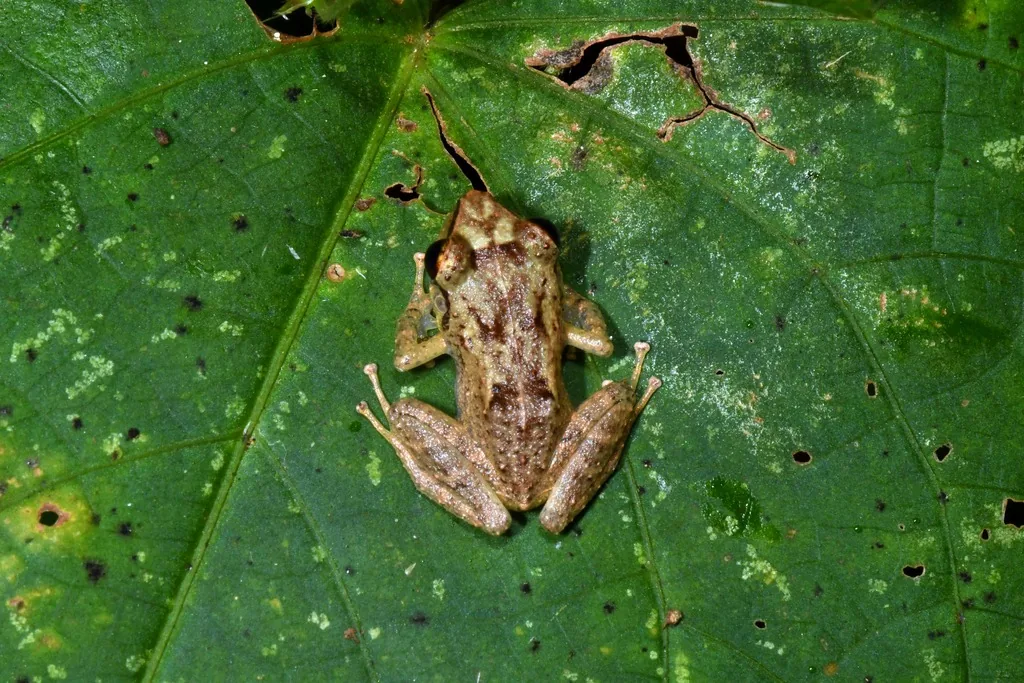
- A small frog with a round body and a broad, rounded snout. The Hawaii Invasive Species Council gives its size as 1 to 2 inches, UH CTAHR as slightly over 1 inch, and USGS as 33 to 57 mm from snout to rear, with Florida frogs averaging slightly smaller.[1][3][4][5]
- Color ranges from light yellow or tan to dark brown. The back may be plain or mottled with black, and USGS lists one or two broad cream stripes, V-shaped marks, spots or a pale band or M shape between the shoulders among the patterns.[3][4][1][5]
- The toes end in suction-cup-like pads, and it climbs from the ground to the tops of trees. Its eyes are gold, golden brown or brown.[3][1][5]
- Males make a loud two-note ko-kee call. The Hawaii Invasive Species Council says it can reach 95 decibels, while measurements cited by USGS from eastern Hawaii Island recorded calling males at up to 73 dB.[1][3][5]
Look-alikes
| Look-alike | How to tell them apart |
|---|---|
| Greenhouse frog | Smaller, under 1 inch, usually copper-colored with warty skin and no distinct toe pads, and USGS says its eyes are red rather than gold or brown. It stays on the ground and makes a cricket-like chirp.[3][5] |
| Cuban treefrog | The largest treefrog in the U.S., averaging 1 to 4 inches with some over 6 inches and females larger than males. Its toe pads are very large, about the size of its eardrum, and the skin on top of the head is fused to the skull. UF/IFAS says most Cuban treefrogs are 1.5 to 2.5 inches long, not counting the legs, with obvious bug eyes and warty skin, and that any treefrog in Florida longer than 3 inches is almost certainly a Cuban treefrog.[6][13] |
| Cane toad | A large, warty, brown or mottled toad that lives on the ground and can weigh up to 3.3 pounds, with a pair of large poison (parotoid) glands running from behind each eye far down the side of the body. UF/IFAS gives adults as three to six inches long, with some reaching eight or nine inches, and describes the shoulder poison glands as enlarged and somewhat triangular, tapering back to a point; like other toads it lives on the ground and doesn't climb well.[7][14] |
Where it lives
Native to Puerto Rico. USGS reports established populations in the U.S. Virgin Islands and in Hawaii, and in Florida populations limited to areas in and around a few greenhouses in Miami-Dade County. On Hawaii Island residents are asked to control coqui on their own property, while sightings on Oahu, Maui, Molokai, Lanai and Kauai should be reported to 643-PEST. GBIF holds about 2,300 U.S. records since 1990, nearly all from Hawaii, with a smaller set from California.[5][1][8][9]
Biology and life cycle
By day coqui hide in leaf litter and other moist shelter; at night they climb into vegetation to feed and call.[8][4]
Females lay clusters of about 34 to 75 eggs every few weeks, often in leaf litter or rolled leaves, and males guard them.[8][1]
Eggs hatch in about 14 to 17 days directly into tiny froglets, with no tadpole stage, so coqui don't need standing water to breed. USGS adds that males brood the eggs in sheltered spots, and that in Hawaii the frogs also shelter and nest in passages in porous lava.[8][4][5]
Froglets mature in roughly 8 to 12 months, and adults may live 4 to 6 years.[8]
Population estimates differ. The Hawaii Invasive Species Council cites densities of up to 91,000 frogs per hectare in Hawaii, two to three times those in Puerto Rico; USGS cites records of up to 20,000 per hectare, with densities near Hilo three times those in Puerto Rico.[1][5]
They are nocturnal insect eaters, and USGS cites estimates that groups can eat up to 114,000 invertebrates per hectare in a single night.[5]
Damage and signs
- The incessant night calling is the main complaint, comparable in loudness to a motorcycle engine.[1]
- They eat huge numbers of insects, disrupting native ecosystems and insect services such as pollination. Effects on birds are debated: USGS cites concern that coqui may compete with native insect-eating birds, but also a later study in which coqui served as food for local birds rather than competing with them. Introduced mongooses are more abundant where coqui are present.[1][5]
- Infestations hinder plant exports, must be disclosed in real estate sales and have lowered property values in some areas; USGS also reports lost sleep and tourist complaints to hotels.[1][5]
Health risk
Coqui don't bite and aren't poisonous, so they can be caught with bare hands. They can carry rat lungworm, a parasite that is a human and animal health concern in Hawaii: a USDA-led study found it in 21 of 24 coqui tested in Hilo, though the authors note that how frogs contribute to its spread is not well understood.[8][2][10]
Control
Prevention
Inspect plants, building materials and vehicles before moving them, and treat infested plants before taking them on or off your property.[8]
Sanitation
Remove dead leaves, thin dense shrubs and understory, avoid water-holding plants like bromeliads, fix leaks and compost or chip green waste.[8][1]
Traps and physical control
After sunset, track calling males with a flashlight and catch frogs by hand or with a clear tube with a bag taped over one end.[8][2]
Hang PVC or bamboo lure traps that frogs use as nest sites, and empty them at least every 2 weeks, before eggs can hatch.[8][1]
Shower infested plants with hot water at 113 to 115 degrees F for 3 to 5 minutes, checked with a thermometer, then cool them with cold water.[8]
Pesticides
Citric acid is the only product labeled for homeowners to control coqui; it kills frogs and eggs on direct contact but can burn ferns, orchids and new growth. Follow label directions and avoid breathing the powder or spray.[8][1]
When to call a professional
Report coqui outside Hawaii Island to the Hawaii Department of Agriculture Pest Hotline, 643-PEST.[8][1]
Coqui and Hawaii law
The Hawaii Department of Agriculture declared the coqui an agricultural pest in 2008, and the state lists it as injurious wildlife.[8][1]
Since April 26, 2008, it has been illegal to use hydrated lime to control coqui in Hawaii.[8]
How coqui reached Hawaii
Coqui arrived in Hawaii in the late 1980s through the horticulture trade. A genetic study found that Hawaii's frogs trace to the San Juan area of Puerto Rico and supports two separate introductions, one on Hawaii Island and one on Maui.[11][1]
USGS says most introductions probably came with nursery and landscaping plants, with some releases in Hawaii intentional, and genetic work on Hawaii Island points to people moving frogs from place to place rather than frogs spreading on their own.[5][11]
Where the sources disagree
Cuban treefrog size: USGS gives an average of 1 to 4 inches, while UF/IFAS says most are 1.5 to 2.5 inches; both say large females can top 6 inches.[6][13]
Common questions
- What frog makes a loud ko-kee sound at night in Hawaii?
- That two-note call is the male coqui frog, which calls from dusk until dawn to attract females.[1][4]
- How do I humanely kill a coqui frog I've caught?
- UH CTAHR advises refrigerating the bagged frog for 24 hours and then freezing it for at least 3 hours, or placing it in hot, soapy water.[8][2]
Sources
- Hawai'i Invasive Species Council, Hawai'i Department of Land and Natural Resources, “Coqui frog, Eleutherodactylus coqui.” dlnr.hawaii.gov/hisc/coqui-frog/ (accessed 2026-11-11)
- University of Hawai'i at Manoa, College of Tropical Agriculture and Human Resources (CTAHR), with the Hawai'i Department of Agriculture, “Coqui Frog Control for Homeowners (revised November 2004).” www.ctahr.hawaii.edu/oc/freepubs/pdf/coquicontrol.pdf (accessed 2026-11-11)
- University of Hawai'i at Manoa, College of Tropical Agriculture and Human Resources (CTAHR), “Differences Between Greenhouse Frog and Coqui Frog.” www.ctahr.hawaii.edu/coqui/differences.asp (accessed 2026-11-11)
- Hawai'i Department of Agriculture, Plant Industry Division, “Pest Alert! Stop the Spread of Coqui in Hawaii.” dab.hawaii.gov/pi/files/2013/01/coquiposter.pdf (accessed 2026-11-11)
- U.S. Geological Survey, Nonindigenous Aquatic Species Program, “Coqui (Eleutherodactylus coqui) species profile.” nas.er.usgs.gov/queries/FactSheet.aspx?speciesID=60 (accessed 2026-11-11)
- U.S. Geological Survey, Nonindigenous Aquatic Species Program, “Cuban treefrog (Osteopilus septentrionalis) species profile.” nas.er.usgs.gov/queries/FactSheet.aspx?speciesID=57 (accessed 2026-11-11)
- U.S. Geological Survey, Nonindigenous Aquatic Species Program, “Cane toad (Rhinella marina) species profile.” nas.er.usgs.gov/queries/FactSheet.aspx?speciesID=48 (accessed 2026-11-11)
- University of Hawai'i at Manoa, College of Tropical Agriculture and Human Resources (CTAHR), Coqui Frog Working Group, “Coqui Frog Control for Homeowners: Methods To Stop the Spread of Coqui Frogs in Hawai'i (MP-5, May 2016).” www.ctahr.hawaii.edu/oc/freepubs/pdf/MP-5.pdf (accessed 2026-11-11)
- Global Biodiversity Information Facility (GBIF), “Eleutherodactylus coqui: U.S. occurrence records since 1990 by state (GBIF occurrence search).” api.gbif.org/v1/occurrence/search?taxonKey=2424091&country=US&hasGeospatialIssue=false&occurrenceStatus=PRESENT&year=1990%2C2026&facet=stateProvince&facetLimit=400&limit=0 (accessed 2026-11-11). Exact count at access: 2,318 U.S. records since 1990 (Hawaii 1,936 plus 118 under variant spellings; California 232; Florida 5).
- Journal of Wildlife Diseases, via PubMed, “Occurrence of rat lungworm (Angiostrongylus cantonensis) in invasive coqui frogs (Eleutherodactylus coqui) and other hosts in Hawaii, USA (Niebuhr et al. 2020).” pubmed.ncbi.nlm.nih.gov/31295084/ (accessed 2026-11-11)
- Molecular Ecology, via PubMed, “Strong founder effects and low genetic diversity in introduced populations of Coqui frogs (Peacock et al. 2009).” pubmed.ncbi.nlm.nih.gov/19674300/ (accessed 2026-11-11)
- iNaturalist, “Eleutherodactylus coqui taxon page (order and family).” www.inaturalist.org/taxa/22454 (accessed 2026-10-06)
- University of Florida IFAS Extension, EDIS, “The Cuban Treefrog in Florida, WEC218/UW259.” ask.ifas.ufl.edu/publication/UW259 (accessed 2026-11-14)
- University of Florida IFAS Extension, EDIS, “The Cane or "Bufo" Toad (Rhinella marina) in Florida, WEC387/UW432.” ask.ifas.ufl.edu/publication/UW432 (accessed 2026-11-14)