On this page
How to identify it
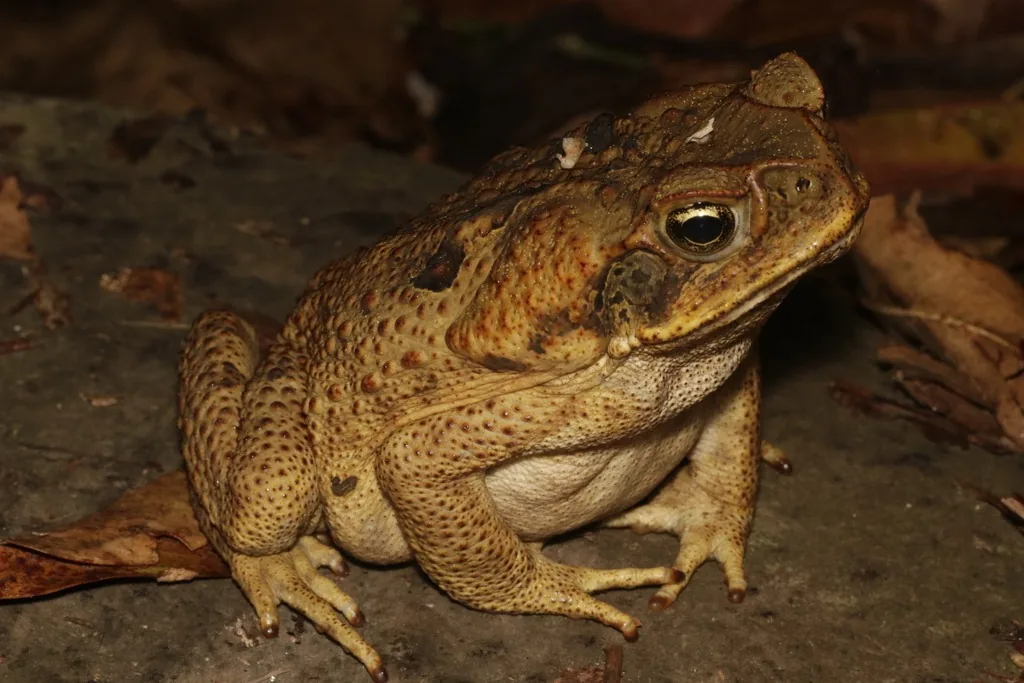
- A heavy, warty ground-dwelling toad, reddish-brown to grayish-brown above with a light-yellow or beige belly, either plain or with darker markings.[1][2]
- Behind each eye sits a large, roughly triangular poison gland that angles down onto the shoulder. Native southern and American toads have small, oval glands instead.[1][2]
- FWC says adults generally run 6 to 9 inches. USGS gives a snout-to-vent length of 100 to 238 mm (about 4 to 9.4 inches) and says toads in the U.S. rarely exceed 178 mm (about 7 inches). UF/IFAS puts adults at three to six inches, with some reaching eight or nine.[1][2][11]
- The eyes have horizontal pupils and golden irises. Tadpoles are black above, with a silvery-white belly spotted with black.[2]
- The call is a low, slow trill often likened to a distant tractor. UF/IFAS describes it as a persistent, low-pitched, warbling trill.[2][11]
- UF/IFAS's checklist for a cane toad: may be larger than three inches, enlarged and somewhat triangular poison glands that taper back to a point, no knobs or crests on top of the head, and a ridge around the eyes and over the nose.[11]
- Females have smooth, mottled brown-and-white backs, while males' rougher backs are more yellow. Newly transformed toadlets are less than half an inch long, about the size of a raisin, and very hard to tell from the young of native toads.[11]
Look-alikes
| Look-alike | How to tell them apart |
|---|---|
| Southern toad (native) | Adults grow only to about 3 to 4 inches, have well-defined crests that look like ridges or horns above the eyes, and have a small, oval gland behind each eye. FWC calls it a beneficial part of Florida's ecosystem, so confirm the ID before removing any toad. UF/IFAS says southern toads are rarely larger than 3 inches and gray, brown or reddish, and their head crests are not obvious until they are about an inch long.[1][2][11] |
| Oak toad (native) | Florida's smallest toad, never larger than 1.5 inches, with small oval glands, indistinct head crests, a light line down the center of the back and orange undersides to the feet.[11] |
| Eastern spadefoot (native) | A native toad from a different family, rarely larger than 2 inches, with flattened, indistinct glands, no head crests, often an hourglass shape and many yellow markings on the back, and a prominent digging spade on each hind foot.[11] |
Where it lives
FWC says cane toads are native from the Amazon basin north to the lower Rio Grande Valley in southern Texas. In Florida they are found in central and south Florida, generally south of the I-4 corridor, and USGS lists them as established in Hawaii, Puerto Rico and several Pacific territories too. UF/IFAS says that as of 2017 they were established in much of the southern peninsula as far north as Tampa, with a small established population in Deland (Volusia County), several isolated sightings in northern Florida and one in southeast Georgia; a population near Panama City survived for several years.[1][2][11]
Biology and life cycle
Cane toads were first brought to Florida to control pests in sugar cane in the 1930s and 40s; USGS records 200 released at Canal Point and Belle Glade, Palm Beach County, before 1936. Today's populations are believed to come from escapes and releases by animal importers in the 1950s and 60s. UF/IFAS says the 1930s introduction did not survive, and that in the 1950s a pet importer released about 100 cane toads at the Miami airport, by accident or on purpose, with other documented purposeful releases in south Florida.[1][2][11]
In Florida they live in urban, suburban and agricultural areas, commonly in yards, around buildings and near canals and ponds. UF/IFAS says they are particularly common in yards, golf courses and school campuses, and they tolerate acidic and saline water. There are few records from Florida's natural areas, though calling toads have been detected in Biscayne and Everglades National Parks.[1][11]
They eat almost anything they can swallow: insects, other frogs and toads, lizards, small birds and mammals, snakes and some plants, plus pet food and table scraps left outdoors. UF/IFAS says beetles and ants make up most of the diet, along with carrion, garbage and smaller cane toads.[1][2][11]
In stomachs of 240 adult toads from two golf course communities in Naples, yellow-banded millipedes, big-headed ants and hunting billbugs were the most frequent prey.[4]
They breed year-round in standing water, streams, canals and ditches, and a female lays 5,000 to 32,000 eggs in jelly strings.[1][2]
Eggs carry the toxin too, and USGS notes that larger toads are much more toxic than small ones.[1][2]
UF/IFAS says males call from temporary pools, ponds and canals but avoid swift currents. Calling can happen year-round in southern Florida but only January through September farther north. Females lay 8,000 to 30,000 eggs in long jelly strings once or twice a year, usually after heavy rain; tadpoles hatch in about 48 hours and take roughly two weeks to two months to become toadlets.[11]
Adults are nocturnal, hiding by day, but tadpoles and young toads are more active in daylight, which research suggests helps them avoid being eaten by larger cane toads.[11]
Some Florida animals eat them: UF/IFAS says American crows and red-shouldered hawks roll the toads onto their backs and eat certain parts while avoiding the toxin, and other birds, several snakes and Virginia opossums have been seen preying on them.[11]
Damage and signs
- The main harm in yards is to pets. In a study of 94 dogs treated for cane toad poisoning, most cases came in spring and summer; 89 dogs recovered fully, 4 died and 1 was euthanized.[3][1]
- Cane toad eggs can kill native animals that eat them, including tadpoles of some native frogs.[1][2]
- They may compete with native frogs and toads for food and breeding sites; USGS reports heavy diet overlap with the native southern toad and says cane toads may displace it in parts of Florida.[1][2]
- They carried a nonnative tick, Amblyomma rotundatum, into Florida, and the dog hookworm has been found in cane toad droppings in Tampa.[2]
- People report native southern toads disappearing or becoming uncommon in their neighborhoods after cane toads arrive. UF/IFAS says cane toads also eat small native vertebrates, including birds, snakes and small mammals, though the large predator die-offs seen in Australia have not been seen in Florida.[11]
- Dense populations in neighborhoods may call all night, which can cost residents sleep.[11]
Health risk
Toad venom contains heart-active steroids, and poisoning resembles digoxin toxicity. CDC investigated deaths among men who swallowed a so-called aphrodisiac containing these compounds, and a child was poisoned after eating cane toad eggs. Never eat or lick a toad or its eggs.[6][7][8]
Control
Prevention
Feed pets indoors when possible, bring outdoor food and water bowls in at night, and clean up scraps around grills and outdoor tables.[1]
Turn off outdoor lights, or use motion lights or yellow bug lights, to draw fewer of the insects toads come to eat. Don't leave pet food or water bowls out at night, and remove standing water and damp spots that make a yard attractive.[11]
Don't leave dogs outdoors unattended at dawn, dusk or night, when cane toads are most active, and keep dogs on a short leash on evening walks where toads are common.[11]
Report cane toads seen within their known range to EDDMapS with a photo and location. UF/IFAS asks that toads found outside the known range be reported to its researchers with a photo, county and address, and then logged in EDDMapS.[11]
Sanitation
Keep grass short, trim the undersides of shrubs, keep branches and riprap off the ground, clear brush piles and clutter, and fill holes around structures.[1]
Remove cane toad egg strings and tadpoles (small and solid black) from ornamental ponds and pools that aren't well chlorinated, and block hiding spots such as compost heaps, the space under A/C units and decks, and building edges.[11]
Traps and physical control
Before removing a toad, make sure it is a cane toad and not a native southern toad. Wear eye and skin protection and latex, rubber or nitrile gloves, and wash your hands well after any contact.[1]
In Florida, cane toads are protected only by anti-cruelty law and may be removed from private property and humanely killed year-round with the landowner's permission. It is illegal to relocate and release them.[1]
Search with a flashlight or headlamp in the early evening. Wear rubber gloves or use a plastic grocery bag as a glove, grab the toad decisively around the waist with thumb and index finger, then turn the bag inside out and tie it shut.[11]
UF/IFAS describes humane euthanasia: generously apply benzocaine or lidocaine ointment or spray to the toad's back or belly and freeze it overnight, or chill it in a refrigerator for a few hours and then freeze it for 24 hours.[11]
When to call a professional
If you would rather not handle them, a wildlife trapper can remove cane toads for you. UF/IFAS notes that trappers charge for the work, so get details before hiring one; FWC's website has a search for nuisance wildlife trappers in your area.[1][11]
If your dog or cat bites a cane toad
Warning signs include frantic or disoriented behavior, brick-red gums, drooling or foaming at the mouth, and seizures. In a study of 94 poisoned dogs, the most common signs were nervous-system problems, red gums, drooling, collapse, fast breathing and vomiting.[1][3]
FWC warns that a pet can die in as little as 15 minutes without proper treatment.[1]
Wash the toxin forward and out of the mouth with a hose for ten minutes, without pointing the water down the throat, then wipe the gums and tongue with a towel and get your pet to a veterinarian.[1]
With prompt treatment the outlook is good: every dog in a 94-dog study had its mouth rinsed with tap water, and most recovered.[3]
Where sources disagree
Size: FWC says adults generally range from 6 to 9 inches, while USGS says toads in the U.S. rarely exceed about 7 inches snout to vent.[1][2]
Head ridges: FWC says cane toads lack the ridges across the head that southern toads have, while USGS describes distinct ridges running from above the eyes down the snout. Both agree the giveaway is the huge triangular shoulder gland.[1][2]
Which species: FWC and this page use Rhinella marina, but USGS notes that cane toads have been split into two species that look the same, and a 2026 genetic study treats Florida's toads as Rhinella horribilis, from a single introduction.[1][2][5]
Native range: FWC says cane toads are native from the Amazon basin north to the lower Rio Grande Valley of Texas, while USGS places Rhinella marina east of the Andes and assigns the Central American and Texas toads to Rhinella horribilis.[1][2]
Adult size, again: UF/IFAS gives three to six inches for most adults, with some reaching eight or nine, smaller than FWC's 6 to 9 inches.[1][11]
Eggs per clutch: this page's FWC and USGS figure is 5,000 to 32,000; UF/IFAS gives 8,000 to 30,000.[1][2][11]
Breeding season: FWC and USGS describe year-round breeding; UF/IFAS says calling is year-round only in southern Florida and runs January through September farther north.[1][2][11]
Where it lives in the U.S.
USGS lists cane toads as established in Florida, Hawaii, Puerto Rico, the U.S. Virgin Islands, Guam and other Pacific territories. In Florida, FWC places them in central and south Florida, generally south of the I-4 corridor.[2][1]
Nearly all GBIF US records since 1990 come from Florida and Hawaii, with a handful from Texas.[9]
USGS says sensitivity to cold and dependence on human-altered habitat may eventually halt their slow northward spread in Florida.[2]
Common questions
- How do I know it's a cane toad and not a native toad?
- Look at the shoulders and size: cane toads have very large triangular glands and adults are much bigger, while native southern toads top out around 3 to 4 inches and have small oval glands and crests above the eyes.[1][2]
- Can I move a cane toad somewhere else?
- No. In Florida, captured cane toads may not be relocated and released. UF/IFAS adds that relocated toads can home back to where they were caught, or start a new population somewhere else.[1][11]
- Is it dangerous to touch a cane toad?
- Handle one only with latex, rubber or nitrile gloves and eye protection, and wash your hands well afterward. The real danger is swallowing the toxin, which acts on the heart.[1][6]
- How fast does toad poisoning affect a dog?
- Fast. FWC says a pet can die in as little as 15 minutes without proper treatment, so rinse the mouth and head to the vet right away.[1][3]
Sources
- Florida Fish and Wildlife Conservation Commission, “Cane Toad (Rhinella marina) species profile.” myfwc.com/wildlifehabitats/profiles/amphibians/cane-toad/ (accessed 2026-11-11)
- U.S. Geological Survey, Nonindigenous Aquatic Species program, “Cane Toad (Rhinella marina) species profile.” nas.er.usgs.gov/queries/FactSheet.aspx?speciesID=48 (accessed 2026-11-11)
- Journal of the American Veterinary Medical Association, via PubMed, “Bufo marinus intoxication in dogs: 94 cases (1997-1998) (Roberts et al. 2000).” pubmed.ncbi.nlm.nih.gov/10863593/ (accessed 2026-11-11)
- Animals (Basel), via PubMed, “Faunal diet of adult cane toads, Rhinella marina, in the urban landscape of southwest Florida (Schuman et al. 2023).” pubmed.ncbi.nlm.nih.gov/37760298/ (accessed 2026-11-11)
- Heredity, via PubMed, “Complex range expansion and selective regime in the introduced Florida cane toad (Mittan-Moreau et al. 2026).” pubmed.ncbi.nlm.nih.gov/41652186/ (accessed 2026-11-11)
- Heart, via PubMed, “Toad venom poisoning: resemblance to digoxin toxicity and therapeutic implications (Gowda et al. 2003).” pubmed.ncbi.nlm.nih.gov/12639891/ (accessed 2026-11-11)
- Centers for Disease Control and Prevention, MMWR Morbidity and Mortality Weekly Report, via PubMed, “Deaths associated with a purported aphrodisiac, New York City, February 1993-May 1995.” pubmed.ncbi.nlm.nih.gov/7476839/ (accessed 2026-11-11)
- Emergency Medicine Australasia, via PubMed, “Bufadienolide toxicity in a child following cane toad egg ingestion (Isoardi et al. 2018).” pubmed.ncbi.nlm.nih.gov/30039591/ (accessed 2026-11-11)
- Global Biodiversity Information Facility (GBIF), “Rhinella marina: US occurrence records since 1990 by state (GBIF occurrence search API).” api.gbif.org/v1/occurrence/search?taxonKey=5216933&country=US&hasGeospatialIssue=false&occurrenceStatus=PRESENT&year=1990%2C2026&facet=stateProvince&facetLimit=400&limit=0 (accessed 2026-11-11)
- iNaturalist, “Rhinella marina taxon page (order and family).” www.inaturalist.org/taxa/553515 (accessed 2026-11-11)
- University of Florida IFAS Extension, EDIS, “The Cane or "Bufo" Toad (Rhinella marina) in Florida, WEC387/UW432.” ask.ifas.ufl.edu/publication/UW432 (accessed 2026-11-14)