On this page
How to identify it
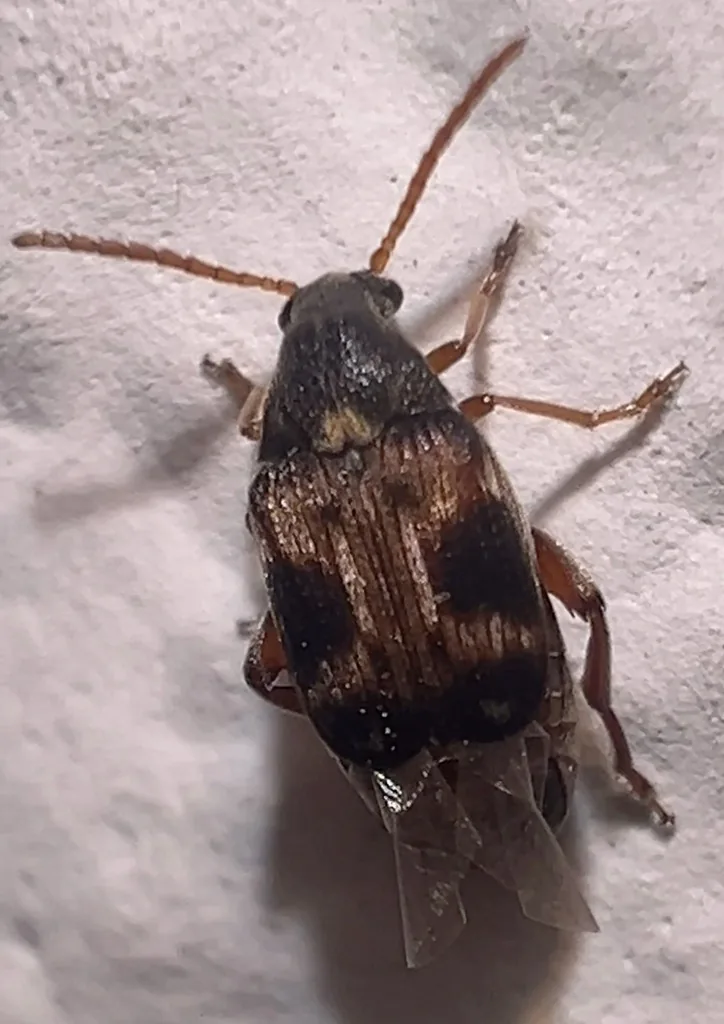
- Adults are small and somewhat teardrop-shaped; UC IPM gives 0.13 to 0.2 inch for the weevils found in beans. Cowpea weevils have long antennae and long legs, and the wing covers carry a large rounded spot at mid-length, are tipped with black, and stop short of the end of the abdomen.[5][2][1]
- Each hind leg has an enlarged thigh with a single large tooth.[2]
- Adults come in two forms: a flying form that is lighter overall with small black spots, and a normal form that lacks most flight muscles.[6]
- Females glue eggs to the seed or pod; the larva bores inside and spends its larval and pupal stages there, and the adult chews a round exit hole.[5][2]
- UF/IFAS describes a black head and brown wing covers with black patches. On the plate at the end of the abdomen, the female's is large, black at the sides with a white lengthwise line; the male's is smaller and lacks the stripes.[4]
Look-alikes
| Look-alike | How to tell them apart |
|---|---|
| Bean weevil | A related seed beetle that also breeds in stored beans. Its eggs are laid loosely among beans or through cracks in the pods rather than glued on, and Utah State describes it as light olive brown with darker brown or cream markings and reddish legs and antennae.[1][5] |
Where it lives
A tropical beetle that researchers describe as a cosmopolitan, global pest of stored legumes. In the US, extension guides from California (UC IPM), Georgia (UGA) and Utah (USU) cover it as a pest of stored beans and peas. UF/IFAS calls it cosmopolitan and says it originated in Africa before spreading to tropical and subtropical regions.[7][8][6][5][2][1][4]
Biology and life cycle
Infestations can start in the field or garden, and indoors the beetles breed continuously in dried legumes kept warm.[1][5][7]
Adults are short-lived and don't feed, but they are very active and run fast. Field studies found that many females of the flying form hold off on laying eggs and live longer, while the normal form lays more eggs.[2][7][6]
Egg numbers and egg-to-adult time vary between strains; a lab comparison of strains from India, Burkina Faso, Niger and the United States found clear differences in both.[3]
UF/IFAS says a female lays more than 100 eggs, gluing one to each seed, and larvae pass through four instars inside it. A generation takes 3-4 weeks on mung beans and black-eyed peas but seven weeks on adzuki beans at 30°C. Adults are sexually mature 24- 48 hours after emerging and live two-three weeks.[4]
Development stops below 12°C, and UF/IFAS says lowering the temperature to 10°C effectively reduces infestation.[4]
Damage and signs
- Larvae eat out nearly the whole seed, ruining dried beans, cowpeas, black-eyed peas, lentils, peas, chickpeas, mung beans, lima beans and soybeans. Damage is a mix of feeding and contamination.[5][1][2]
- UF/IFAS cites research that legume seeds stored for six months can reach 70% seed infestation and about 30% yield loss, leaving them unacceptable for human consumption.[4]
Health risk
Extension sources describe the harm as feeding damage and contamination of stored legumes.[5][1]
Control
Prevention
In the garden, make sure seed is free of weevils before planting and remove bean plants right after harvest.[5]
Keep moisture low in food storage areas by improving ventilation.[1]
UF/IFAS says storing cowpeas in a sealed metal drum or in triple plastic bags gave effective control, because the sealed space runs short of oxygen.[4]
Cool storage helps: UF/IFAS says development stops below 12°C.[4]
Sanitation
Inspect incoming legumes, clean up spills, rotate stock, and store dried beans and peas in pest-proof containers. Find and throw out infested legumes; insecticides are not recommended, and should never be applied to food.[1][5][2]
Traps and physical control
Items that can't be discarded can be held in a household freezer for six days at 0 to -2°F, Georgia Extension says, though how well cold works depends on how cold the item actually gets and for how long.[2]
Where sources disagree
Flight: Georgia Extension calls adults strong fliers, while researchers report that the normal adult form has lost the ability to fly and only the separate flying form can.[2][6]
Common questions
- Why do my black-eyed peas have round holes?
- The round holes are exit holes chewed by adult cowpea weevils after they developed inside the seed.[5][2]
- Are cowpea weevils the same as bean weevils?
- No. They are related seed beetles with similar habits, but cowpea weevils glue their eggs to seeds or pods, while bean weevils lay theirs loosely among beans or through cracks in pods.[5][1]
- Where do cowpea weevils come from?
- UF/IFAS says the species originated in Africa and spread to tropical and subtropical regions, and that infestations often begin in the field before the seeds are stored.[4]
Sources
- Utah State University Extension (Integrated Pest Management), “Bean and Cowpea Weevils (nuisance pest fact sheet).” extension.usu.edu/planthealth/ipm/notes_nuisance/bean-cowpea-weevils.php (accessed 2026-11-14)
- University of Georgia Extension, “Stored Product Pests in the Home (Bulletin 1378).” fieldreport.caes.uga.edu/publications/B1378/ (accessed 2026-11-14)
- Journal of Insect Physiology, via PubMed, “Cheng et al. (2015), Comparison of life history and genetic properties of cowpea bruchid strains and their response to hypoxia.” pubmed.ncbi.nlm.nih.gov/25733404/ (accessed 2026-11-14)
- University of Florida/IFAS Extension (Featured Creatures), “Cowpea Weevil, Callosobruchus maculatus (Fabricius 1775), EENY-769/IN1338.” ask.ifas.ufl.edu/publication/IN1338 (accessed 2026-11-14)
- University of California Statewide IPM Program, “Bean Weevils (Home and Landscape).” ipm.ucanr.edu/home-and-landscape/bean-weevils/ (accessed 2026-11-14)
- Insects, via PubMed, “Du et al. (2024), Divergence in the morphology and energy metabolism of adult polyphenism in the cowpea beetle Callosobruchus maculatus.” pubmed.ncbi.nlm.nih.gov/39859610/ (accessed 2026-11-14)
- Journal of Insect Physiology, via PubMed, “Zannou et al. (2003), Life history of flight morph females of Callosobruchus maculatus: evidence of a reproductive diapause.” pubmed.ncbi.nlm.nih.gov/12804717/ (accessed 2026-11-14)
- Frontiers in Plant Science, via PubMed, “Stevenson et al. (2018), Novel agmatine derivatives in Maerua edulis with bioactivity against Callosobruchus maculatus, a cosmopolitan storage insect pest.” pubmed.ncbi.nlm.nih.gov/30386361/ (accessed 2026-11-14)
- iNaturalist, “Callosobruchus maculatus taxon page (order and family).” www.inaturalist.org/taxa/243762 (accessed 2026-11-14)