On this page
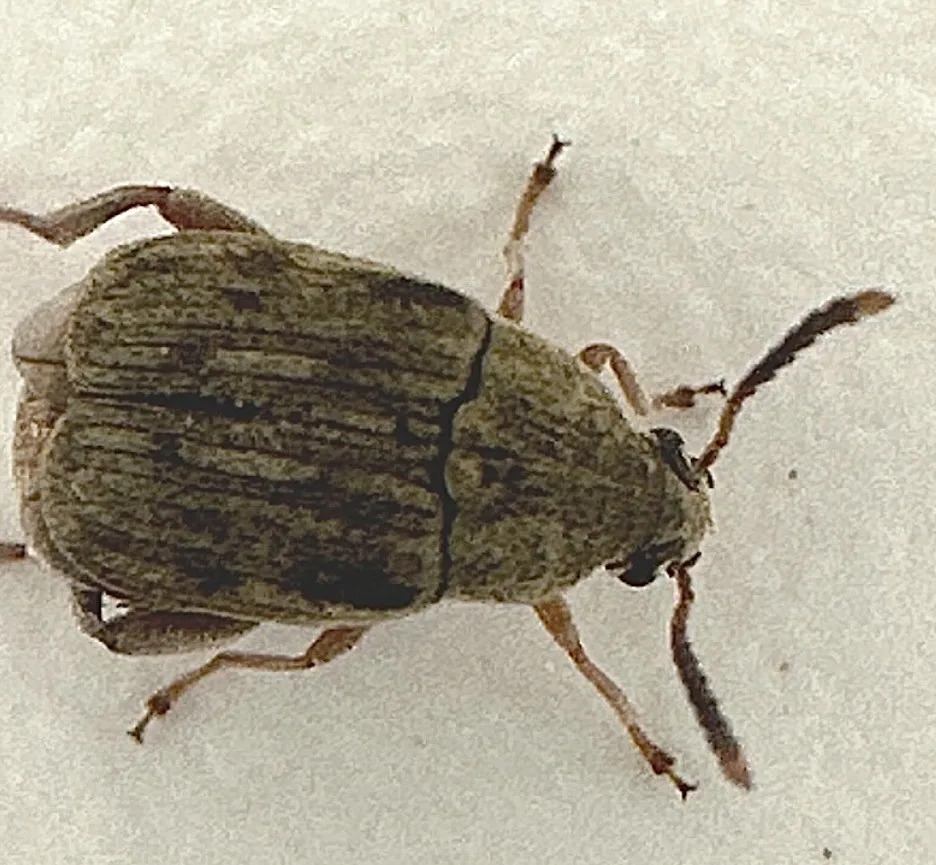
How to identify it
Look-alikes
| Look-alike | How to tell them apart |
|---|---|
| Granary weevil | A true weevil with a long snout. The female bores a hole in a grain kernel and lays an egg in it, and the larva develops inside the kernel; the bean weevil develops in legume seeds, and its body narrows evenly toward a small head.[3][1] |
| Rice weevil | Another small snout beetle, one of the true weevils of stored grain; the bean weevil's body narrows evenly toward a small head, and it develops in dry beans and peas.[3][1] |
| Cowpea weevil | A related bean pest whose wing covers are tipped with black and carry two large black dots.[1] |
Where it lives
Widespread in most bean-growing areas of the tropics and subtropics. In temperate regions it only occasionally survives winter in the field but multiplies in stored beans; Utah State says it usually infests legumes in the field and breeds indoors in stored dried legumes.[4][1]
Biology and life cycle
Females lay eggs loosely among stored beans or through cracks in the pods.[2]
Larvae and pupae develop inside the bean, and adults chew out through a round hole in the seed coat.[2]
Indoors the beetles breed continuously in dried legumes kept warm. In temperate regions it only occasionally survives winter in the field but builds up through several generations a year in stored beans.[1][4]
Adults are strong fliers.[1]
Its main host is the common bean (Phaseolus vulgaris), and it has spread with people as they moved those beans around the world.[4]
Damage and signs
Health risk
The concern is food loss: larvae hollow out beans and contaminate stored legumes, which are best thrown out once infested.[2][1]
Control
Prevention
Keep food storage areas dry with good ventilation, and check stored legumes regularly.[1]
In the garden, plant weevil-free seed and remove and destroy bean plants right after harvest; insecticide treatment isn't recommended. Infestations can also start from leftover trash beans.[2]
Keep them out
Inspect incoming beans for beetles and store all susceptible foods in pest-proof containers.[1]
Sanitation
Find and dispose of infested legumes, clean up spills and storage areas, and keep legumes in regular rotation.[1]
Weevils in other beans
Beetles found in dry beans are not always this species. UC IPM lists the cowpea weevil and the broad bean weevil as other common bean weevils; as a group they are 0.13 to 0.2 inch long, teardrop or triangular in shape and dull-colored with white, reddish or black markings.[2]
Researchers note that no sensitive detection or monitoring tools exist for the bean weevil, and that control of local populations still relies mainly on fumigant insecticides.[4]
Common questions
- Where did the little beetles in my dry beans come from?
- Bean weevil infestations can start in the field or garden before harvest, then keep breeding in storage.[2]
- Should I spray my pantry for bean weevils?
- No. Throw out infested legumes, clean the storage area and keep beans in sealed containers; insecticides aren't recommended.[1][2]
Sources
- Utah State University Extension, Integrated Pest Management, “Bean and Cowpea Weevils (Nuisance Pests).” extension.usu.edu/planthealth/ipm/notes_nuisance/bean-cowpea-weevils (accessed 2026-11-12)
- University of California Statewide IPM Program, “Bean Weevils (Home and Landscape).” ipm.ucanr.edu/home-and-landscape/bean-weevils/ (accessed 2026-11-12)
- USDA Agricultural Research Service, “Stored-Grain Insects (Agriculture Handbook No. 500, issued 1978, revised 1986).” www.ars.usda.gov/ARSUserFiles/2863/pdfdocuments/StoredGrainInsects.pdf (accessed 2026-11-12)
- Annals of Applied Biology, via PubMed, “A semiochemical view of the ecology of the seed beetle Acanthoscelides obtectus (Vuts et al. 2024).” pubmed.ncbi.nlm.nih.gov/38516560/ (accessed 2026-11-12)
- iNaturalist, “Acanthoscelides obtectus taxon page (order and family).” www.inaturalist.org/taxa/212223 (accessed 2026-11-12)