On this page
How to identify it
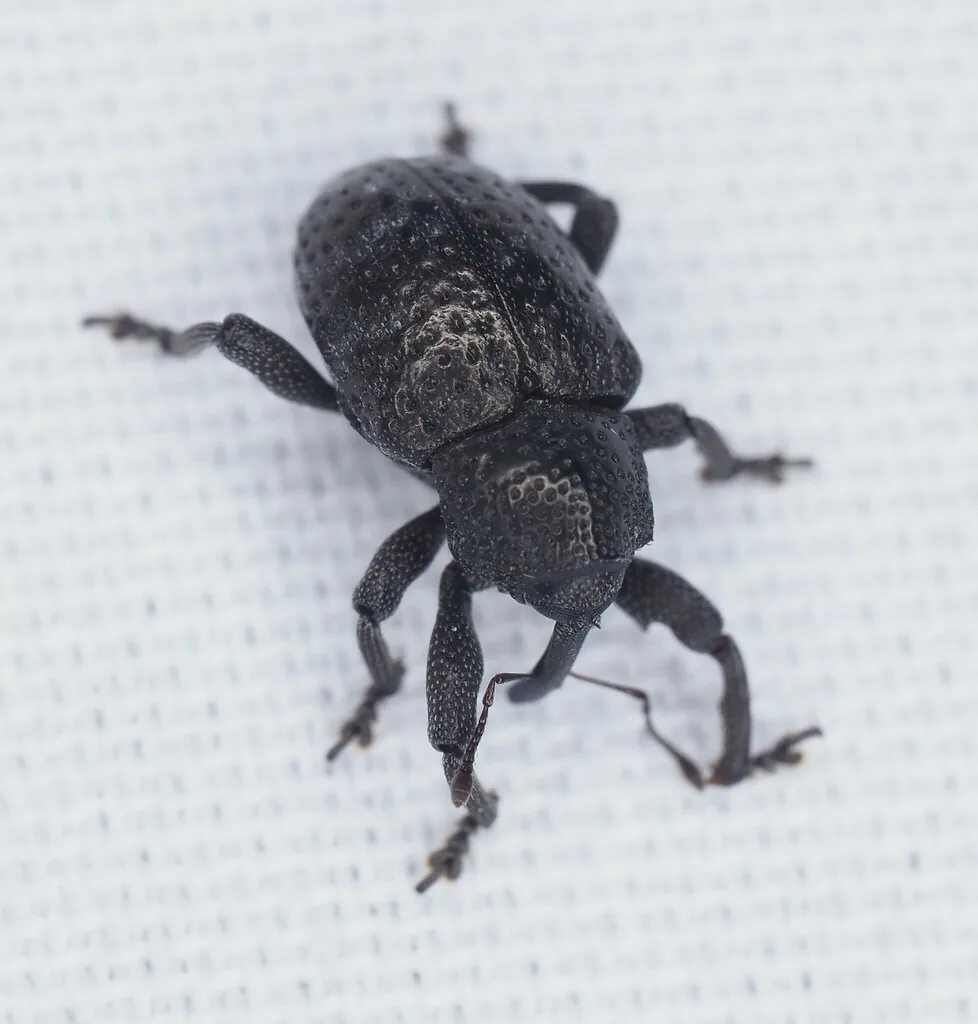
- Adults are oval, hump-backed snout beetles with small dents on the wing covers and upper body. Clemson describes them as bronze-tinged black and about 1/4 inch long; Mississippi State calls them dark gray and about 3/16 inch.[1][3]
- You rarely see the adults: they drop to the ground when disturbed and seldom fly.[3][2]
- Pods show small, brown, wart- or blister-like raised spots where adults punctured them to feed or lay eggs.[1][2]
- Damaged peas have small, dark, indented spots or small round holes and often hold a legless, pale yellow grub with a brown head.[1][2]
Look-alikes
Where it lives
The southeastern United States, where University of Georgia researchers call it the most destructive insect pest of cowpeas over the last century; Clemson and Mississippi State rank it a leading southern pea pest in South Carolina and Mississippi.[4][1][2]
Biology and life cycle
Adults spend the winter in crop refuse, grass or leaf litter in or near the field; tufts of broom sedge along wooded edges are favorite spots.[1][2]
Adults leave their winter quarters in March or early April and keep emerging until June or July, about when the first peas are ready for egg-laying. These overwintered adults are long-lived and may survive through August.[1]
The female punctures a pod, chews a small hole in a pea and lays a single egg in it. About seven or eight days pass from egg-laying until the grub leaves the pod; it feeds on one or more peas, grows to slightly more than 1/4 inch, chews out, drops to the ground and pupates about 1 inch deep in the soil some six days later.[1]
The life cycle takes about 21 to 50 days, with two generations a year in South Carolina; because egg-laying is spread out, generations overlap and all stages can be on the peas at once.[1]
University of Georgia researchers tracked a summer and a fall generation and found egg development in females dropped off sharply by September, the first biological evidence of diapause in this weevil, which helps it survive winter where frost ends the pea crop.[4]
Damage and signs
- Southern peas are the main host. Snap beans are rarely a problem (Clemson) or only occasionally attacked (Mississippi State).[1][3]
- Grubs develop inside individual peas, and damaged peas are often found when shelling; the frass and insects themselves contaminate the crop.[2][3]
- Late plantings set apart from early peas usually suffer less, and wild host plants with pods attract curculios and can be a source of infestation.[1]
- Pea patches planted in the same place year after year are likely to be heavily infested unless sprays are timed well.[3]
Health risk
It feeds on peas and beans; none of the sources mentions any risk to people, though infested peas are usually picked out before cooking.[1][2]
Control
Prevention
Because adults rarely fly, moving the pea patch at least a few hundred feet from the old site helps, though less so where many weed hosts grow nearby.[3]
Sanitation
Destroy pea vines promptly after the last harvest so many grubs don't finish developing.[3]
Pesticides
Spray timing is the key, and it follows the crop stage, not sightings of the weevils. Mississippi State says to start at the first open blooms or when pods are about 1/2 inch long and make three sprays five days apart, so adults die before pods are big enough for egg-laying.[2][3]
Garden insecticides that list cowpea curculio include bifenthrin, zeta-cypermethrin, malathion and carbaryl products labeled for home gardens. To protect pollinators, spray late in the day, after sunset; read and follow the label.[2][3]
Where sources disagree
Adult size and color: Clemson gives about 1/4 inch and bronze-tinged black; Mississippi State gives about 3/16 inch and dark gray.[1][3]
Spray schedule: Clemson recommends a first spray at first bloom, then repeats every five to seven days; Mississippi State recommends three sprays five days apart starting at first open bloom or 1/2-inch pods.[1][2][3]
Snap beans: Clemson says curculios are rarely a problem on snap beans; Mississippi State says they attack southern peas and occasionally beans.[1][3]
Common questions
- What's making small holes in my southern peas?
- Most likely the cowpea curculio: the small dark spots and round holes are egg-laying punctures, and the peas often hold a small legless grub.[2][1]
- When should I spray for cowpea curculio?
- At first bloom or when pods are about 1/2 inch long, before pods are big enough for egg-laying, then repeat on a 5-day (Mississippi State) or 5- to 7-day (Clemson) schedule.[2][1]
- Where do they spend the winter?
- As adults in crop refuse, grass, leaf litter or broom sedge near the garden.[1][2]
Sources
- Clemson Cooperative Extension Home & Garden Information Center, “Bean & Southern Pea Insect Pests (HGIC 2203).” hgic.clemson.edu/factsheet/bean-southern-pea-insect-pests/ (accessed 2026-11-11)
- Mississippi State University Extension, “Cowpea Curculio, Vol. 4, No. 12.” extension.msstate.edu/newsletters/bugs-eye-view/2018/cowpea-curculio-vol-4-no-12 (accessed 2026-11-11)
- Mississippi State University Extension, “Insect Pests of the Home Vegetable Garden (Publication 2347).” extension.msstate.edu/publications/insect-pests-the-home-vegetable-garden (accessed 2026-11-11)
- Journal of Economic Entomology, via PubMed, “Reproductive biology and evidence of diapause in the cowpea curculio (Riley et al. 2020).” pubmed.ncbi.nlm.nih.gov/31889179/ (accessed 2026-11-11)
- iNaturalist, “Chalcodermus aeneus taxon page (order and family).” www.inaturalist.org/taxa/304953 (accessed 2026-11-11)