On this page
How to identify it
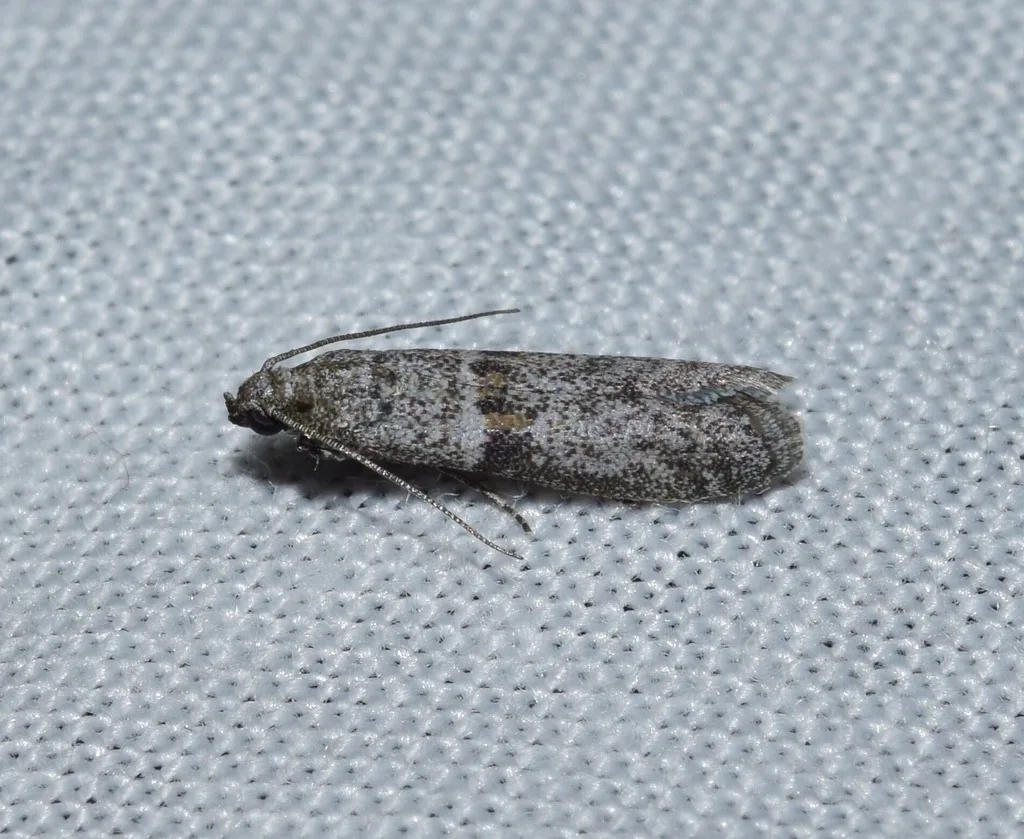
- Adults have light gray wings with straight dark lines, most noticeable near the outer edge of the front wing. Moths at rest are small, roughly 1/4 to 3/8 inch long, like other pantry moths. The University of Florida gives a wingspan of 14 to 20 mm, with the front wings mottled gray on most specimens.[4][3][5]
- Moths fly mostly around dawn and dusk. The University of Florida says they fly with a rapid wing vibration and dart quickly about.[2][5]
- Larvae can be told from Indian meal moth and raisin moth larvae by small, round black spots (pinacula) on the body.[4]
- Living larvae may show some pink markings, but these don't form stripes along the body.[1]
- The caterpillars spin silk threads over and through infested food, especially thick just before they pupate; the webbing is a key sign of an infestation.[2][3]
- Larvae are cream or dirty white, with brown or purple dots on the back, each dot bearing a black hair; the head and first segment behind it are dark brown.[5]
Look-alikes
| Look-alike | How to tell them apart |
|---|---|
| Indian meal moth | Easier to recognize: the inner part of each front wing is whitish gray or light tan and the outer part reddish brown with a coppery luster. It is the most common pantry moth in homes.[3][6] |
| Mediterranean flour moth | Similar in appearance, but its front wings are pale leaden gray with wavy black crosswise markings, and the wingspan is slightly under an inch. The University of Florida says the adult almond moth closely resembles it, but the Mediterranean flour moth has two black zigzag bands across its front wings.[4][7][2][5] |
| Clothes moths | Smaller and hairier, weak fliers usually seen near closets; the webbing clothes moth has a fuzzy reddish head. Food moths are strong fliers seen anywhere in the house.[3][6] |
Where it lives
A cosmopolitan pest of stored products, most common in tropical and subtropical regions and present in the United States, where USDA calls it a serious pest of rough rice and grain sorghum in the South. The University of Florida describes it as found worldwide.[1][2][7][5]
Biology and life cycle
Females lay their eggs on or near the food. Adults don't feed and are short-lived. The University of Florida says females lay about 110 to 120 eggs and adults live one to two weeks.[2][4][5]
In a 2017 lab study on dates, the caterpillar stage lasted 48.95 days on average at 25 °C and 32.12 days at 35 °C, with six larval instars. At 35 °C females laid few eggs and none hatched, and at 15 °C larvae developed very slowly.[8]
USDA port inspectors commonly intercept the larvae in stored products from countries around the world; about a quarter of interceptions come from India.[1]
Mature caterpillars of pantry moths wander off to pupate and often chew through the packaging of the food they grew in.[3]
The University of Florida gives about 60 to 80 days for the whole life cycle.[5]
Damage and signs
- Larvae feed in dried fruit, whole or shelled nuts such as almonds, peanuts and pistachios, and other seeds, as well as confectionery and cereal products. The University of Florida lists dried fruits, nuts, grains, seeds and candy.[3][2][5]
- USDA calls it the most troublesome of three moths that occasionally infest grain and cereal products: it is common in seed stores and a serious pest of rough rice and grain sorghum in the South.[7]
- Infested food fills with silk webbing, excess dust and holes or tunnels, and larvae may bore holes in containers.[3][6]
Health risk
The concern is spoiled food: the caterpillars fill dried fruit, nuts, grain and seeds with silk webbing and droppings, and pantry pests contaminate food with their bodies and by-products.[3][6]
Control
Prevention
Store susceptible foods in glass or plastic containers with tight-fitting lids (plastic bags aren't enough), or in the refrigerator or freezer, at least for several months after an infestation.[3][6]
Sanitation
Whatever the moth species, the treatment is the same: find the infested products, seal them up and throw them out, then check every other package stored nearby, especially opened ones.[3][6]
Look beyond the kitchen: dry pet food, bird seed, nuts, trail mix in camping gear, dried flower arrangements and rodent caches in walls can all harbor caterpillars.[3]
Empty the shelves, then wash them with soap and water and vacuum spilled food, cracks and crevices, which also removes wandering caterpillars and pupae.[3][6]
Traps and physical control
Holding items in a deep freezer at 0 degrees F or lower for a week or more will control most stored food pests.[3]
After cleanup, pheromone traps help show whether moths remain. They catch males, not females, so they detect a problem rather than end it; check them weekly and re-inspect food whenever new moths turn up.[6]
Pesticides
Insecticides are no substitute for cleanup. Mississippi State says any product used must be labeled for food storage areas and applied to an empty pantry; UC IPM doesn't recommend insecticides for pantry pests at all.[3][6]
Where sources disagree
Eggs: the University of Florida says females lay about 110 to 120; the University of Minnesota IPM World Textbook says up to 300; in a 2017 lab study on dates at 25°C, females averaged 213.60.[5][2][8]
Development time: the University of Florida gives about 60 to 80 days for the life cycle; the University of Minnesota gives a minimum life cycle of 25 days; in the 2017 study on dates at 25°C, the caterpillar stage alone took 48.95 days on average.[5][2][8]
Insecticides: Mississippi State says labeled products can be applied to an emptied pantry after cleanup, though they aren't really necessary; UC IPM says insecticides aren't recommended for any pantry pests.[3][6]
Common questions
- Do almond moths only infest almonds?
- No. Despite the name, the University of Florida says its preferred foods are dried figs and dates. The University of Minnesota IPM World Textbook says they prefer dried fruits, nuts, confectionery and cereal products, and Kansas State notes ties to imported dates, carobs and cocoa.[5][2][4]
- Is the almond moth the same as the tropical warehouse moth?
- Yes. USDA's identification resource lists both names for Cadra cautella, and the University of Minnesota uses both.[1][2]
- Will a pheromone trap get rid of pantry moths?
- Not on its own. The traps attract male moths, so they are best for spotting moths left after the infested food has been found and thrown out.[6]
Sources
- USDA APHIS PPQ Identification Technology Program, “LepIntercept fact sheet: Cadra cautella (almond moth, tropical warehouse moth).” idtools.org/id/lepintercept/cautella.html (accessed 2026-11-14)
- University of Minnesota, Radcliffe's IPM World Textbook, “Almond Moth (Tropical Warehouse Moth).” ipmworld.umn.edu/almond-moth (accessed 2026-11-14)
- Mississippi State University Extension Service, “Bug-Wise No. 14: Moths That Infest Stored Foods (August 2005).” extension.msstate.edu/sites/default/files/newsletter/bw1405.pdf (accessed 2026-11-14)
- Kansas State University Agricultural Experiment Station and Cooperative Extension Service, “Stored Product Protection (S156; D. W. Hagstrum, T. W. Phillips, G. Cuperus, eds., 2012).” bookstore.ksre.ksu.edu/pubs/stored-product-protection_S156.pdf (accessed 2026-11-14)
- University of Florida/IFAS, Entomology and Nematology Department, “Almond moth, Cadra cautella (Stored Product Pests Photographs CD-ROM).” entnemdept.ufl.edu/projex/gallery/dl/stored_product_pests/text/Almond_moth.htm (accessed 2026-11-14)
- University of California Statewide IPM Program, “Pantry Pests (Pest Notes).” ipm.ucanr.edu/home-and-landscape/pantry-pests/ (accessed 2026-11-14)
- USDA Agricultural Research Service, “Stored-Grain Insects (Agriculture Handbook No. 500, issued 1978, revised 1986).” www.ars.usda.gov/ARSUserFiles/2863/pdfdocuments/StoredGrainInsects.pdf (accessed 2026-11-14)
- Journal of Economic Entomology, via PubMed, “Biological Traits of Cadra cautella Reared on Khodari Date Fruits Under Different Temperature Regimes (Husain et al. 2017).” pubmed.ncbi.nlm.nih.gov/28605547/ (accessed 2026-11-14)
- iNaturalist, “Cadra cautella taxon page (order and family).” www.inaturalist.org/taxa/215616 (accessed 2026-11-14)