The short answer
- Can you see it? An adult bed bug is about the size of an apple seed, 5 to 7 mm (3/16 to 1/4 inch) long. Dust mites can only be seen under a microscope; adults are about 0.5 mm.[8][2][4][1]
- Color and shape: bed bugs are reddish-brown, flat and oval. Dust mites are globular and clear to creamy white.[8][7][1]
- Bites or allergies? Bed bugs bite and feed on blood. House dust mites don't bite people; they matter because they're the main cause of dust allergies.[7][5][1][4]
- Signs: bed bugs leave dark fecal spots, light-brown shed skins and tiny white eggs along mattress seams. Dust mites leave nothing you can see.[9][2][4]
Profiles on this site
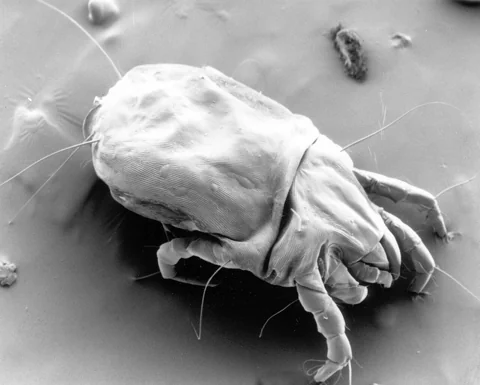 House Dust Mites
Dermatophagoides farinae (American house dust mite) and D. pteronyssinus (European house dust mite)
House dust mites are microscopic relatives of ticks and spiders that live in house dust and feed on skin flakes shed by people and pets. They don't bite, but their body parts and droppings are a major indoor allergen and the main cause of dust allergy.
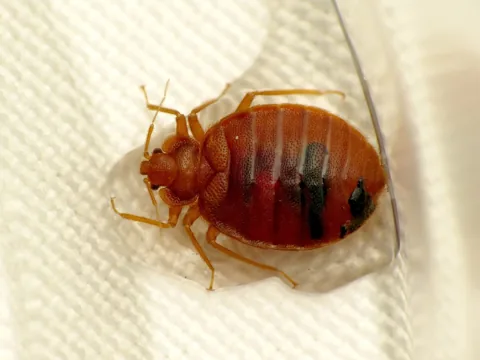 Bed Bug
Cimex lectularius
Bed bugs are wingless, blood-feeding insects that feed on sleeping or resting people, mostly at night; they have resurged worldwide and now turn up even in the finest hotels. CDC says they turn up in five-star hotels and resorts, and how clean a place is does not determine whether bed bugs are present.
Side by side
Each line describes the house dust mite first, then the bed bug.[1][8]
- What they are: dust mites are relatives of ticks, chiggers and spiders. The two common U.S. species are the North American house dust mite (Dermatophagoides farinae) and the European house dust mite (D. pteronyssinus). Bed bugs (Cimex species) are true bugs, insects with a three-segmented beak and four-part antennae.[1][7][8]
- Size: adult dust mites are about 0.5 mm long and the young are smaller, so you need a microscope. EPA gives adult bed bugs 5 to 7 mm (3/16 to 1/4 inch), Kentucky about 3/16 inch, UC IPM about 1/5 inch and MedlinePlus 1/4 to 3/8 inch; CDC gives 1 to 7 mm across all ages.[1][4][8][2][9][5][7]
- Color and shape: dust mites are globular, clear to creamy white, with hairs on the legs and body. Bed bugs are reddish-brown (UC IPM says rusty red or mahogany), flat and oval when unfed, and swollen and more elongated after feeding.[1][8][9][7]
- Young: dust mite larvae and nymphs are even smaller than the adults. Bed bug nymphs are smaller and lighter, translucent or whitish-yellow, and can be nearly invisible before they feed.[1][8][5]
- Wings and movement: neither flies. Bed bugs are wingless, don't jump like fleas, but crawl quickly over floors, walls and ceilings.[7][9][2]
- Food: dust mites eat dander, the skin flakes shed by people and pets. Bed bugs feed only on blood.[1][3][9]
- Where they live: dust mites are most numerous in beds, overstuffed sofas and chairs and nearby carpet, and MedlinePlus says most in a home are in bedding, mattresses and box springs. Bed bugs hide in mattress seams, box springs, bed frames and headboards, then upholstered chairs and sofas, usually close to where people sleep.[1][4][3][2][9][5]
- Climate: dust mites dry out easily. Kentucky says they do best at about 75-80 degrees F and 70-80 percent relative humidity and struggle below 50 percent; a review in Current Allergy and Asthma Reports says they are rare or absent in dry climates unless indoor humidity is raised. CDC says bed bugs can live several months without a blood meal.[1][10][7]
- Season: Kentucky says dust mites and their allergens are in homes year-round. Bed bugs travel into homes in luggage, clothing, bedding and furniture.[1][7][9]
- Bite: Kentucky Extension says house dust mites aren't parasites and can't bite or sting people. Bed bugs bite people at night while they sleep; CDC says bites look like mosquito or flea bites and may be in a line, and MedlinePlus says some people have no reaction at all.[1][7][5]
- Health effects: MedlinePlus calls dust mites the main cause of dust allergies. CDC and MedlinePlus say bed bugs aren't known to spread disease; bites can cause itching and lost sleep, and severe allergic reactions are rare.[4][7][5]
- What you'll find: nothing visible for dust mites. For bed bugs, look for the bugs, dark fecal spots that are reddish-brown to black, light-brown shed skins and pinhead-sized pearl-white eggs.[4][9][2][8]
How to confirm which one you have
If you can see something crawling, it isn't a dust mite. Use a flashlight and magnifying glass along mattress seams and tufts, the box spring, bed frame and headboard. UC IPM says bed bugs and their signs are the only real way to confirm them, because their bites are hard or impossible to tell from mosquito, flea or spider bites.[4][1][9]
If you catch a bug, look at it closely and compare it with the size, color and shape above. Kentucky says bed bugs are sometimes mistaken for ticks, cockroaches and carpet beetles; the bed bug look-alikes guide covers those.[2][8]
Dust mites are confirmed indirectly. Kentucky says a dust sample can be examined under a microscope, and home test kits sold in drug and allergy stores measure mite levels in collected dust.[1]
For the allergy itself, MedlinePlus says skin testing is the most common allergy test, with blood tests when skin testing isn't possible. Allergic rhinitis symptoms include sneezing, itchy and watery eyes and a stuffy nose.[6]
Why it matters
The fixes are different. Bed bugs need to be found and killed, and UC IPM says confirmed infestations should be handled by trained professionals. Dust mites can't be wiped out; NIEHS says no matter how clean a home is they can't be completely eliminated, so the goal is fewer mites and less allergen.[9][3]
Bed bug bite reactions can show up a day or more after the bite, sometimes days or weeks later, which makes it hard to tell where or when the bites happened.[2][7]
What to do about each
Dust mites: wrap mattresses, box springs and pillows in mite-proof covers, and wash bedding once a week in hot water (130 to 140 degrees F). NIEHS says bedding that can't be washed can be frozen overnight.[4][3][1]
Dust mites: keep indoor humidity at or below 50 percent with a dehumidifier or air conditioner, and use a vacuum with a HEPA filter. Kentucky says vacuuming alone hasn't shown much benefit in reducing mite numbers; covers, humidity control and swapping carpet and fabric furniture for hard surfaces matter most.[3][1][4]
Bed bugs: check for them early, wash and dry bedding and clothing at high temperatures, and use mattress, box spring and pillow encasements to trap bed bugs and help spot them. Kentucky says laundering should reach at least 120 degrees F, and a dryer on medium to high heat for 10 to 20 minutes kills all life stages.[5][2][7]
Bed bugs: reduce clutter, and check secondhand furniture and luggage after travel. UC IPM and Kentucky both recommend a professional for a confirmed infestation, since the bugs hide in so many places.[5][9][2]
Either one: mattress encasements help with both, trapping bed bugs and sealing dust mite allergen inside. CDC says to speak with a healthcare provider if you think you're having an allergic reaction to bed bug bites, and MedlinePlus says allergy testing can show what triggers allergy symptoms.[4][5][7][6]
Common questions
- Do dust mites bite?
- No. House dust mites don't bite people. They feed on skin flakes, and they cause problems through allergies, not bites.[1][3]
- Can I see dust mites on my bed?
- No. Dust mites can only be seen under a microscope. Something you can see crawling on a bed is a different animal, and a reddish-brown, flat, apple-seed-sized one may be a bed bug.[4][1][8]
- Do bed bugs cause allergies like dust mites?
- They can cause allergic reactions to bites, but CDC and MedlinePlus say severe reactions are rare. Dust mites are the main cause of dust allergies.[7][5][4]
- Do bed bugs spread disease?
- CDC and MedlinePlus say bed bugs aren't known to spread disease. Heavy scratching of bites can lead to a skin infection.[7][5]
- Will washing my sheets get rid of both?
- It helps with both but finishes neither. Hot washing kills dust mites in bedding, and a hot dryer kills bed bugs in fabric, but bed bugs also hide in the bed frame, furniture and cracks, and dust mites keep living in mattresses and carpet.[3][2][9][1]
Photo credits
- House Dust Mites: Matt Colloff, CSIRO — CSIRO ScienceImage 11085 (CC BY 3.0) — via Wikimedia Commons, CC BY 3.0
- Bed Bug: (c) Katja Schulz, some rights reserved (CC BY) — via iNaturalist, CC BY 4.0
Sources
- University of Kentucky Entomology, “ENTFACT-646: House Dust Mites.” entomology.ca.uky.edu/ef646 (accessed 2026-11-14)
- University of Kentucky Entomology, “ENTFACT-636: Bed Bugs.” entomology.ca.uky.edu/ef636 (accessed 2026-11-14)
- National Institute of Environmental Health Sciences, NIH, “Dust Mites and Cockroaches.” www.niehs.nih.gov/health/topics/agents/allergens/dustmites (accessed 2026-11-14)
- MedlinePlus, U.S. National Library of Medicine, “Allergies, asthma, and dust (Medical Encyclopedia).” medlineplus.gov/ency/patientinstructions/000487.htm (accessed 2026-11-14)
- MedlinePlus, U.S. National Library of Medicine, “Bed Bugs (health topic).” medlineplus.gov/bedbugs.html (accessed 2026-11-14)
- MedlinePlus, U.S. National Library of Medicine, “Allergic rhinitis (Medical Encyclopedia).” medlineplus.gov/ency/article/000813.htm (accessed 2026-11-14)
- Centers for Disease Control and Prevention, “About Bed Bugs.” www.cdc.gov/bed-bugs/about/index.html (accessed 2026-11-14)
- U.S. Environmental Protection Agency, “Bed Bugs Appearance and Life Cycle.” www.epa.gov/bedbugs/bed-bugs-appearance-and-life-cycle (accessed 2026-11-14)
- UC Statewide IPM Program, “Pest Notes: Bed Bugs.” ipm.ucanr.edu/home-and-landscape/bed-bugs/ (accessed 2026-11-14)
- Current Allergy and Asthma Reports, via PubMed, “Dust mite allergens: ecology and distribution (Arlian, Morgan and Neal 2002).” pubmed.ncbi.nlm.nih.gov/12165207/ (accessed 2026-11-14)