On this page
How to identify it
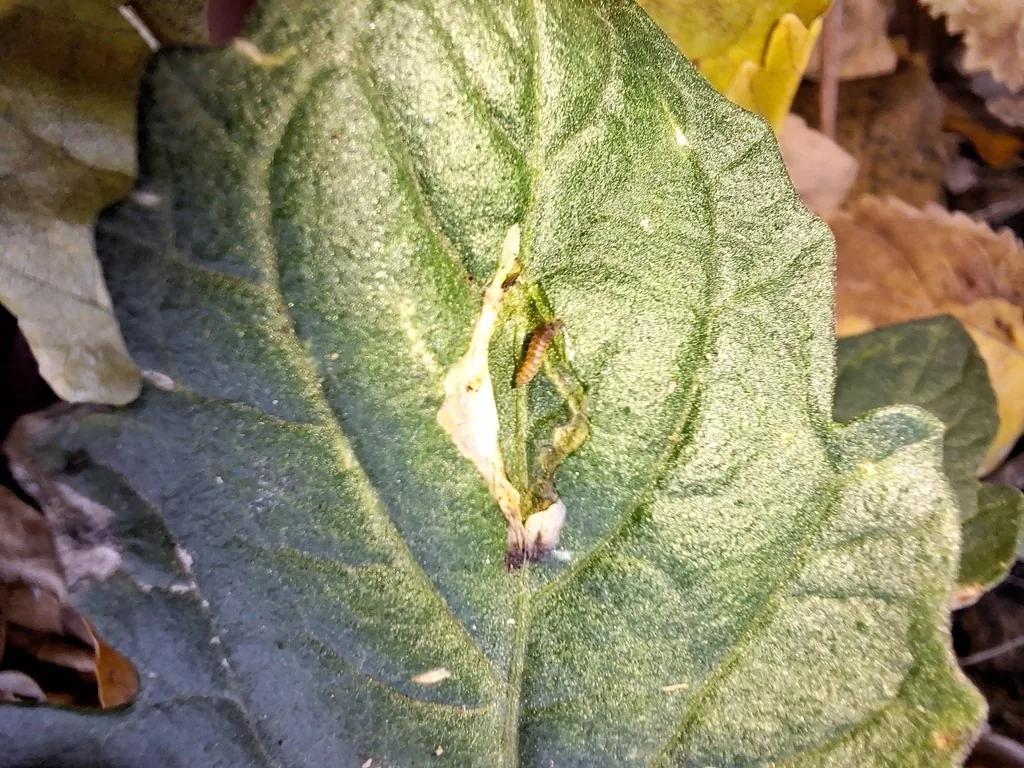
- Young larvae are light colored (yellow to green) and smooth, without the obvious bumps and bristles of newly hatched tomato fruitworms. Older larvae are gray, yellowish or green with red or purple bands or spots, about 1/4 inch (6.5 mm) long when grown.[2][3][4]
- The leaf mines widen into blotches, and older larvae fold and web leaves together to feed inside.[4][3][2]
- Adults are tiny, about 1/4 inch, light gray moths peppered with small black flecks. They are hard to identify by eye and can be confused with the potato tuberworm.[2][1][3]
Look-alikes
| Look-alike | How to tell them apart |
|---|---|
| Potato tuberworm | A related moth that UC IPM says can be confused with tomato pinworm adults. Researchers developed DNA tests to separate the two, and the invasive tomato leafminer (Phthorimaea absoluta), from look-alike moths.[2][5] |
| Leafminer flies | Fly maggots that make narrow, winding mines. Pinworm mines become blotches inside folded leaves, though Lincoln University notes the youngest pinworm larvae start with slender winding mines before widening them.[3][4] |
Where it lives
A member of a New World moth genus, it lives year round in warm farm areas of Mexico, California, Texas and Florida, and Purdue adds Hawaii. In California it occurs throughout the south and sporadically farther north. Farther north it turns up in greenhouses and high tunnels, and in 2024 pheromone traps recorded it in Armenia for the first time.[6][4][3][1][7]
Biology and life cycle
Eggs are laid on the lower surfaces of leaves, and moths are active mostly at night. Larvae mine leaves for about six days, then fold leaves or bore into fruit for about another six, and pupate in leaf shelters or in the soil.[2][1][4]
There can be seven or eight overlapping generations a year. A generation takes less than a month in summer (26 to 34 days, per Lincoln University) and 3 to 4 months in winter, and there is no resting stage: development continues as long as host plants are there.[2][1][4]
It feeds only on nightshade-family plants: tomato, potato, eggplant, and the weeds nightshade and horse nettle. Purdue notes a strong preference for tomato.[4][3][6]
Damage and signs
- Larvae usually enter fruit at the calyx, or anywhere when numbers are high, making dry, shallow, blackened burrows. Infested fruit is hard to spot at picking unless brown, granular frass shows at the calyx edge.[1][2][4]
- Where abundant it can seriously damage foliage and infest nearly all the fruit. It gets worse as the season goes on, so tomatoes grown from early season into late fall, and places where early and late plantings overlap, suffer most.[1][4]
- Purdue has confirmed it in two or three cases of high-tunnel growers losing entire tomato crops, with plants suddenly brown and covered in mines.[3]
Health risk
It feeds on nightshade-family plants; none of the sources describes any harm to people or pets.[1][3][4]
Control
Prevention
Check transplants closely and refuse infested ones; infestations usually start with transplants shipped in or grown in local greenhouses.[1][4]
Sanitation
Destroy plant debris and disc or till plants right after harvest, and remove nightshade-family weeds nearby. UC IPM says a host-free period of three months or more is essential, and suggests not growing both early and late crops where pinworm is a regular pest.[2][1][4]
Traps and physical control
Watch for mines and folded leaves, and use pheromone traps from planting to tell when moths are flying.[1][3][4]
Pesticides
Sprays must reach caterpillars as they hatch, before they mine into the leaf; larvae inside mines, folds or fruit are protected. UC IPM notes broad-spectrum products often have to be repeated to harvest and can set off leafminer outbreaks by killing their parasites. Follow the label.[3][1][4]
Not just a Southern pest
It can't survive winter outdoors in temperate states, but it has been reported in greenhouses in Delaware, Mississippi, Missouri, Pennsylvania and Virginia, has caused economic damage in Missouri field and high-tunnel tomatoes, and Purdue has confirmed it in high tunnels in a state where it can't survive outdoors. Northern outdoor infestations are usually near infested greenhouses.[4][3]
Where sources disagree
Natural enemies: UC IPM's home-garden page says they aren't effective; its commercial guidelines say parasitic wasps can be important in unsprayed or lightly sprayed fields.[2][1]
Mine shape: Purdue says pinworm mines are blotchy, not narrow and winding; Lincoln University says the first two stages make slender winding mines that later widen into one large blotch.[3][4]
Common questions
- What makes tiny pin holes in my tomatoes?
- Possibly tomato pinworm larvae boring in near the stem. Look for small round holes with dark frass at the calyx and for blotch mines and folded leaves on the plant.[3][2][4]
- How do pinworms get into a garden?
- Usually on infested transplants, or from plants and debris left after the last harvest.[4][1]
Sources
- University of California Statewide IPM Program, “Tomato Pinworm (Tomato Pest Management Guidelines).” ipm.ucanr.edu/agriculture/tomato/tomato-pinworm/ (accessed 2026-11-11)
- University of California Statewide IPM Program, “Tomato Pinworm (Home and Landscape).” ipm.ucanr.edu/home-and-landscape/tomato-pinworm/ (accessed 2026-11-11)
- Purdue University Department of Entomology Extension, “Tomato Pinworm.” ag.purdue.edu/department/entm/extension/fruit-vegetable-insects/tomato-pinworm.html (accessed 2026-11-11)
- Lincoln University Cooperative Extension (Missouri), “Tomato Pinworm (FS#18-B-2011, rev. 2012).” www.lincolnu.edu/_files/publications/tomato-pinworm-fact-sheet.pdf (accessed 2026-11-11)
- Journal of Economic Entomology, via PubMed, “Probe-based quantitative PCR and RPA-Cas12a molecular diagnostics for detection of the tomato pest Phthorimaea absoluta (Lewald et al. 2023).” pubmed.ncbi.nlm.nih.gov/37177893/ (accessed 2026-11-11)
- Biodiversity Data Journal, via PubMed, “Keiferia azapaensis sp. nov., the first representative of the New World micromoth genus Keiferia associated with Asteraceae (Vargas 2025).” pubmed.ncbi.nlm.nih.gov/39877676/ (accessed 2026-11-11)
- Chemistry and Biodiversity, via PubMed, “Novel Synthetic Strategy and Field Testing Tomato Pinworm Pheromone in Armenia (Hobosyan et al. 2025).” pubmed.ncbi.nlm.nih.gov/40035160/ (accessed 2026-11-11)
- iNaturalist, “Keiferia lycopersicella taxon page (order and family).” www.inaturalist.org/taxa/416926 (accessed 2026-11-11)