On this page
How to identify it
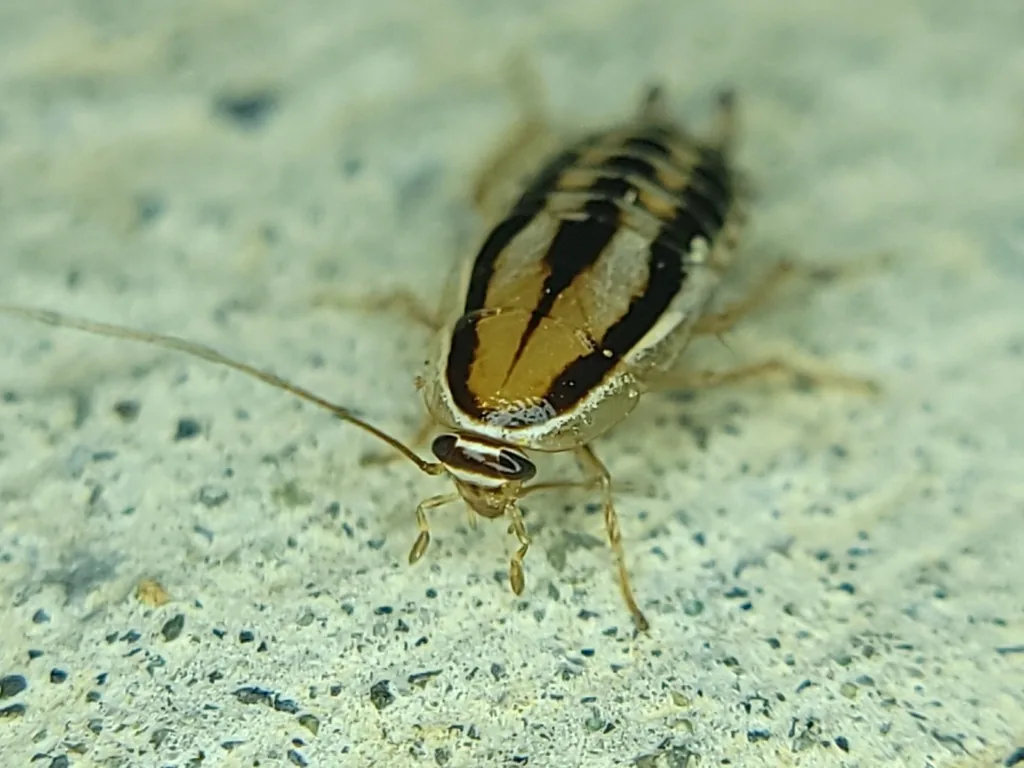
- It is the smallest cockroach in California: adults average 5 to 7 mm long, about 1/4 inch.[1][3]
- It is light-colored with three dark stripes on the pronotum and abdomen; trivittata means 'three-lined.' Young German cockroaches look similar but have two dark lines on the pronotum instead of three.[3][2][1]
- Males and females are easy to tell apart. Males have long forewings that run the length of the body, while females have short forewings that leave the abdomen fully exposed.[1]
- Females carry their egg case, or ootheca, at the tip of the abdomen. It starts out mint green, turns olive green and then dark brown before she drops it.[1][2]
- The young are so small that people rarely notice them in spring, and you won't see the species at all in winter.[4]
Look-alikes
| Look-alike | How to tell them apart |
|---|---|
| German cockroach (young nymphs) | Young German cockroaches are also small, but they have two dark lines on the pronotum instead of three. German cockroaches live and breed entirely indoors, while the three-lined cockroach lives outdoors and only wanders inside.[2][3][1] |
Where it lives
Native to dry Mediterranean habitats, with records from Morocco, Algeria, Spain, Italy, Libya and Israel. In California it was first seen around 2004 in Marin County and positively identified in 2009. It has spread through the San Francisco Bay Area, and by 2021 its range reached San Luis Obispo to the south, the El Dorado County foothills to the east and Mendocino County to the north.[2][1]
Biology and life cycle
It lives outdoors around people. In California it shelters in leaf litter, plant debris, matted thatch, mulch and compost, in irrigated, partly irrigated or dry landscapes; in its native range it lives in the leaf litter of semi-arid forests.[2][1][3]
Adults sometimes come indoors, mainly in late summer and fall, apparently looking for water during the driest part of the year; the Marin/Sonoma district adds that they may be extremely abundant outdoors where there are plant-based mulches. They get in through poorly sealed doors and windows.[3][1][2][4]
They are attracted to sweets: the Marin/Sonoma district has caught them in juice-baited yellowjacket traps and found them at night on overripe garden fruit.[4]
Sources disagree on how many generations it has. The Essig Museum's 2021 field observations indicate one a year: young hatch around mid-April, become adults in July and August, and the egg cases wait out the winter. CDFA's pest rating instead says two generations are produced in one year (spring and fall), with each egg case usually holding between 30 and 40 young.[1][2]
The young cannot hatch without rain in spring, yet too much water over the winter kills them before they hatch, a pattern that suits the long dry summers and short wet winters of a Mediterranean climate.[1]
Much of its biology is still unknown, and attempts to rear it in the laboratory have so far failed. In older literature it appears as Phyllodromica trivittata.[3][2]
A 2022 revision of its genus counts 10 Luridiblatta species around the Mediterranean, seven of them newly described; the three-lined cockroach shares a species group with one close relative.[5]
Damage and signs
- It is not an agricultural pest, and it is not expected to lower crop yields, disrupt natural communities or significantly affect home gardens and ornamental plantings. The California Department of Food and Agriculture gave it a 'C' pest rating, concluding that it does not appear to have a significant economic or environmental impact; it is not under official control anywhere.[2]
- Its main effect is as a nuisance: residents who find it indoors or in gardens may resort to new chemical treatments.[2]
- Unlike German cockroaches, it is not known to form colonies indoors.[4]
Health risk
These sources describe it as an outdoor cockroach that only wanders indoors and is not the kind that settles in kitchens, and none of them reports it causing illness. UC IPM notes that, in general, outdoor cockroaches that get inside are regarded as nuisance pests and potential public health pests.[1][3][4]
Control
Prevention
Limit hiding places near the house. UC IPM advises reducing cockroach harborage in outdoor vegetation, and this species shelters in leaf litter, plant debris, mulch and compost.[3][2]
Keep them out
Keep wandering adults out by sealing cracks and other openings and fitting door sweeps and weather stripping around doors and windows, the gaps they use to get in. The Marin/Sonoma district warns it is probably impossible to keep every one out.[3][1][4]
Sanitation
A few strays don't call for a cleaning frenzy, but tidying spots such as under the refrigerator removes food and hiding places.[4][3]
Traps and physical control
Traps placed near exterior doors catch outdoor cockroaches as they come in.[3]
Pesticides
No traps, baits or other products are marketed specifically for this species. For outdoor cockroaches in general UC IPM says baits give better control than sprays and can go in water meter boxes, drains or under slabs, and that pesticides alone will not solve cockroach problems.[4][3]
Common questions
- Is the three-lined cockroach a baby German cockroach?
- No. It is a separate, tiny outdoor species. Young German cockroaches look similar, but they have two dark lines on the pronotum, while the three-lined cockroach has three.[2][3]
- Will three-lined cockroaches infest my kitchen?
- They are not known to form colonies indoors. They live outdoors in leaf litter, thatch and compost, and adults only wander indoors in summer and fall.[1][4]
- Why do I see them indoors in late summer?
- UC IPM notes that they sometimes come into buildings in late summer and autumn, in search of water during the driest part of the year.[3][1]
- What do three-lined cockroaches eat?
- Outdoors they live among plant debris; the Marin/Sonoma district finds they are drawn to sweets such as overripe fruit, and CDFA notes they can feed on leftover food and plant debris in the home.[4][2]
Sources
- Essig Museum of Entomology, University of California, Berkeley, “A Charismatic Cockroach in California (C. Hubble, September 2021).” essig.berkeley.edu/2021/09 (accessed 2026-11-12)
- California Department of Food and Agriculture, Plant Health and Pest Prevention Services, “California Pest Rating for Three-lined Cockroach, Luridiblatta trivittata (Pest Rating: C; J. Iqbal, 2018).” blogs.cdfa.ca.gov/Section3162/?p=4354 (accessed 2026-11-12)
- University of California Statewide IPM Program, “Pest Notes: Cockroaches, UC ANR Publication 7467 (A. M. Sutherland, D. H. Choe and M. K. Rust).” ipm.ucanr.edu/home-and-landscape/cockroaches/ (accessed 2026-11-12)
- Marin/Sonoma Mosquito and Vector Control District, “Three-lined roach.” msmosquito.specialdistrict.org/three-lined-roach (accessed 2026-11-12)
- Zootaxa 5215(1), 2022 (Bohn), via PubMed, “Revision of the genus Luridiblatta (Blaberoidea, Ectobiidae, Ectobiinae).” pubmed.ncbi.nlm.nih.gov/37044886/ (accessed 2026-11-12)
- iNaturalist, “Luridiblatta trivittata taxon page (order and family).” www.inaturalist.org/taxa/354644 (accessed 2026-11-09)