On this page
How to identify it
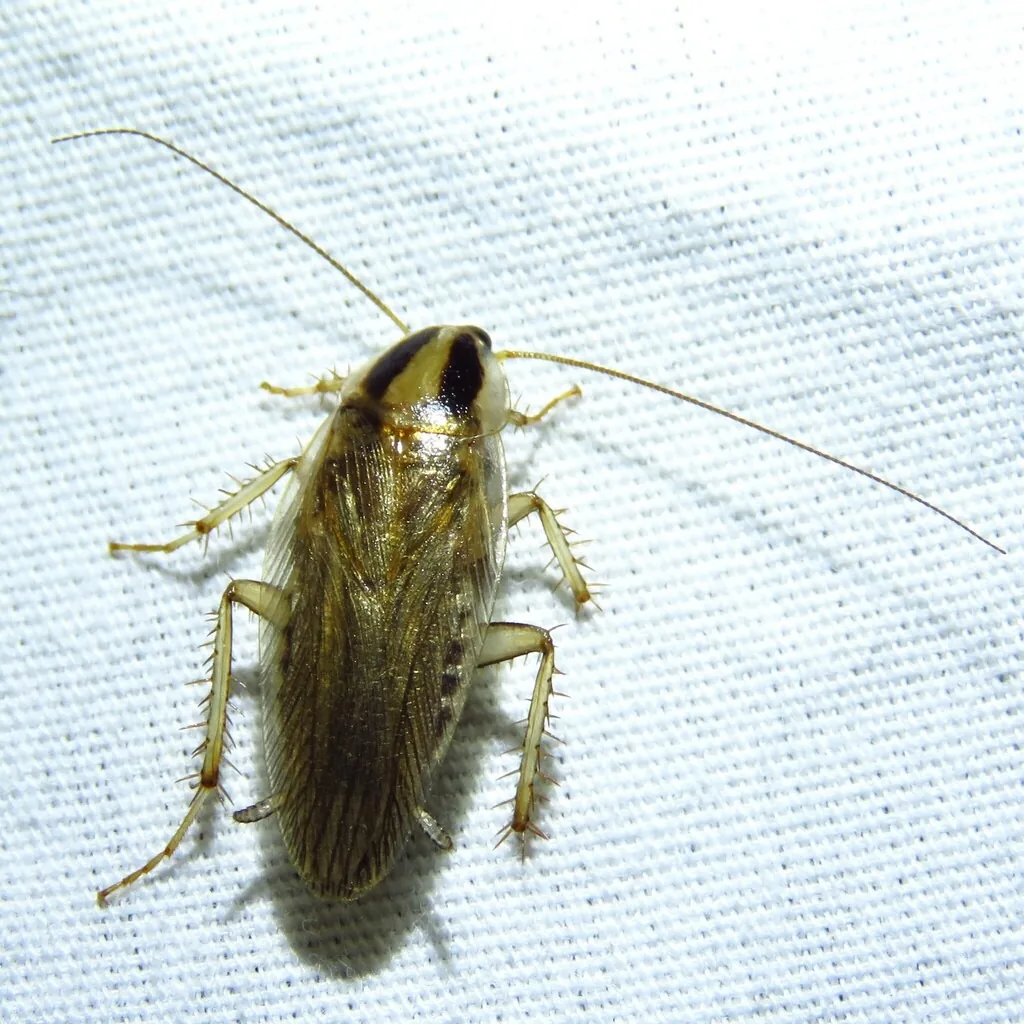
- Adults are about 1/2 inch long and gray to olive brown, only slightly smaller than a German cockroach. UF/IFAS gives 3/8 to 1/2 inch, light brown to tan with an olive green tint.[1][2][3]
- Like the German cockroach, it has two dark lengthwise stripes on the shield behind the head; on the field cockroach they are very dark and sharply defined.[1][2]
- The best field mark is a blackish-brown stripe on the face, running from the mouthparts up between the eyes, which German cockroaches lack. UF/IFAS describes it as a broad, dark brown to black band on the face between the eyes.[1][2][3]
- Young nymphs are yellowish cream; older nymphs darken but stay lighter than German cockroach nymphs.[3]
Look-alikes
| Look-alike | How to tell them apart |
|---|---|
| German cockroach | Lives mainly indoors and avoids light, while the field cockroach lives outdoors, is more likely to be seen in daytime and around lights, and has a dark stripe on the face between the eyes. Jeon and colleagues add that the German cockroach does not fly and is almost exclusively an indoor pest of homes, apartments and food preparation areas.[1][2][4] |
| Asian cockroach | Similar in length, with the same pair of dark stripes behind the head, and like the field cockroach it lives outdoors and flies to lights. UF/IFAS notes that the field cockroach has a broad dark band on the face between the eyes.[4][3] |
Where it lives
Probably Asian in origin, it was discovered in Arizona in 1933 (UC Riverside). UC IPM says it is most common in southern California and desert areas; UC Riverside adds irrigated fields and yards in Arizona and Texas, sometimes far out in the desert, and a severe infestation at Oroville in northern California in 1967. GBIF holds 400 U.S. records since 1990, the most from Texas (211), California (109), Arizona (31) and New Mexico (26), with single records from Alabama and Ohio. UF/IFAS says it is native to south Asia and found across the southwestern U.S. to Louisiana. Jeon and colleagues say it was described in 1935 from specimens collected in 1933, that its spread appears to follow interstate highways such as I-10, and they report the first Alabama record, from Mobile, collected in 2016.[2][1][5][3][4]
Biology and life cycle
Females carry the egg case until it is about to hatch; each case usually holds 30 to 40 young.[1]
Females lay fewer eggs than German cockroaches. In a lab study cited by UC Riverside, egg cases held an average of 28 eggs (19 hatched), against 37 for the German cockroach, and after the third egg case the number of eggs dropped until the eighth held only 10 percent as many as the first three. UF/IFAS says a female produces about five egg cases in her lifetime; the first three hold 28 eggs each and later ones far fewer.[2][3]
Females carry each egg case until it is ready to hatch, and development from newly hatched nymph to adult can take about 3 months.[1]
Unlike the German cockroach, it is not repelled by light: it is more likely to be seen in daytime and gathers in the evening around street lights and lit display windows.[2]
UF/IFAS gives about 70 days from egg to adult, through five to seven molts, and an adult life of about 100 to 150 days.[3]
Adults of both sexes fly readily in daylight, usually in short flights of 0.5 to 5 m that change direction each time. It resists drying out and avoids extreme heat, dryness and cold by burrowing into the ground or other material.[4]
Damage and signs
- It feeds outdoors on decaying vegetation and is mainly a nuisance, though during dry seasons it may invade houses in large numbers. UF/IFAS adds that populations may build up in irrigated garden or vegetable areas.[2][1][3]
- UC Riverside records a Texas case where a pest control operator treating a house for German cockroaches failed until the insects were identified as field cockroaches; spraying the yard, the real source, brought control.[2]
Health risk
The field cockroach mostly lives outdoors, and none of these sources reports a health problem tied to it specifically. Cockroach allergen indoors is a known asthma trigger: in a U.S. study of 476 inner-city children with asthma, those both allergic to cockroach allergen and exposed to high levels of it in bedroom dust had more hospitalizations, unscheduled medical visits and days of wheezing. That study measured a German cockroach allergen.[1][6]
Control
Prevention
Identify the species first; knowing which cockroach you have and where it hides tells you where to focus control.[1]
Keep them out
When roaches are coming in from outside, seal cracks and openings and add door sweeps and weather stripping to doors and windows.[1]
Sanitation
Trim shrubbery near the house, thin dense ground covers, and clear trash, lumber and firewood stacks that give outdoor roaches shelter.[1]
A strip of gravel 6 to 12 inches wide around the foundation keeps the area drier and less inviting to outdoor cockroaches.[1]
UC Riverside notes that field cockroach infestations have been eliminated by removing decomposing plant material from around house foundations.[2]
Pesticides
Outdoors, place baits or bait stations around the building perimeter, in meter boxes, wood piles and planters.[1]
Indoor insecticide treatment is warranted only for an established infestation, not for an occasional roach that wandered in.[1]
Where sources disagree
Family: GBIF places the field cockroach in the family Ectobiidae, while iNaturalist, the ITIS database and UC Riverside's Urban Entomology list it under Blattellidae. Jeon and colleagues (2018) also use Ectobiidae.[7][8][9][2][4]
Eggs per egg case: UC IPM says each egg case usually holds 30 to 40 young, while a lab study cited by UC Riverside found an average of 28 eggs per case, of which 19 hatched.[1][2]
Time to adulthood: UF/IFAS gives about 70 days from egg to adult, while UC IPM says development from newly hatched nymph to adult can take about 3 months.[3][1]
Origin: UC Riverside says it is probably Asian, UF/IFAS says south Asia, and Jeon and colleagues say central Asia, including Afghanistan, India, Iran, Pakistan and Sri Lanka.[2][3][4]
Size and color: UC IPM and UC Riverside give about 1/2 inch and gray to olive brown; UF/IFAS gives 3/8 to 1/2 inch and light brown to tan with an olive green tint.[1][2][3]
Common questions
- How can I tell a field cockroach from a German cockroach?
- Look at the face. Field cockroaches have a dark stripe between the eyes and an olive tint, and they are usually found outdoors or near lights, including in daytime.[1][2]
- Will field cockroaches infest my kitchen?
- They live and breed outdoors in leaf litter and plant debris, and mostly come inside when it is hot or dry outside.[1][2]
- Where are field cockroaches found?
- Mostly in the Southwest: UC IPM names southern California and desert areas, UC Riverside adds Arizona and Texas, and GBIF has a few records from farther east, including Alabama. Jeon and colleagues reported the first Alabama record, from Mobile.[1][2][5][4]
- Will field cockroaches spread to the Southeast?
- Researchers expect so. Jeon and colleagues suggest it will spread to Florida and possibly into Georgia and South Carolina, perhaps by flying onto vehicles or riding in potted plants, sod or other freight along interstate highways.[4]
Sources
- University of California Statewide IPM Program, “Pest Notes: Cockroaches, Publication 7467 (revised December 2019).” ipm.ucanr.edu/legacy_assets/PDF/PESTNOTES/pncockroaches.pdf (accessed 2026-11-14)
- University of California, Riverside, Department of Entomology, “Urban Entomology, Chapter 6: Pests On or Near Food (Walter Ebeling).” entomology.ucr.edu/ebelingchapter6 (accessed 2026-11-14)
- University of Florida/IFAS, Department of Entomology and Nematology, “Field cockroach, Blattella vaga (UF/IFAS Cockroach Photographs CD-ROM).” entnemdept.ufl.edu/projex/gallery/dl/cockroaches/text/field_cockroach.htm (accessed 2026-11-14)
- Florida Entomological Society (journals.flvc.org), “First record of Blattella vaga (Blattodea: Ectobiidae) from southern Alabama (S. A. Jeon, R. R. Balusu, L. Zhang, H. Y. Fadamiro and A. G. Appel), Florida Entomologist 101(1), 2018.” journals.flvc.org/flaent/article/view/105203 (accessed 2026-11-14)
- Global Biodiversity Information Facility (GBIF), “Blattella vaga: U.S. occurrence records since 1990 by state (GBIF occurrence search).” api.gbif.org/v1/occurrence/search?taxonKey=1997229&country=US&hasGeospatialIssue=false&occurrenceStatus=PRESENT&year=1990%2C2026&facet=stateProvince&facetLimit=400&limit=0 (accessed 2026-11-14)
- N Engl J Med 1997;336(19):1356-1363, via PubMed, “The role of cockroach allergy and exposure to cockroach allergen in causing morbidity among inner-city children with asthma.” pubmed.ncbi.nlm.nih.gov/9134876/ (accessed 2026-11-14)
- Global Biodiversity Information Facility (GBIF), “Blattella vaga Hebard, 1935 (GBIF Backbone Taxonomy).” api.gbif.org/v1/species/1997229 (accessed 2026-11-14)
- iNaturalist, “Blattella vaga taxon page (order and family).” www.inaturalist.org/taxa/466559 (accessed 2026-11-14)
- Integrated Taxonomic Information System (ITIS), “Blattella vaga Hebard, 1935, TSN 666696.” www.itis.gov/servlet/SingleRpt/SingleRpt?search_topic=TSN&search_value=666696 (accessed 2026-11-14)