On this page
How to identify it
- Workers are rust to dark brown and vary from 1/16 to 1/2 inch long; the queen is about 3/4 inch.[1]
- Workers have three pairs of prominent spines on the thorax and one pair on the back of the head.[1]
- Colonies show many crater-shaped mounds, 5 to 14 inches tall and up to 1.5 feet across, each with a central entrance hole.[1]
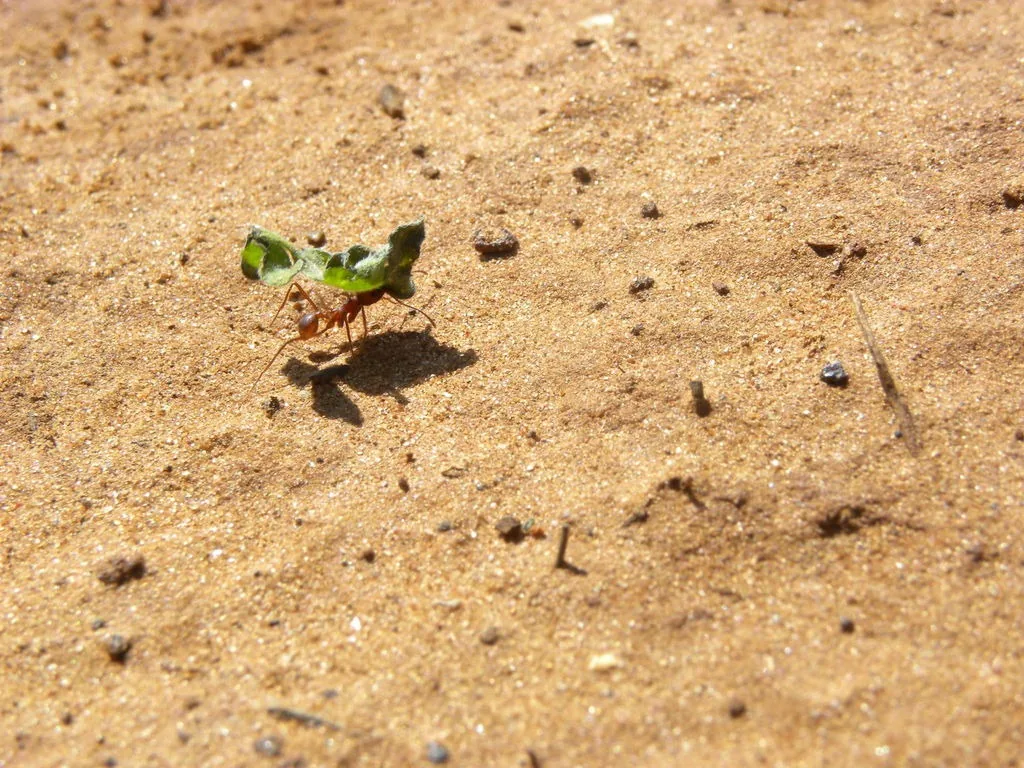
- Workers carry leaf pieces over their heads like parasols along clear trails, often littered with leaf fragments.[1]
Look-alikes
| Look-alike | How to tell them apart |
|---|---|
| Red harvester ant | Texas A&M says leafcutter workers can be told from other ants by their three pairs of prominent spines on the thorax and one pair on the back of the head, and by the leaf pieces they carry over their heads.[1] |
Where it lives
Known from 129 Texas counties and 13 Louisiana parishes, plus northeastern Mexico, and generally confined to deep, well-drained sandy or loamy soils.[2][1]
Biology and life cycle
Winged males and females fly on clear, moonless nights. Texas A&M AgriLife gives April, May and June; the Texas A&M Forest Service says flights follow a rain of at least 1/4 inch, mainly in May and June.[1][2]
Before her mating flight, a new queen stores a small wad of the fungus garden in a cavity in her mouth; after digging her first chamber she spits it out and starts a new garden for her first brood.[1]
Nest chambers lie deep underground: 15 to 20 feet according to Texas A&M AgriLife, and as deep as 25 feet according to the Texas A&M Forest Service. Workers may travel 600 feet or more to reach a suitable plant.[1][2]
In summer the ants forage almost entirely at night, coming out at dusk once temperatures drop below 86 degrees F; the rest of the year they forage by day when air temperatures run from 45 to 80 degrees F.[1][2]
The ants don't eat leaves; the fungus they grow on the cut leaves is their only known food.[1]
Fun fact: it is the northernmost of the fungus-farming leafcutter ants, and it grows two main types of fungus.[5]
Another fun fact: a tiny cockroach, Attaphila fungicola, lives inside Texas leafcutter nests. It hitches rides on winged queens during mating flights and also rides the leaf pieces foragers carry home to get into established colonies.[4]
Damage and signs
- Workers strip leaves and buds from many plants, including peach and plum trees, blackberries, ornamentals, grasses and crops; small to medium trees can be stripped in one night.[1]
- In winter, when other green plants are scarce, they kill pine seedlings in East Texas and west-central Louisiana.[2][1]
- Where the ants are abundant in East Texas pine country, it is almost impossible to establish natural pine reproduction, and the ants strip seedlings completely of foliage.[1][2]
Health risk
Texas A&M AgriLife and the Texas A&M Forest Service describe it as a pest of plants and pine seedlings; neither lists it as a health threat to people or pets.[1][2]
Control
Prevention
Colonies are easiest to find in late fall and early winter, when the ants are active and the mounds aren't hidden by vegetation.[2]
Pesticides
Powder or granular contact insecticides such as acephate (Orthene), carbaryl (Sevin) or permethrin protect plants only temporarily, must be reapplied often, and don't eliminate the underground colony.[1][2]
Most ant baits, including those labeled for fire ants, don't work because the ants feed only on their fungus.[1]
A special hydramethylnon bait, Amdro Ant Block, is the product Texas A&M names for leafcutter ants. Texas A&M Forest Service tests found it about 30% effective at eliminating colonies with a single application, so follow-up applications may be needed.[1][2]
Acephate dusts or ant mound granules applied to all nest openings by label directions can help, but large, established colonies are hard to eliminate completely.[1]
Where sources disagree
Nest depth: Texas A&M AgriLife says chambers may reach 15 to 20 feet deep; the Texas A&M Forest Service says as deep as 25 feet.[1][2]
Flight season: Texas A&M AgriLife gives April, May and June; the Texas A&M Forest Service says mainly May and June, after a rain.[1][2]
Common questions
- Why didn't my ant bait work on leafcutter ants?
- Leafcutter ants eat only the fungus they grow, so they ignore most ant baits made for other species.[1]
- What are the big winged ants flying on spring nights in Texas?
- They may be Texas leafcutter ant queens and males on their mating flights, which happen on clear, moonless nights in spring, often after rain. Females have larger heads than males.[1][2]
- When is the best time to treat leafcutter ants?
- The Texas A&M Forest Service says colonies are easiest to locate in late fall and early winter, and the first sign that a bait is working is less foraging and digging, usually within 5 - 7 days.[2]
Sources
- Texas AgriLife Extension Service, “Texas Leaf Cutting Ant, House and Garden Series Ent-1029 (revised August 30, 2006).” williamson.agrilife.org/files/2011/07/Texas_Leaf_Cutting_Ants_10.pdf (accessed 2026-11-12)
- Texas A&M Forest Service, “Texas Leaf-Cutting Ant.” montgomery.agrilife.org/files/2015/02/Texas-AM-Forest-Service-TX-Leaf-Cutter.pdf (accessed 2026-11-12)
- iNaturalist, “Atta texana taxon page (order and family).” www.inaturalist.org/taxa/151794 (accessed 2026-11-12)
- The American Naturalist (2021), via PubMed, “Emigrating Together but Not Establishing Together: A Cockroach Rides Ants and Leaves.” pubmed.ncbi.nlm.nih.gov/33417528/ (accessed 2026-11-12). Cited from the PubMed abstract.
- Molecular Ecology (2019), via PubMed, “Landscape genomics of an obligate mutualism: Concordant and discordant population structures between the leafcutter ant Atta texana and its two main fungal symbiont types.” pubmed.ncbi.nlm.nih.gov/31141257/ (accessed 2026-11-12). Cited from the PubMed abstract.