On this page
How to identify it
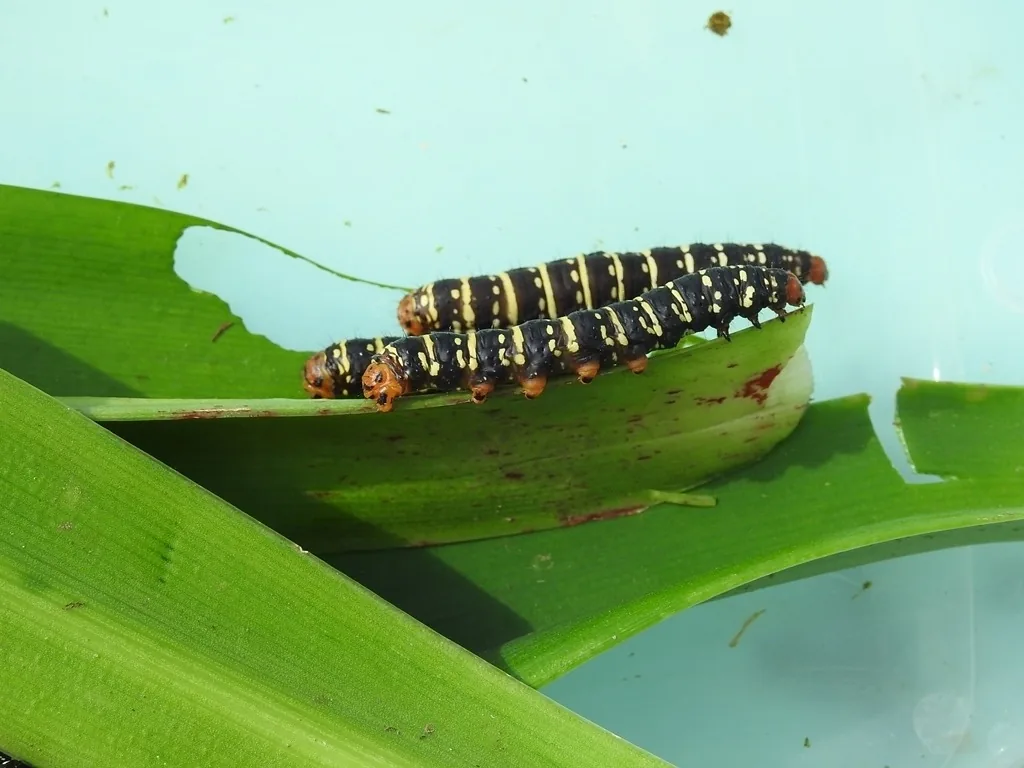
- Caterpillars are black with cream-white or yellowish-white bands and an orange head, prolegs and rear end. Two eye-like black spots on both the head and the rear make the back end look much like the head. UF/IFAS adds that each body segment also has a cream-white patch on top and on the side near each band.[2][1][3]
- Mature caterpillars are about 2 inches long; the Florida circular gives up to 5 cm. UF/IFAS describes the pupa as almost black and the eggs as rounded, somewhat flattened and yellowish.[1][2][3]
- The moth is pink and black, with orange markings running through the black on the forewings, a black body and gray hind wings. Some are whiter than pink. UF/IFAS says adults look much the same throughout their range, from North America to the American tropics.[1][2][3]
Look-alikes
| Look-alike | How to tell them apart |
|---|---|
| Lily borer (Brithys crini) | UF/IFAS says spotted caterpillar forms of the Spanish moth look like the lily borer of Europe and the Old World tropics, but only the banded form of the Spanish moth occurs in North America.[3] |
Where it lives
Southeastern US from the Carolinas to Texas, straying north along the Atlantic coast as far as coastal New York and inland to Kentucky and Arkansas, and through lowland Central and South America and the Caribbean. UF/IFAS adds that it was first described from Suriname, reaches as far south as northern Argentina, and occurs in all of Florida.[2][4][3]
Biology and life cycle
In Florida the moths fly from January to early June and from September to December, with nearly continuous generations in the far south. One generation takes about 46 days, so up to six a year are possible there; Mississippi State notes several generations a year.[2][1]
Females lay several hundred eggs in clusters, usually under the leaves. Because eggs are laid in masses, one plant may carry dozens of caterpillars while nearby plants are untouched.[2][1]
Caterpillars pass through six stages in about 17 days of feeding, then pupate in loose soil; the pupa stage lasts about 19 days. UF/IFAS says hatching takes about eight days under good conditions, and adults live about eight to 10 days, including two to three days of flight and mating.[2][3]
Hosts are mainly the amaryllis family, including amaryllis, spider lily, clivia, rain lily and narcissus (daffodil), plus iris and lilies such as crinum. UF/IFAS lists amaryllis-family hosts including Clivia, Cooperia, Eucharis, Haemanthus, Hippeastrum, Hymenocallis, Narcissus, Pancratium, Polianthes and Zephyranthes, plus Iris, Crinum, Leucojum and Lilium; Xanthosoma and calla (Zantedeschia) are rare alternate hosts, and reports of Ficus and Hibiscus are probably wrong.[2][1][3]
Damage and signs
- Caterpillars chew in groups on leaves, bulbs and rhizomes. Heavy infestations can strip isolated plantings, and when the leaves run out they feed on exposed parts of the bulbs. UF/IFAS says numbers of caterpillars can damage lily leaves in a short time.[2][1][3]
- Mississippi State calls it a rather uncommon pest.[1]
Health risk
It feeds on plants; none of the sources describes any harm to people or pets.[1][2]
Control
Prevention
Look over amaryllis and lily plantings often. By the time most people notice the caterpillars they are nearly full size and have already eaten a lot of leaf. UF/IFAS says looking for caterpillars on the plants early in spring, while the plants are small, is the best way to check, and a blacklight shows when adult moths are flying; once moths turn up, search for eggs and caterpillars.[1][3]
Biological control
The Florida circular notes a tachinid fly parasitoid, and a new tachinid species, Lespesia melloi, was described in 2014 from Spanish moth caterpillars feeding on amaryllis in Brazil. UF/IFAS also notes an ectoparasitic nematode reported on the caterpillars in French Guiana.[2][4][3]
Pesticides
A bacterial insecticide spray controls the caterpillars; other insecticides act faster. Mississippi State suggests a fast-acting pyrethroid such as permethrin, bifenthrin or zeta-cypermethrin to stop further damage. Follow the label. UF/IFAS names the bacterial spray as Bt (Bacillus thuringiensis).[2][1][3]
Where sources disagree
The name: the Florida circular treats it as Xanthopastis timais and says the population here can be called X. timais regnatrix; Mississippi State lists the species as Xanthopastis regnatrix. iNaturalist groups them as the X. timais complex.[2][1][5]
Generation time: the Florida circular gives a total generation time of about 46 days, while UF/IFAS gives seven to eight weeks; both allow up to six generations a year.[2][3]
Common questions
- What are the black and white striped caterpillars eating my amaryllis?
- Most likely Spanish moth caterpillars, also called convict caterpillars: few other caterpillars feed on amaryllis or have those black and white stripes.[1][2]
- How do I control convict caterpillars?
- Check plants often, because the caterpillars are usually nearly full grown by the time they're noticed. A bacterial insecticide spray works, and a fast-acting pyrethroid labeled for ornamentals stops the damage sooner.[1][2]
- How many generations does the Spanish moth have?
- UF/IFAS says a generation takes seven to eight weeks, allowing up to six a year. In Florida moths fly from January to early June and September to December, with nearly continuous generations in the far south.[3]
Sources
- Mississippi State University Extension, “Spanish Moth, Vol. 6, No. 18.” extension.msstate.edu/newsletters/bugs-eye-view/2020/spanish-moth-vol-6-no-18 (accessed 2026-11-14)
- Florida Department of Agriculture and Consumer Services, Division of Plant Industry (via the Florida State Collection of Arthropods), “Spanish Moth, Xanthopastis timais: A Pest of Amaryllis and Other Lilies (Entomology Circular No. 401, J. B. Heppner, 2000).” thefsca.org/publications/circulars/spanish-moth-xanthopastis-timais/ (accessed 2026-11-14)
- University of Florida/IFAS Extension (Featured Creatures), “Spanish Moth or Convict Caterpillar, Xanthopastis timais (Cramer), EENY-271/IN550.” ask.ifas.ufl.edu/publication/IN550 (accessed 2026-11-14)
- Journal of Insect Science, via PubMed, “Lespesia melloi sp. nov. (Diptera: Tachinidae) from Brazil, a parasitoid of Xanthopastis timais (Gil-Santana et al. 2014).” pubmed.ncbi.nlm.nih.gov/25368065/ (accessed 2026-11-14)
- iNaturalist, “Xanthopastis timais taxon page (order and family).” www.inaturalist.org/taxa/1071140 (accessed 2026-11-14)