On this page
How to identify it
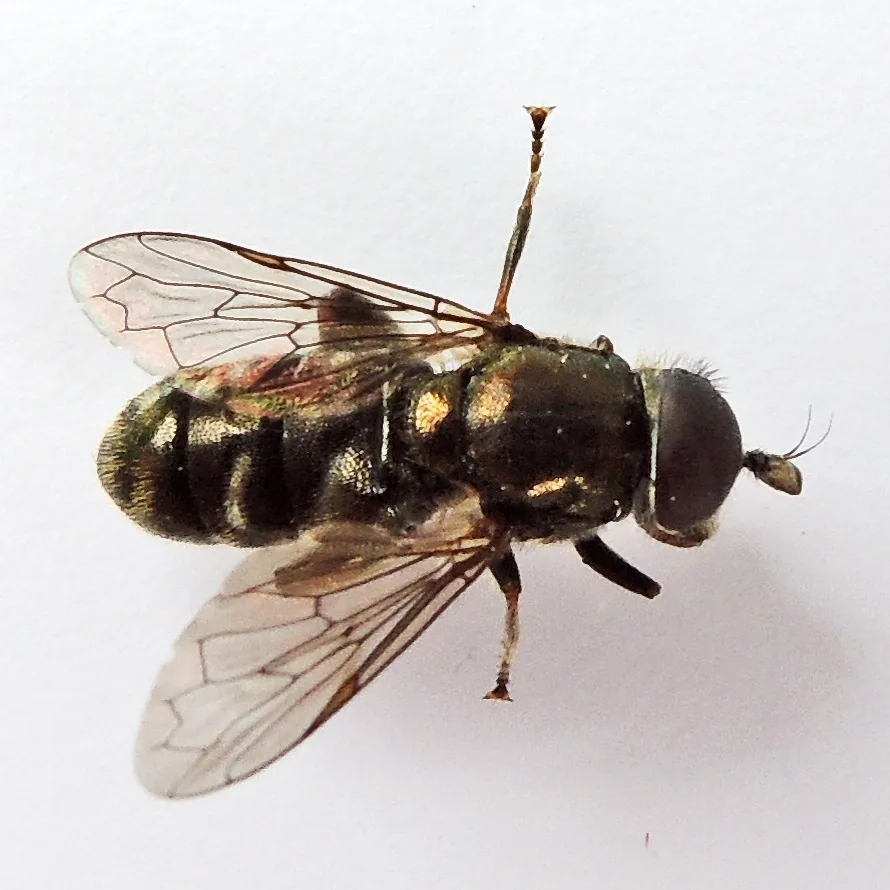
- Adults are stocky, hairy flies, blackish to dark green or variably colored with black, orange and yellow, that look like small bumble bees. The large narcissus bulb fly is about 1/2 inch long according to PNW and Colorado State; the RHS says about 15 mm.[1][2][4][3]
- Larvae are plump, wrinkled, dirty white to brownish maggots with a short dark breathing tube at the rear. A large narcissus bulb fly larva grows to about 3/4 inch, usually one to a bulb. Lesser bulb fly maggots are smaller, up to about 6 mm per the RHS, and several may share one rotting bulb.[1][4][6][3]
- Adults hover around blooming plants on warm, sunny days, feeding on pollen and nectar.[1]
Look-alikes
| Look-alike | How to tell them apart |
|---|---|
| Bumble bees and other beneficials | Adult bulb flies resemble small bumble bees and some beneficial flies, but like all flies they have only one pair of wings.[1][3] |
Where it lives
The large narcissus bulb fly reaches new areas in infested bulbs and spreads slowly from there, so it turns up in spots (Colorado State); in Britain it became established in the late 1800s. Besides daffodils, PNW lists amaryllis, Galtonia, hyacinth, iris, lily, Leucojum, Scilla, tulip and Vallota as hosts.[2][3][4]
Biology and life cycle
Females lay eggs singly near the base of plants, in soil cracks, on the bulb neck or on exposed bulbs. Sources give different windows: spring or summer (UC IPM), May or early June (PNW), mid-May to June (RHS). Eggs hatch in 5 to 14 days per UC IPM, or about 8 to 10 days per Colorado State, and one female may lay as many as 100.[1][4][3][2]
The larva enters through the basal plate, eats out the center of the bulb including next year's flower bud, and spends the winter full grown inside. In spring it pupates in the bulb or in nearby soil, and adults live about 2 to 3 weeks. The large narcissus bulb fly has one generation a year.[1][3][2][6]
The Connecticut Agricultural Experiment Station says the lesser bulb fly Eumerus tuberculatus is believed to have two generations a year, and as many as 77 of its larvae have been found in a single bulb.[6]
Damage and signs
- Infested bulbs yield yellow, stunted plants, rings of small leaves, and blooms or small bulbs that die.[1]
- The large narcissus bulb fly attacks healthy bulbs. Lesser bulb flies are mostly secondary pests that move into bulbs already damaged by disease, decay, other animals or injury, though their tunneling can still destroy the bulb.[1][3][2]
- By the time anything looks wrong, the bulb has often rotted completely. The RHS notes bulb flies are only one of several reasons daffodils stop flowering, so don't confuse them with daffodil blindness.[3]
Health risk
No cited source describes any risk to people or pets. The adults are hoverflies that visit flowers, and the RHS notes that adult hoverflies are pollinators.[1][3]
Control
Prevention
Buy and plant only firm, healthy bulbs and handle them carefully to avoid injury; soft bulbs may already be infested.[1][4][5][3]
Plant in open, windy or shaded spots, since bulb flies prefer warm, sheltered places. PNW adds that deep planting, about 10 inches, helps bulbs escape the fly.[3][4][5]
Keep them out
Keep egg-laying females off: after flowering, firm the soil around the plants, or cover them with insect-proof mesh or row cover while females are laying (mid-May to June, per the RHS).[3][4]
Sanitation
Dig up and destroy infested bulbs and stunted plants as soon as you find them, before the larvae leave to pupate in the soil.[1][3][6][5]
The Connecticut Agricultural Experiment Station suggests hot-water treatment of dug bulbs as a help.[6]
Pesticides
PNW and WSU list no chemical controls for home use. Colorado State says the insecticides once used against narcissus bulb fly have all been removed from the market and that no recent research has tested current products against it.[4][5][2]
Large and small bulb flies
The RHS names three species in bulbs: the large narcissus bulb fly, Merodon equestris, and the small bulb flies Eumerus strigatus and E. funeralis. Colorado State and the Connecticut station also describe E. tuberculatus.[3][2][6]
The large fly is a bumble bee mimic that usually rests on foliage and sometimes visits flowers for nectar. Colorado State says adults appear in late April or early May and are present through June; the RHS gives mid-May to June.[2][3]
Colorado State says pupation in spring takes place about an inch below the soil surface and lasts about a month; UC IPM gives 4 to 8 weeks.[2][1]
Common questions
- Why did my daffodils come up as a ring of small leaves?
- A bulb fly larva may have killed the central growing point. Infested bulbs often send up only a few grass-like leaves and no flowers.[1][3][4]
- Are the fuzzy flies at my flowers bees?
- Some may be bulb flies, which look like small bumble bees.[1]
- Should I spray for bulb flies?
- Extension sources don't recommend it. PNW and WSU list no chemical controls, and Colorado State says the older bulb fly insecticides are off the market. Rely on clean bulbs, site choice and removing infested plants.[4][5][2]
Sources
- University of California Statewide IPM Program, “Bulb Flies (Pests in Gardens and Landscapes).” ipm.ucanr.edu/PMG/GARDEN/FLOWERS/INVERT/bulbfly.html (accessed 2026-11-13)
- Colorado State University Extension, Department of Agricultural Biology, “Colorado Insect of Interest: Narcissus Bulb Fly (2020).” webdoc.agsci.colostate.edu/bspm/InsectInformation/FactSheets/Narcissus%20Bulb%20Fly%202020.pdf (accessed 2026-11-13)
- Royal Horticultural Society, “Narcissus bulb fly (RHS Advice).” www.rhs.org.uk/biodiversity/narcissus-bulb-fly (accessed 2026-11-13)
- Pacific Northwest Pest Management Handbooks (OSU, WSU, U of Idaho Extension), “Narcissus (Narcissus)-Narcissus bulb fly, PNW Insect Management Handbook.” pnwhandbooks.org/insect/hort/nursery/hosts-nursery/narcissus-narcissus-narcissus-bulb-fly-0 (accessed 2026-11-13)
- Washington State University Extension, “Narcissus (Daffodil): Narcissus bulb fly (HortSense).” hortsense.cahnrs.wsu.edu/fact-sheet/narcissus-daffodil-narcissus-bulb-fly/ (accessed 2026-11-13)
- Connecticut Agricultural Experiment Station, “Plant Pest Handbook: Bulbs.” portal.ct.gov/caes/plant-pest-handbook/pphb/bulbs (accessed 2026-11-13)
- Global Biodiversity Information Facility (GBIF), “Merodon equestris (Fabricius, 1794) (GBIF Backbone Taxonomy).” api.gbif.org/v1/species/1544340 (accessed 2026-11-13)
- Global Biodiversity Information Facility (GBIF), “Eumerus funeralis Meigen, 1822 (GBIF Backbone Taxonomy).” api.gbif.org/v1/species/7198254 (accessed 2026-11-13)