On this page
How to identify it
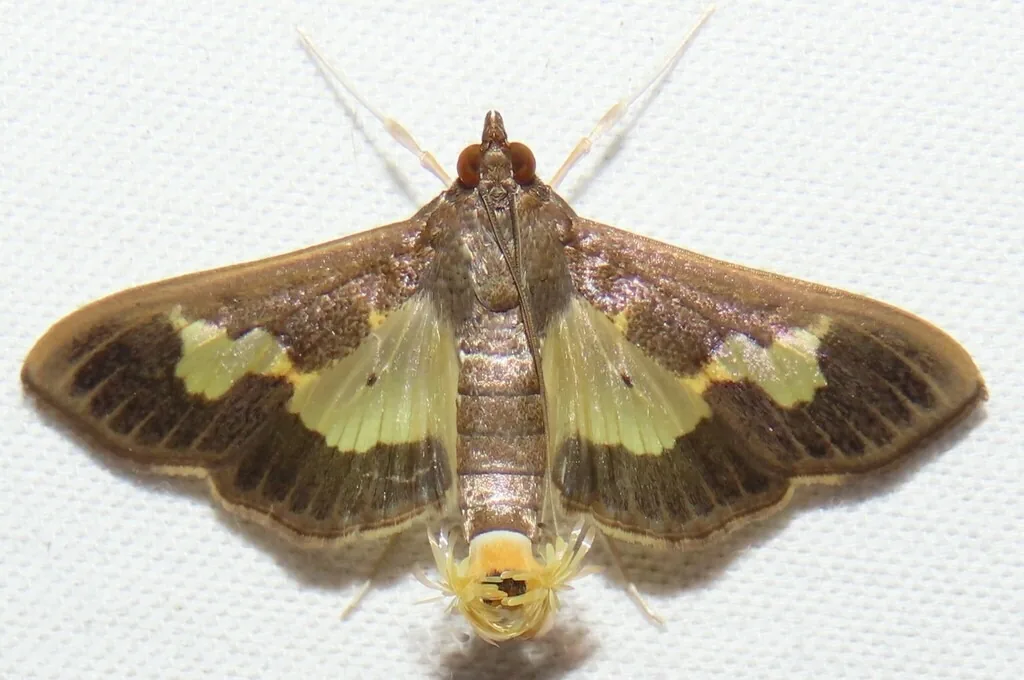
- The moth has wide, triangular wings about 1 inch across, mostly iridescent brown with a central band of see-through yellow, and a brush-like tuft at the tip of the abdomen at rest.[2]
- Young larvae are thin and white with many small black spots; older larvae are plump, lose the spots, and range from off-white to green, yellow or orange depending on food.[2]
- Eggs are tiny and laid on new leaf buds, flowers and shoots; they hatch in 3 to 4 days.[2]
- Moths rest by day and fly at night, peaking about 3 to 5 hours after sundown.[2]
Look-alikes
Where it lives
A tropical insect that can't tolerate cold, it overwinters in the U.S. only in south and central Florida and southern Texas. Moths move north each spring and summer, reaching the Carolinas and sometimes Oklahoma and Nebraska. GBIF has about 550 U.S. records since 1990 from 20 states, the most from North Carolina (105), Alabama (85), Georgia (75) and Florida (67), plus records from Hawaii and from Mexico, Central and South America.[2][6]
Biology and life cycle
It can have up to four generations a season. Moths usually take one or two months to reach the Carolinas, so north of the overwintering areas infestations usually start in late June or early July, and farther north not until August or September.[2]
Larvae feed first in blossoms and growing tips, then bore into fruit when about half grown, preferring young fruit before the rind hardens. They usually pupate in a folded leaf, often dead, dry leaf material.[2][1]
In greenhouse tests with whole plants, females laid a higher share of their eggs on squash than on cantaloupe or watermelon and few on bean; newly hatched larvae survived 24 to 64 hours without food and showed no preference among squash, cantaloupe and watermelon.[4][3]
Damage and signs
- Summer squash is the favorite host, and cucumber and cantaloupe are also damaged. Varieties of Cucurbita maxima and C. moschata resist it better than C. pepo, so winter squash and gourds are rarely damaged and pumpkin varies.[2][1]
- Larvae hollow out large cavities inside the fruit, and the entry hole is often marked by a pile of white frass. Once a pickleworm bores in, the fruit soon rots and can't be sold.[1][2]
Health risk
It feeds on cucurbit plants, and no cited source describes any risk to people or pets.[2][1]
Control
Prevention
Plant squash and other susceptible crops early so they are harvested before pickleworms arrive; early-season crops usually escape injury.[2]
Keep them out
Put floating row covers on right after planting. Once plants flower, either remove them for good or take them off during the day for bee pollination and replace them in the late afternoon, since the moths lay eggs at night.[2]
Sanitation
Remove and destroy infested vines and fruit after harvest, and clear wild cucurbit weeds such as creeping cucumber nearby, since some larvae can overwinter in plant material in mild winters.[2]
Traps and physical control
Check flower buds for small caterpillars before they bore into fruit. Squash planted as a border can serve as a trap crop and an early warning; eOrganic notes that Smith (1911) recommended destroying the squash blossoms periodically so larvae don't move to nearby cantaloupes, and in a 2016 greenhouse study females laid a higher share of their eggs on squash than on cantaloupe or watermelon.[2][4]
Pesticides
Bt (Bacillus thuringiensis var. kurstaki) must be eaten to work, so start sprays when the first buds or flowers appear or when larvae are first seen, with good coverage; once larvae are inside fruit they are protected.[2]
More from Clemson Extension
Larvae feed and develop inside the fruit, hollowing out large cavities before leaving to pupate in folded leaf tissue; once they bore in, the fruit can't be sold.[1]
Where the sources disagree
Where females lay eggs: in a 2016 study, females offered single leaves in the laboratory laid a higher proportion of eggs on cantaloupe, but given whole plants in the greenhouse they laid more on squash; eOrganic says squash, especially summer squash, is the preferred host.[4][2]
Watermelon: eOrganic says watermelon is not a preferred host, while the 2016 studies found females laid about as many eggs on watermelon as on cantaloupe and did not appear averse to it, and newly hatched larvae showed no preference among squash, cantaloupe and watermelon.[2][4][3]
Cantaloupe: eOrganic says pickleworm may damage cantaloupe, yet in the same article says muskmelon is rarely damaged; Clemson lists cantaloupe among the crops it tunnels into.[2][1]
Natural enemies: eOrganic reports that one author found none of pickleworm's many natural enemies can reliably suppress damage, while another says natural enemies have a significant impact.[2]
Scientific name: the extension and research sources use Diaphania nitidalis, while the GBIF Backbone Taxonomy treats that name as a synonym of Cryptographis nitidalis Stoll.[2][3][5]
Common questions
- What's boring into my squash blossoms in late summer?
- In the Southeast, pickleworm larvae are a likely cause. Look for small caterpillars under the ring of stamens in squash flowers and holes with white frass in the fruit.[2][1]
- How can I avoid pickleworms?
- Plant early, use row covers and lift them only by day once plants flower, use squash as a trap crop, and clean up vines and fruit after harvest.[2]
- Why do pickleworms only show up in summer?
- They can't survive cold winters, so each year moths fly north from southern Florida and Texas and usually reach the Carolinas by late June or July.[2]
Sources
- Clemson Cooperative Extension, Home & Garden Information Center, “What Is It? Wednesday – Pickleworm.” hgic.clemson.edu/what-is-it-wednesday-pickleworm/ (accessed 2026-11-13)
- eOrganic (Extension Foundation), “Biology and Management of Pickleworm and Melonworm in Organic Cucurbit Production Systems (G. Zehnder, Clemson University).” eorganic.org/node/5320 (accessed 2026-11-13)
- Insects, via PubMed, “Leiner R, Spafford H (2016), Pickleworm (Diaphania nitidalis Cramer) neonate feeding preferences and the implications for a push-pull management system, Insects 7(3):32.” pubmed.ncbi.nlm.nih.gov/27399783/ (accessed 2026-11-13). Cited from the PubMed abstract.
- Environmental Entomology, via PubMed, “Leiner RC, Spafford H (2016), Oviposition preferences of pickleworm (Lepidoptera: Crambidae) in relation to a potential push-pull cropping management approach, Environmental Entomology 45(3):677-684.” pubmed.ncbi.nlm.nih.gov/27118111/ (accessed 2026-11-13). Cited from the PubMed abstract.
- Global Biodiversity Information Facility (GBIF), “Cryptographis nitidalis Stoll (accepted name in GBIF; Diaphania nitidalis is its synonym, key 7598372) (GBIF Backbone Taxonomy).” api.gbif.org/v1/species/1886123 (accessed 2026-11-13)
- Global Biodiversity Information Facility (GBIF), “Cryptographis nitidalis (Diaphania nitidalis): occurrence records, 1990-2026 (GBIF occurrence search).” api.gbif.org/v1/occurrence/search?taxonKey=1886123&hasGeospatialIssue=false&occurrenceStatus=PRESENT&year=1990%2C2026&facet=country&facetLimit=400&limit=0 (accessed 2026-11-13). Fetched 2026-11-13: 991 records worldwide, 549 U.S. from 20 states (NC 105, AL 85, GA 75, FL 67; HI 17); the state split uses the same query with country=US&facet=stateProvince. Records reported, not abundance.