On this page
How to identify it
- Newly hatched larvae lack color and turn pale green in the second instar. Older caterpillars are pale to dark green with two cream-white stripes down the back.[2][1]
- The caterpillars spin a silken shelter under the leaves, and leaves are often rolled or folded over where they pupate.[2][1]
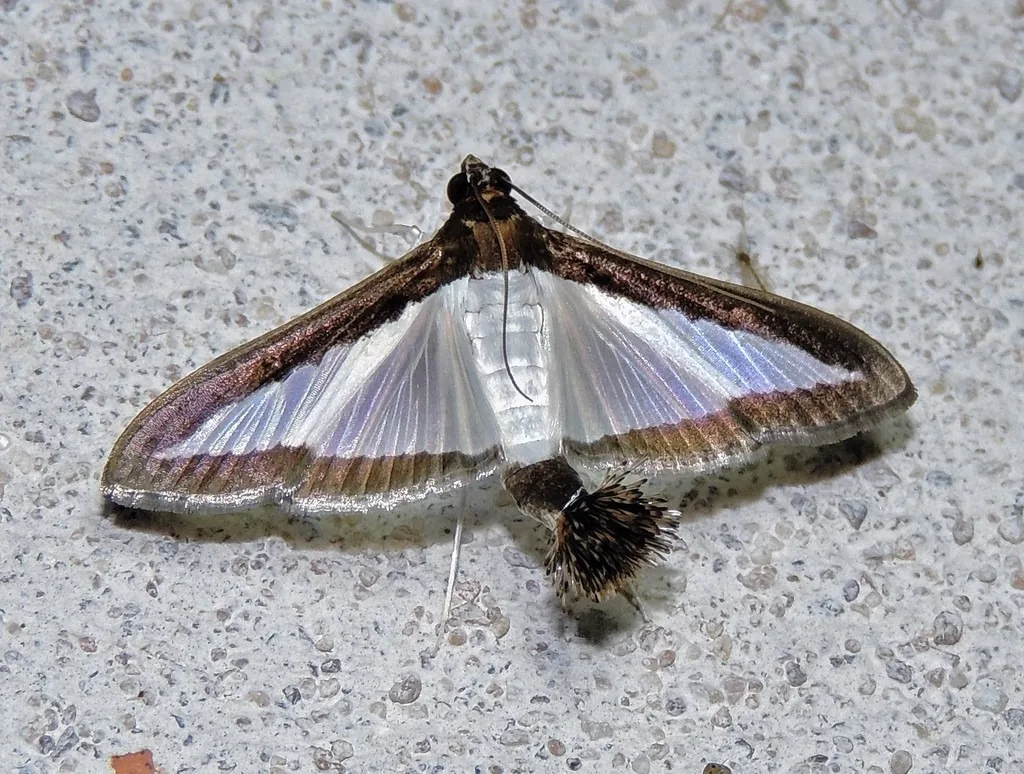
- The adult moth has a pearly white body and white, slightly iridescent wings with a broad dark brown border, plus brushy hair-pencils at the tip of the abdomen. Virginia Cooperative Extension describes a single large, translucent central marking across the front and hind wings.[1][2][4]
- Damaged leaves are left lace-like, with the veins intact.[2][1]
Where it lives
It is a tropical moth that can't take cold. In the United States it overwinters only in south and central Florida and southern Texas, and moths move north each year. Sources differ on how far (see where the sources disagree). GBIF holds about 1,500 U.S. records since 1990, most from Texas (982), then Florida, Louisiana, Oklahoma and Mississippi, with a scattering farther north; outside the U.S. most come from Mexico, Argentina, Martinique and Brazil.[2][1][5][6]
Biology and life cycle
Clemson says the moths lay small clusters of white to greenish eggs, usually on the undersides of leaves; eOrganic says eggs go on growing parts such as new leaf buds, flowers and shoots. Eggs hatch in 3 to 4 days. Larvae go through five instars, and the life cycle usually takes about 30 days.[1][2]
eOrganic says pickleworm and melonworm can have as many as four generations a season.[2]
It commonly infests summer and winter squash. Cucumber, gherkin and cantaloupe are attacked but not preferred, watermelon is a rare host, and pumpkin varies.[2]
Damage and signs
- Damage is mainly to foliage. Virginia Cooperative Extension says melonworm usually feeds on leaves rather than on buds, flowers and fruit. If the leaves run out, or on a less preferred host, larvae feed on the fruit surface, scarring melon rinds; growers sometimes call them rindworms. Sources differ on whether they bore into the fruit.[2][4]
- Melonworms also feed inside squash blossoms on the flower's reproductive parts and chew an exit hole when they leave to pupate. Pickleworms do the same, so the culprit can be hard to name, but the two are managed alike.[3]
- Populations are usually higher on fall-planted cucurbits than spring-planted ones.[1]
Health risk
It feeds only on cucurbit plants. Clemson, eOrganic and Virginia Cooperative Extension describe it only as a crop pest; none of them mentions bites, stings or any effect on people or pets.[1][2][4]
Control
Prevention
Plant early: spring-planted cucurbits escape most melonworm damage, and fall plantings need careful scouting.[1][2]
Keep them out
Floating row covers put on right after planting keep the moths from laying eggs. They must come off for bees once plants flower; removing them for good at flowering still prevents the early-season infestation that matters most for melonworm.[2]
Sanitation
After harvest, remove and destroy infested vines and fruit, where immature stages can survive warm winters, and clear wild cucurbit weeds such as creeping cucumber near the garden.[2]
Biological control
Parasitic wasps, tachinid flies, ground beetles and soldier beetles attack melonworms, so Clemson advises against broad-spectrum sprays such as pyrethroids and neonicotinoids and suggests spinosad instead. Bt (kurstaki strain) and neem are other options for organic growers.[1][2]
Resistant plants
eOrganic found no commercial cucurbit variety sold as melonworm-resistant. In field trials in Guadeloupe, two wild Cucumis species were damaged far less than cultivated melons, and two melon lines killed at least 87.9 percent of larvae fed their leaves in the lab, against 34 percent on a susceptible variety.[2][7]
Where the sources disagree
How far north: eOrganic says the melonworm is rarely found north of the Gulf states; Clemson calls it a midsummer-to-fall pest of squash and cucumber in South Carolina, arriving from Florida by late June or July, and GBIF holds a few records from as far north as Michigan, New York, Minnesota and Maine.[2][1][5]
Where eggs go: Clemson says small clusters are laid usually on the undersides of leaves; eOrganic says eggs go on growing parts such as new leaf buds, flowers and shoots.[1][2]
Fruit damage: eOrganic says larvae may feed on the fruit surface or even burrow into the fruit; Virginia Cooperative Extension says they feed only on the surface and do not tunnel inside.[2][4]
Common questions
- Why are my squash leaves lacy?
- Melonworm caterpillars skeletonize leaves, leaving only the veins. Look under the leaves for green caterpillars with two pale stripes and their silk.[2][1]
- How do I prevent melonworms?
- Plant early, cover young plants with floating row covers until flowering, and clean up vines and fruit after harvest.[2][1]
Sources
- Clemson Cooperative Extension, Home & Garden Information Center, “Cucumber, Squash, Melon & Other Cucurbit Insect Pests (HGIC 2208).” hgic.clemson.edu/factsheet/cucumber-squash-melon-other-cucurbit-insect-pests/ (accessed 2026-11-13)
- eOrganic (Cooperative Extension), “Biology and Management of Pickleworm and Melonworm in Organic Cucurbit Production Systems.” eorganic.org/node/5320 (accessed 2026-11-13)
- Clemson Cooperative Extension, Home & Garden Information Center, “What Is It? Wednesday – Melonworm.” hgic.clemson.edu/what-is-it-wednesday-melonworm/ (accessed 2026-11-13)
- Virginia Cooperative Extension, Virginia Tech, “Pickleworm (3104-1559, ENTO-665NP; Wooden, Dellinger and Day).” pubs.ext.vt.edu/3104/3104-1559/3104-1559.html (accessed 2026-11-13)
- Global Biodiversity Information Facility (GBIF), “Diaphania hyalinata: U.S. occurrence records since 1990 by state (GBIF occurrence search).” api.gbif.org/v1/occurrence/search?taxonKey=8425580&country=US&hasGeospatialIssue=false&occurrenceStatus=PRESENT&year=1990%2C2026&facet=stateProvince&facetLimit=400&limit=0 (accessed 2026-11-13). State counts are records reported, not abundance. 1,480 records on 2026-11-13.
- Global Biodiversity Information Facility (GBIF), “Diaphania hyalinata: occurrence records since 1990 by country (GBIF occurrence search).” api.gbif.org/v1/occurrence/search?taxonKey=8425580&hasGeospatialIssue=false&occurrenceStatus=PRESENT&year=1990%2C2026&facet=country&limit=0 (accessed 2026-11-13). Country counts are records reported, not abundance. 2,018 records on 2026-11-13.
- Journal of Economic Entomology, via PubMed, “Resistance to Diaphania hyalinata (Lepidoptera: Crambidae) in Cucumis species (Guillaume and Boissot 2001).” pubmed.ncbi.nlm.nih.gov/11425029/ (accessed 2026-11-13)
- Global Biodiversity Information Facility (GBIF), “Diaphania hyalinata (Linnaeus, 1767) (GBIF Backbone Taxonomy).” api.gbif.org/v1/species/8425580 (accessed 2026-11-13)
- iNaturalist, “Diaphania hyalinata taxon page (order and family).” www.inaturalist.org/taxa/151769 (accessed 2026-10-06)