On this page
How to identify it
- The caterpillars are small, slender and green. UF/IFAS describes the last-stage caterpillar as about 23 mm long, yellowish white and transparent, so the green of the leaf it has eaten shows through, with a yellow head.[1][6]
- Several caterpillars may feed or overwinter together inside one rolled leaf; they don't appear to be cannibalistic. UF/IFAS says five or six may share a roll, but usually only one or two.[1][6]
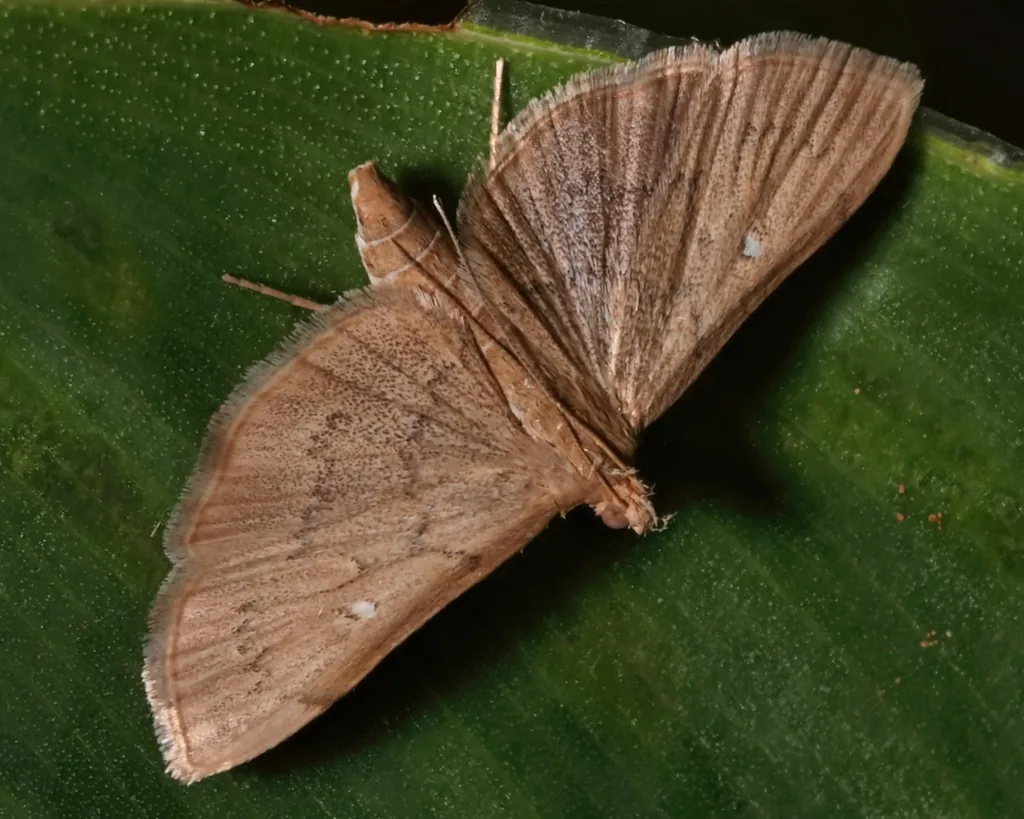
- The moths typically rest upside down. UF/IFAS describes the moth as small, plain and light brown, with a female wingspan averaging 25 mm, two brownish black lines across both pairs of wings and a small angular white patch on the forewing; moths often rest in the shade of the canna during the day.[1][6]
- Look at the leaves: NC State says the caterpillars skeletonize canna leaves rather than chewing holes, and Arkansas says the lesser canna leaf roller generally feeds on the leaf surface without chewing completely through, while the larger canna leaf roller feeds through the leaf.[1][2]
- Eggs are laid in groups of six to 15 on the upper surface of a canna leaf; they are flat, whitish yellow and average 0.9 mm. The pupa is 11.5 mm long and chocolate brown, held in its silk shelter by eight hooked hairs at the tail end.[6]
Look-alikes
| Look-alike | How to tell them apart |
|---|---|
| Larger canna leafroller (Calpodes ethlius) | A bigger, more voracious caterpillar on the same plants, and both can be present at once. It rolls the edge of a fully opened leaf, eats through the whole leaf and flicks its droppings out, so its roll is clean. The lesser canna leafroller more often ties unopened leaves shut, eats only the upper layers and leaves the lower skin intact, and its shelter is full of dark brown droppings.[6] |
Where it lives
GBIF has 1990-2026 U.S. records from 11 southern states (Mississippi, Georgia, North Carolina, Texas, Florida, Louisiana, South Carolina, Alabama, Virginia, Arkansas and Oklahoma) plus records from Costa Rica. NC State covers it as a canna pest in North Carolina, and the University of Arkansas reports both canna leaf roller species in Arkansas. UF/IFAS cites records from Florida, Texas, Louisiana, Tennessee and South Carolina and says it is likely also in the American tropics, where canna originated.[3][1][2][6]
Biology and life cycle
It spends winter as slender caterpillars in canna leaves and stems. After pupating, moths emerge in spring to mate and lay eggs once new growth appears. UF/IFAS says the last generation spends winter as pupae in dead canna leaves, and that moths are usually first seen in late February and early March in Florida.[1][6]
Tiny new caterpillars feed inside new leaves that are still rolled up. Older caterpillars tie the edges of older leaves together, rolling the leaf back up, and they pupate inside the rolled, damaged leaves. UF/IFAS says the first-stage caterpillars, about 1.4 mm long, mine between the upper and lower leaf surfaces, then feed in groups on the upper surface and begin rolling leaves at about one week old.[1][6]
Wild and cultivated cannas seem to be its only host plant.[1]
UF/IFAS gives the first generation as 35 days, with summer generations probably as short as 28 or 30 days. Generations overlap in summer, so every life stage can be found in the same canna bed.[6]
Damage and signs
- Caterpillars eat the upper surface and inner tissue of the leaf, mostly inside rolled leaves, so leaves look skeletonized and ragged rather than holed. If not managed, they can destroy the ornamental value of cannas.[1]
Health risk
It feeds on canna. NC State and the University of Arkansas don't mention any risk to people or pets.[1][2]
Control
Sanitation
NC State says not to leave old dead growth on the canna bed as mulch: remove and destroy all dead leaves and stems in the fall after frost has killed them back, and because canna seems to be the only host, plantings somewhat remote from other cannas can be drastically cleared this way. Arkansas says to cut canna foliage to the ground in winter and remove it from the garden, which reduces the overwintering larvae and pupae. UF/IFAS says cutting dead cannas to the ground in late winter and disposing of the cut material with the overwintering pupae lowers the spring population.[1][2][6]
Traps and physical control
Arkansas says the larvae can be handpicked.[2]
Pesticides
NC State says Bacillus thuringiensis (Bt) insecticides are effective for this pest: spray the diluted product straight down into the rolled leaves so it soaks into the shelter around the caterpillars. Arkansas says a Bt product applied to the leaves gives control without toxicity to organisms other than butterflies and moths, also lists systemic insecticides, and says to begin at the first sign of damage, or to apply a systemic before damage in plantings with a history of leafroller. Follow the label. UF/IFAS adds that sprays must go into the leaf roll with a sticker added, because the waxy canna leaf repels water, and that Bt products are the least toxic to beneficial organisms.[1][2][6]
Where the sources disagree
Family: NC State's reference list and the University of Arkansas place it in Pyralidae; GBIF places Geshna cannalis in Crambidae. UF/IFAS also places it in Crambidae.[1][2][4][6]
Host plants: NC State says wild and cultivated cannas seem to be its only host; Arkansas says canna leaf rollers feed only on plants in the genus Canna and close relatives.[1][2]
Cleanup timing: NC State says to remove dead leaves and stems in the fall after frost has killed the plants back; Arkansas says to cut the foliage to the ground in winter.[1][2]
Overwintering stage: NC State says it spends winter as caterpillars; UF/IFAS says the last generation overwinters as pupae in dead canna leaves; Arkansas mentions both larvae and pupae.[1][6][2]
Caterpillar color: NC State calls the caterpillars green; UF/IFAS says they are yellowish white and transparent, with the green leaf they've eaten showing through.[1][6]
Common questions
- Why are my canna leaves rolled up and ragged?
- Lesser canna leafroller caterpillars feed inside rolled leaves and skeletonize them from within.[1]
- How do I stop canna leafrollers next year?
- NC State says to remove and destroy dead canna leaves and stems after frost, since the caterpillars spend the winter in them; Arkansas says to cut the foliage to the ground in winter and remove it from the garden.[1][2]
- Does Bt work?
- NC State says Bt insecticides are effective for this pest if sprayed straight down into the rolled leaves so they reach the caterpillars; Arkansas says Bt applied to the leaves gives control.[1][2]
- How do I tell the lesser canna leafroller from the larger one?
- Open the roll. UF/IFAS says the lesser canna leafroller's shelter is full of dark brown droppings and the lower leaf skin is left intact, while the larger canna leafroller eats through the leaf and flicks its droppings out of a clean roll.[6]
Sources
- NC State Extension, “Lesser Canna Leafroller (PDIC Factsheet).” content.ces.ncsu.edu/lesser-canna-leafroller (accessed 2026-11-13)
- University of Arkansas System Division of Agriculture, Cooperative Extension Service, “Canna - Lesser Leaf Roller (Disease Notes, Plant Health Clinic; S. Smith and J. Pavel).” www.uaex.uada.edu/yard-garden/plant-health-clinic/disease-notes/posts/canna-lesser-leaf-roller.aspx (accessed 2026-11-13)
- Global Biodiversity Information Facility (GBIF), “Geshna cannalis (lesser canna leafroller): occurrence records, 1990-2026 (GBIF occurrence search).” api.gbif.org/v1/occurrence/search?taxonKey=1882018&hasGeospatialIssue=false&occurrenceStatus=PRESENT&year=1990%2C2026&facet=stateProvince&facet=country&facetLimit=400&limit=0 (accessed 2026-11-13). Counts are records reported (iNaturalist research-grade, museum specimens, surveys), not abundance; the U.S. state split uses the same query with country=US.
- Global Biodiversity Information Facility (GBIF), “Geshna cannalis Quaintance, 1898 (GBIF Backbone Taxonomy).” api.gbif.org/v1/species/1882018 (accessed 2026-11-13). GBIF places it in the family Crambidae
- iNaturalist, “Geshna cannalis taxon page (order and family).” www.inaturalist.org/taxa/491637 (accessed 2026-11-11)
- University of Florida IFAS Extension, EDIS (Featured Creatures), “Lesser Canna Leafroller, Geshna cannalis (Quaintance), EENY133/IN290 (Featured Creatures).” ask.ifas.ufl.edu/publication/IN290 (accessed 2026-11-14)