On this page
How to identify it
- Full-grown caterpillars reach about 2 inches and are pale, translucent green with a dark orange head on a short, distinct neck. Newly hatched caterpillars are tiny and pale with black heads. UF/IFAS says the second through fourth stages have a dark brown, almost black head and a semi-transparent dark green body with a white stripe running along each side of the back, and the fifth stage has an orange head with a dark triangle on the front.[1][2]
- Eggs are tiny, pale bluish green and dome-shaped to round, and are sometimes laid in clusters. The pupa is slender and pointed at both ends, inside a thin white cocoon in the folded leaf. UF/IFAS gives the egg as about 1.25 mm across and 0.68 mm high, pale green when laid and distinctly pink within a day. It describes the chrysalis as bright green and about 36 mm long, with a black spine at the front and a case for the long tongue that reaches past the tip of the abdomen.[1][2]
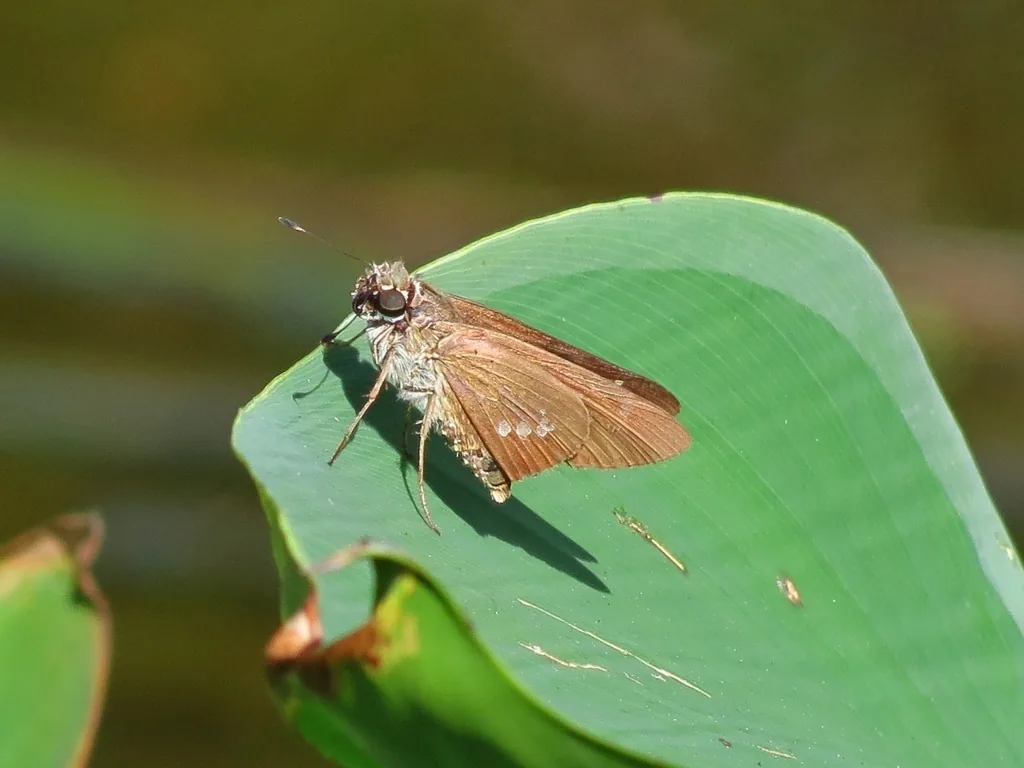
- The adult is a robust skipper with a long, pointed forewing and a wingspan of about 1 3/4 to 2 3/8 inches. The upper side is brown-black with large translucent spots on both wings; the underside is red-brown, with three or four cream spots on the hindwing. UF/IFAS describes the forewings as rich dark brown with five transparent spots and a fringe of dirty golden yellow hairs on the rear edge, and the slightly darker hind wings as carrying three transparent spots in an almost straight line. It gives the female's forewing as 22 to 27 mm long, with the male's somewhat smaller.[3][2]
- The adult has hooked antennae and, like other skippers, darts from flower to flower with a quick, snapping flight.[1]
- UGA Extension describes the eggs as about 1 mm across, pale green and turning pinkish a day after laying. The caterpillar's head is black at first and turns orange with black triangular marks in the fourth and fifth stages; the larvae molt five times before pupating inside the leaf roll.[4]
- UF/IFAS says the newly hatched caterpillar is about 4 mm long and yellowish, with a very large, glossy black, two-lobed head, and black thoracic shield, legs and tail tip. The later four stages range from 5 to 50 mm.[2]
Look-alikes
| Look-alike | How to tell them apart |
|---|---|
| Lesser canna leafroller | NC State notes that in North Carolina the larger canna leafroller is a fairly minor canna pest compared with the lesser canna leafroller, which can badly damage whole canna beds season after season.[1] |
Where it lives
BAMONA gives the range as south Florida and south Texas south through the West Indies, Mexico and Central America to Argentina, with strays and temporary colonies north to southern Nevada, north Texas, Illinois and Massachusetts. GBIF records since 1990 bear this out: most U.S. records are from Texas and Florida, followed by the Carolinas, Louisiana and New Jersey, and outside the U.S. most come from Costa Rica, Mexico and Argentina. NC State reports at least two generations a year in North Carolina but doubts it can survive winters north of southern Florida. UF/IFAS says it is well established in Florida, Texas and southern Arizona, is an occasional visitor to other Gulf Coast states and can be found in coastal Georgia and South Carolina. It has been collected in at least 24 states, though many of those records are considered strays. It also lives on the Galapagos Islands and throughout the West Indies.[3][5][6][1][2]
Biology and life cycle
Just after hatching, each caterpillar cuts and ties part of a leaf into a shelter, and it builds new, larger tubes as it grows. NC State says it stays in the roll except to feed; BAMONA adds that caterpillars usually spend the day in the rolled leaf and come out after dark to eat. UF/IFAS describes how the newly hatched caterpillar eats most of its egg shell, cuts two narrow strips from the leaf edge toward the midrib, and ties the flap down with silk; as the silk dries and shrinks, it pulls the flap into a flattened tube open at both ends. The caterpillar keeps most of its body inside and only reaches out with its head to feed.[1][3][2]
Females lay eggs on the upper side of leaves high on the plant. Adults are fast fliers and strong migrants.[3]
Flight season runs late summer in the north, April to December in several broods in south Texas, July to November in two broods in Arizona, and all year in Florida and the tropics. In southern Florida, UF/IFAS says adults are usually first noticed in May, with a second generation in early June; adults have been collected in every month and all caterpillar stages in January. It is thought to survive winter only in the southernmost part of Florida and to recolonize areas farther north each year.[3][2]
Hosts are all species of canna plus the related West Indian arrowroot and alligator flag. UF/IFAS lists members of the canna family and West Indian arrowroot, a close relative in the arrowroot family.[1][2]
In Georgia, UGA Extension says adults start laying eggs in mid-May and go through multiple generations over the summer, and the attacks continue until the weather cools in fall.[4]
Caterpillars flick their droppings out of the leaf roll, so the roll stays clean and droppings pile up on the ground. UF/IFAS says this 'fecal firing' is driven by pressure in the last abdominal segment, and it may help them avoid parasites and predators that find hosts by the smell and sight of droppings.[2]
In Florida summers, UF/IFAS says eggs hatch in four to five days and the first stage lasts three days. Before pupating the caterpillar stops feeding, empties its gut, shortens and turns bright bluish green for one to eight days, then spins a thin silk mat on the floor of the roll and pupates there; the pupal stage lasts seven to eight days.[2]
Damage and signs
- Caterpillars fold over the edge of a leaf and chew large, ragged chunks out of the rest of it, and NC State notes they can cause significant damage. UF/IFAS adds that several large caterpillars can strip an entire canna plant, building bigger rolls as they outgrow old ones, and that feeding can be so heavy the plants don't flower. In arrowroot grown for food, badly defoliated plants may yield little of the harvested rhizome.[1][2]
- Cannas with red leaves and red or orange flowers are especially attractive to the egg-laying butterflies; UGA Extension saw fewer eggs on green-leaved varieties. In UF/IFAS's account of a 1981 test of 39 canna varieties, red-leaved varieties, especially 'Wyoming', 'Black Velvet' and 'Ambassador', got many more eggs than green-leaved ones, and varieties with scarlet, red or orange flowers took more egg-laying and feeding regardless of leaf color. No variety was found resistant.[1][4][2]
- UGA Extension calls it a major pest of canna lily in Georgia: damage can be severe when most of the leaves are rolled, new shoots from the rhizome are quickly attacked, the caterpillars also feed on emerging flowers, and unmanaged plants produce few flowers.[4]
Health risk
It feeds on canna and its relatives, and no cited source describes any risk to people or pets.[1][3][4]
Control
Prevention
UGA Extension recommends scouting leaves for young larvae twice a week starting in May, since catching them as they begin to roll the leaves is critical.[4]
Traps and physical control
Caterpillars can be squashed inside their leaf rolls or picked off by hand, though UGA Extension notes this can become overwhelming once an infestation is severe. UF/IFAS says that on a few plants this is relatively easy: check the cannas every couple of days and squish any small shelters that appear, before the caterpillars cause much defoliation.[1][4][2]
Biological control
UGA Extension says parasitic wasps attacking the eggs and pupae have been reported from Florida, but it is not clear whether they are active in Georgia, and natural enemies have a hard time suppressing heavy infestations. UF/IFAS names three wasps recorded on it in Florida, Brachymeria incerta on pupae and Xenufens ruskini and Trichogramma minutum on eggs, plus tachinid flies (Eucelatoria australis, Eusisyropa blanda and Lixophaga diatraeae) that have emerged from pupae. An egg parasite, Ooencyrtus calpodicus, found in Trinidad was introduced to other Caribbean islands but has not been recorded from the United States. Diseases that turn caterpillars black also kill some.[4][2]
Pesticides
NC State says Bacillus thuringiensis (Bt) or another contact insecticide should give adequate control if sprayed into the rolled parts of the leaves. UGA Extension says Bt gives some control while most caterpillars are young, contact insecticides need more spray water than usual to reach caterpillars hidden in the rolls, and systemic insecticides are also available; it advises asking your county Extension office for current recommendations and reading the label. UF/IFAS notes that chemical control is hard because the caterpillars are protected inside the rolls; if it is needed, it should target small caterpillars still actively feeding, Bt products are probably the best choice, and a sticker will probably need to be added because the waxy canna leaf repels water. Follow the product label.[1][4][2]
Where the sources disagree
How serious: NC State calls it a relatively minor canna pest in North Carolina compared with the lesser canna leafroller, while UGA Extension calls it a major pest of canna lily in Georgia.[1][4]
Eggs: NC State describes them as pale bluish green and sometimes laid in clusters; UGA Extension as pale green, laid singly on upper and lower leaf surfaces; BAMONA says they are laid on the upper side of leaves high on the plant. UF/IFAS says they are laid singly or in widely spaced groups of five to seven on both the upper and lower leaf surfaces.[1][4][3][2]
Host plants: NC State lists all cannas plus West Indian arrowroot and alligator flag, while UGA Extension says West Indian arrowroot is the only host found outside the canna family. UF/IFAS agrees with UGA: canna and West Indian arrowroot.[1][4][2]
Native range: UGA Extension says it is native to Mexico, Central America and northern South America, while BAMONA gives a range south to Argentina, and GBIF has records from Argentina. UF/IFAS gives Mexico, Central America and northern South America, as far south as the northern border of Argentina.[4][3][6][2]
Common questions
- What's rolling and eating my canna leaves?
- Often the larger canna leafroller, a pale green caterpillar with an orange head that hides in a rolled leaf and chews ragged chunks from it. In North Carolina the lesser canna leafroller is the more serious canna pest.[1]
- Are some cannas less affected?
- NC State notes that cannas with red leaves and red or orange flowers are particularly attractive to the butterflies, and UGA Extension found fewer eggs on green-leaved varieties and more egg-laying and damage on red- or orange-flowered ones.[1][4]
- Can cannas recover from leafroller damage?
- Scouting early helps most. UF/IFAS says checking plants every couple of days and squishing small shelters cuts the population before it causes much defoliation, while heavy feeding by large caterpillars can leave plants without flowers.[2]
Sources
- NC State Extension, “Larger Canna Leafroller (PDIC Factsheet).” content.ces.ncsu.edu/larger-canna-leafroller (accessed 2026-11-13)
- University of Florida IFAS Extension (EDIS), “Larger Canna Leafroller, Calpodes ethlius (Stoll), EENY132/IN289 (H. J. McAuslane; Featured Creatures).” ask.ifas.ufl.edu/publication/IN289 (accessed 2026-11-14)
- Butterflies and Moths of North America (BAMONA), “Brazilian Skipper, Calpodes ethlius (species account).” www.butterfliesandmoths.org/species/Calpodes-ethlius (accessed 2026-11-13)
- University of Georgia Cooperative Extension, “Larger Canna Leafroller: A Major Insect Pest of Canna Lily (Circular 1233).” fieldreport.caes.uga.edu/publications/C1233/larger-canna-leafroller-a-major-insect-pest-of-canna-lily (accessed 2026-11-13)
- Global Biodiversity Information Facility (GBIF), “Calpodes ethlius: U.S. occurrence records since 1990 by state (GBIF occurrence search).” api.gbif.org/v1/occurrence/search?taxonKey=1946074&country=US&hasGeospatialIssue=false&occurrenceStatus=PRESENT&year=1990%2C2026&facet=stateProvince&facetLimit=400&limit=0 (accessed 2026-11-13). Fetched 2026-11-13: 3,131 U.S. records since 1990; Texas 1,680, Florida 746, South Carolina 152 (plus 12 filed as 'South carolina'), North Carolina 107, Louisiana 92, New Jersey 61, Georgia 55.
- Global Biodiversity Information Facility (GBIF), “Calpodes ethlius: occurrence records since 1990 by country (GBIF occurrence search).” api.gbif.org/v1/occurrence/search?taxonKey=1946074&hasGeospatialIssue=false&occurrenceStatus=PRESENT&year=1990%2C2026&facet=country&limit=0 (accessed 2026-11-13). Fetched 2026-11-13: 4,092 records since 1990; United States 3,131, Costa Rica 325, Mexico 219, Argentina 94.
- Global Biodiversity Information Facility (GBIF), “Calpodes ethlius (Stoll, 1782) (GBIF Backbone Taxonomy).” api.gbif.org/v1/species/1946074 (accessed 2026-11-13)