On this page
How to identify it
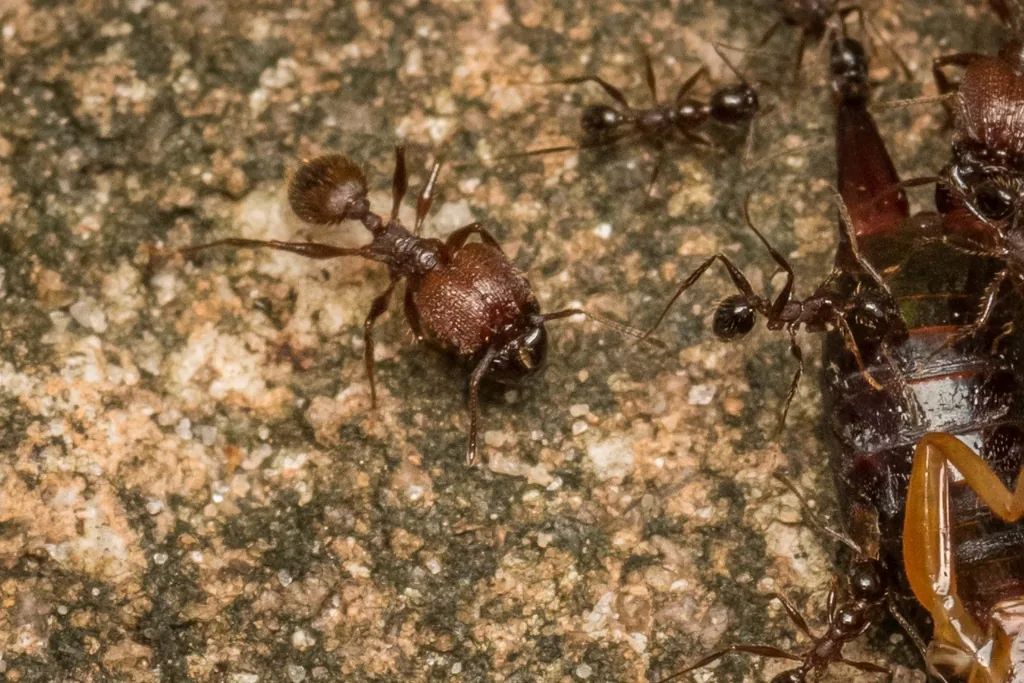
- Two sharply different worker castes, as in all Pheidole: minor workers with a head about 0.7 mm long and a body uniformly dark reddish-brown with lighter mandibles and feet, and major workers (soldiers) more than twice that size, with a head 1.6 to 1.8 mm long.[1]
- Majors are the easiest big-headed ants to name in North America: the large size, a head covered in strong net-like sculpture with a deeply notched rear margin, and a short, thick antennal scape that is strongly angled at its base are unique among the continent's Pheidole. No other big-headed ant in the Southeast is this large.[1]
- Major mandibles are big and mostly toothless apart from a basal tooth and two large tips, built for crushing; minor mandibles are elongate triangles with nine small teeth and two large apical teeth.[1]
- Both castes have 12-segmented antennae ending in a loose three-segmented club, a two-segmented waist, short propodeal spines, a shiny gaster and a thorax that looks stepped in profile, with the pronotum raised above the mesonotum and the mesonotum above the propodeum.[1]
- Nests in open ground are medium to large and marked by an obvious crater of excavated soil.[1]
Look-alikes
| Look-alike | How to tell them apart |
|---|---|
| Toothed big-headed ant (Pheidole dentata) | The native big-headed ant found in the same habitats. Its minor workers are smaller than those of P. obscurithorax, with a less oval head and no nuchal collar visible in full face view; its majors are far smaller than the imported ant's soldiers.[1] |
| Bigheaded ant (Pheidole megacephala) | Another exotic Pheidole in the region. P. obscurithorax majors are told from every other native or exotic big-headed ant in North America by their large size, heavily sculptured head and thick, basally angled scape.[1] |
| Red imported fire ant | The fire ant has a working sting and is the species P. obscurithorax competes with at baits and for prey; big-headed ants have an atrophied sting and cannot sting at all.[1] |
Where it lives
Native to South America (thought to be Argentina), it is now recorded in Alabama, Florida, Georgia, Louisiana, Mississippi and Texas and is common along the Gulf Coast from northern Florida to eastern Texas. GBIF's U.S. records since 1990 come mostly from Florida, Mississippi and Texas, and a 2007 survey added new county records in 5 states.[1][6][2]
Biology and life cycle
In the United States it is largely confined to highly disturbed habitats such as lawns and roadsides, often alongside the red imported fire ant, and belongs to a largely exotic community of ants that tolerate disturbed ground. Nests in open ground are medium to large, marked by an obvious crater of excavated soil.[2][4][1]
Pheidole obscurithorax is omnivorous but also an aggressive predator. Minor and major workers cooperate to attack and carry much larger prey, such as caterpillars, into the colony, and the ant has been seen defending prey from red imported fire ants, though not always successfully. One report describes it attacking a hatchling chicken.[1]
It is a major competitor of the red imported fire ant. In the U.S. it quickly finds baits and outcompetes fire ants at them; in Argentina, where it is native, it was the best food discoverer among the ants studied, though fire ants won most of their contests with it there.[1][5]
How it spreads is debated: a 2004 survey suggested gradual spread by natural means, with nest density in Tallahassee increasing 6.4-fold over two years, while a 2007 follow-up found a patchy distribution suggesting people are moving it to new places.[4][2]
Queens are larger than major workers, carry three ocelli, and have the thorax enlarged for flight muscles; their wings are 7.4 to 7.8 mm long and lightly tinted yellow-brown.[1]
Damage and signs
Health risk
Like other Pheidole species, Pheidole obscurithorax has an atrophied sting and cannot sting.[1]
Control
Prevention
It is mainly an outdoor ant of lawns and roadsides and cannot sting, so colonies in open ground often need no action.[2][1]
Pesticides
For big-headed ants (Pheidole) in general, Texas A&M says to find the colonies and treat them directly: small colonies around buildings and under objects can be drenched with a liquid insecticide, and a foundation spray keeps foraging ants out of buildings.[3]
Where colonies can't be reached, use ant baits; Texas A&M calls indoor baiting effective and the safest method. This species finds baits quickly.[3][1]
Common questions
- Does the large imported big-headed ant sting?
- No. The sting is atrophied, as in other Pheidole species, so it cannot sting.[1]
- How is it different from fire ants?
- Fire ants sting; this ant cannot. In the field it coexists with the red imported fire ant, competes with it at baits and for prey, and often wins those contests, though the two share the same disturbed habitats.[1][4]
- How far has it spread?
- It is established in Alabama, Florida, Georgia, Louisiana, Mississippi and Texas, and GBIF also holds a few records from South Carolina. Surveys in 2004 and 2007 found its range and local numbers still growing.[1][6][4][2]
Sources
- Mississippi Entomological Museum, Mississippi State University, “Ants of the Southeastern United States: Pheidole obscurithorax Naves, 1985 (J. A. MacGown, updated 2016).” mississippientomologicalmuseum.org.msstate.edu/Researchtaxapages/Formicidaepages/genericpages/Pheidole.obscurithorax.htm (accessed 2026-11-12)
- Florida Entomologist 90(3), 2007 (King and Tschinkel; author copy, University of Central Florida), “Range expansion and local population increase of the exotic ant, Pheidole obscurithorax, in the southeastern United States.” sciences.ucf.edu/biology/king/wp-content/uploads/sites/14/2011/08/2007KingTschinkelFlaEnt.pdf (accessed 2026-11-12)
- Texas A&M AgriLife Extension, Urban and Structural Entomology Program, “Big-Headed Ant, Pheidole sp..” urbanentomology.tamu.edu/urban-pests/ants/big_headed/ (accessed 2026-11-12)
- Journal of Insect Science, abstract via PubMed, “Distribution, spread, and ecological associations of the introduced ant Pheidole obscurithorax in the southeastern United States (Storz and Tschinkel 2004, Journal of Insect Science 4:12; PubMed 15861228).” doi.org/10.1093/jis/4.1.12 (accessed 2026-11-12)
- Oecologia 2008, via PubMed, “Ecological dominance of the red imported fire ant, Solenopsis invicta, in its native range.” pubmed.ncbi.nlm.nih.gov/18305962/ (accessed 2026-11-12)
- Global Biodiversity Information Facility (GBIF), “Pheidole obscurithorax: U.S. occurrence records since 1990 by state (GBIF occurrence search).” api.gbif.org/v1/occurrence/search?taxonKey=8223587&country=US&hasGeospatialIssue=false&occurrenceStatus=PRESENT&year=1990%2C2026&facet=stateProvince&facetLimit=400&limit=0 (accessed 2026-11-12)
- iNaturalist, “Pheidole obscurithorax taxon page (order and family).” www.inaturalist.org/taxa/710657 (accessed 2026-11-10)