On this page
How to identify it
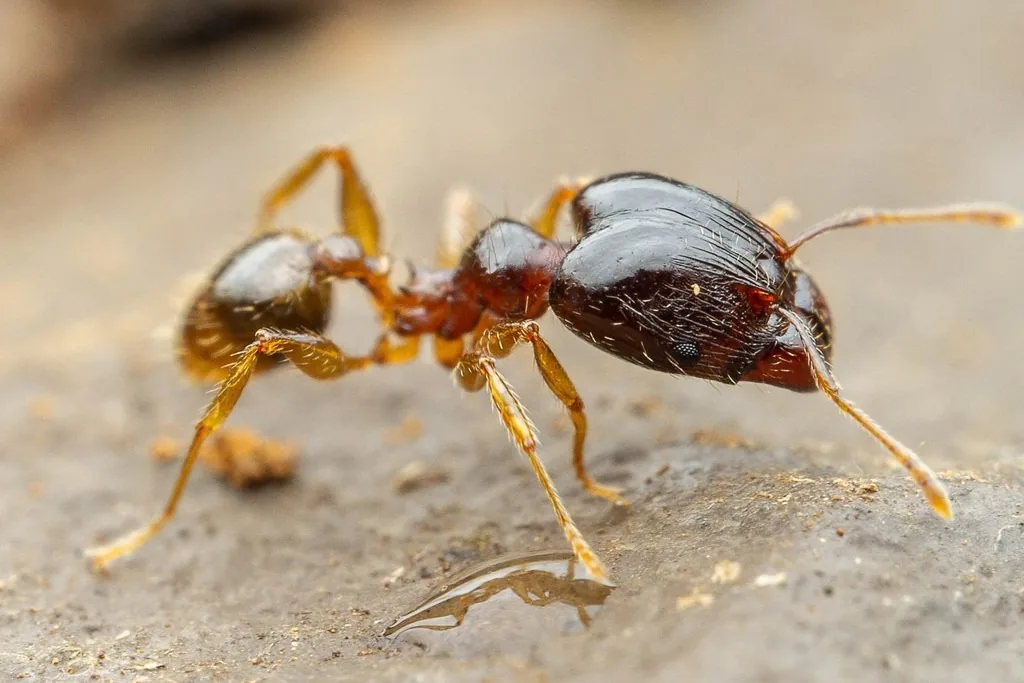
- Workers come in two distinct sizes, minors and majors (soldiers), from about 2.4 to 3.8 mm (1/16 to 1/8 inch) long, and are reddish brown. Texas A&M's description covers the genus Pheidole; a 2015 study describes P. megacephala as light brown to dark brown. For P. megacephala, UF/IFAS gives about 2 mm for the reddish-brown minors and 3 to 4 mm for the majors, which make up only about 1% of foragers.[1][2][9]
- The major worker's head is very large for its body and two-lobed, with a groove down the middle. In P. megacephala it is heart-shaped, and the back third of the top of the head is smooth and glossy. UF/IFAS adds that the front half of the major's head is sculptured and the back half smooth and shiny.[1][2][9]
- Like other Pheidole, it has two nodes at the waist, 12-segmented antennae ending in a 3-segmented club, and two spines on the back of the thorax.[1]
- Both worker sizes of P. megacephala have a swollen second waist segment (postpetiole) that bulges above and below, which sets it apart from other introduced Pheidole.[2]
- The body carries sparse, long hairs, the two short spines on the thorax point almost straight up, and there is usually a dark spot on the underside of the abdomen (gaster).[9]
- People often notice the soil before the ants: piles of loose sandy soil along lawn edges, walkways and driveways. The ants can also build fragile, debris-covered foraging tubes that are sometimes mistaken for termite tubes.[9]
Look-alikes
| Look-alike | How to tell them apart |
|---|---|
| Red imported fire ant | The Mississippi Entomological Museum lists fire ants as serious nuisance and stinging pests and bigheaded ants as occasional household pests. A bigheaded ant colony has just two worker sizes, and the big ones have a head out of proportion to the body. UF/IFAS adds that bigheaded ants are slightly smaller, darker and less shiny. Nests look alike: disturb one slightly and look for the big-headed majors, or for fire ants of many sizes swarming out aggressively.[4][1][9] |
| Subterranean termites | Bigheaded ants can build debris-covered foraging tubes that look somewhat like termite mud tubes, but UF/IFAS says they are much more fragile.[9] |
Where it lives
Pheidole megacephala is probably of African or Madagascan origin and is now established throughout the tropics. GBIF has about 10,600 records worldwide since 1990, most from Australia, Egypt, the United States and Madagascar. Of about 1,070 U.S. records, nearly all are from Hawaii and Florida, with a few dozen each from California and Maryland. The native bigheaded ant Pheidole dentata ranges from Kansas to Virginia and south to Florida and is the most common Pheidole in the southern states. UF/IFAS says it was first recorded from Mauritius in the Indian Ocean. Early Florida reports came from the Everglades, Key West and St. Augustine, and it has since been confirmed in 17 Florida counties, from Alachua and Volusia south to Monroe. Florida has some 17 Pheidole species, 14 of them native.[2][5][6][4][1][9]
Biology and life cycle
Colonies have many queens and spread by budding, and over large areas its nests often form supercolonies that fight other ants or outcompete them for food.[2][3]
Rather than winning fights head-on, it tends to dominate other ants by raiding their colonies, and it has been recorded raiding colonies of the red imported fire ant.[2][7]
It prefers humid, disturbed places and is limited by drying out and heat, so colonies sit in moist microhabitats and workers often forage inside leaf litter, at night, or under covered trails.[2][3]
Nests can be in any crack big enough to enter: soil, rotting logs, under rocks, in houses or in tree bark.[2]
It is an omnivorous scavenger and an able predator, recruiting nestmates fast enough to take over food and drag in prey too large for one worker. Workers also tend scale insects for honeydew. Indoors, the native species feeds on meats, grease, liver, fruit juices and peanut butter.[2][1]
In a laboratory study at 28 °C, workers and soldiers took about 28.7 days from egg to adult and winged reproductives about 37.6 days. Caste production was seasonal, and eggs were laid in batches.[3]
Colonies can have large numbers of fertile queens and raise brood year-round in tropical and subtropical areas. UF/IFAS cites Australian reports that new colonies form by budding without mating flights, but in south Florida winged reproductives make mating flights in winter and spring.[9]
UF/IFAS cites egg incubation of 13 to 32 days, a larval stage of 23 to 29 days and a pupal stage of 10 to 20 or more days. Minor workers lived 78 days at 21°C and 38 days at 27°C, and queens can lay up to 292 eggs a month.[9]
Foragers trail up tree trunks, sometimes into the canopies of tall trees, and up outside walls into attics and other voids. Populations spread along lawn-walkway edges and roadways and can move into new areas and displace other ants quickly.[9]
Nests are in disturbed soil, lawns and flowerbeds, under bricks, slabs and flower pots, around trees and water pipes, and along foundations and walkways. On well-kept lawns colonies may go unnoticed except where soil piles up at the lawn edge.[9]
Damage and signs
- It causes no structural damage. The Mississippi Entomological Museum lists it as an occasional household pest.[4]
- Where it invades, it can devastate native insects and other invertebrates, as documented in northern Australia, and it harms crops by tending plant-damaging scale insects.[2]
- The native Pheidole dentata lives mainly outdoors and only occasionally invades buildings, though colonies nesting in soil around a structure can cause chronic problems.[1]
- It causes no structural damage, but UF/IFAS says homeowners are annoyed by the dirt piles and by ants foraging in kitchens and bathrooms and around doors and windows. In a 1995 survey of Florida pest control companies it accounted for 7% of customer calls about ants, and its status has risen since, at least in southeastern Florida.[9]
Health risk
The Mississippi Entomological Museum lists fire ants, not bigheaded ants, among the stinging pest ants of the Southeast; it lists bigheaded ants only as occasional household pests.[4]
Control
Prevention
Find where the colonies are first, then treat them directly. Use baits where nests can't be reached.[1]
Neighbors need to cooperate: if adjoining infested properties aren't treated, ants quickly come back, so UF/IFAS says to expect retreatments without area-wide control. A homeowners' association may need to arrange treatment of unoccupied infested areas.[9]
Pesticides
Small colonies around buildings, along foundations and under objects can be drenched with a liquid insecticide from a small hand sprayer, and a perimeter spray around the foundation helps keep outdoor foragers from coming inside.[1]
Indoors, baiting can be effective and is the safest method; ant baits come in child-resistant containers. Colonies in wall voids can be treated with a dust labeled for that use, puffed into cracks and entry holes. UF/IFAS adds sweet liquid baits, gels, foams and baits set near void entrances as indoor options, always alongside treatment outside.[1][9]
In a UF/IFAS trial in Fort Lauderdale, two baits (one with metaflumizone, one with fipronil) gave control for up to about 4 weeks, while two residual sprays gave some control for about 2 weeks. Baiting can take several weeks to reduce numbers significantly.[9]
When to call a professional
UF/IFAS says control is difficult because colonies are numerous and usually extend across property lines. A program needs to cover lawns, flowerbeds, the areas around trees, walkways and brick driveways, not just the house perimeter; one-time treatments are of very limited value.[9]
Where the sources disagree
Worker size: Texas A&M gives about 2.4 to 3.8 mm for the genus; UF/IFAS gives about 2 mm for P. megacephala minors and 3 to 4 mm for majors.[1][9]
Pest status: the Mississippi Entomological Museum lists it as an occasional household pest; UF/IFAS says pest control operators rank it the most pervasive nuisance ant in south Florida.[4][9]
Common questions
- How can I tell a bigheaded ant?
- Look for two distinct worker sizes in the same trail. The larger soldiers have a huge, two-lobed head out of proportion to the body.[1][2]
- Do bigheaded ants sting?
- The Mississippi Entomological Museum lists fire ants as stinging pests and bigheaded ants only as occasional household pests. The sources used for this page don't describe stings from bigheaded ants.[4]
- Are there native bigheaded ants?
- Yes. Pheidole dentata is native and the most common Pheidole in the southern states; it lives mostly outdoors.[1]
- Why are there little piles of sand along my sidewalk?
- In Florida, often bigheaded ants. UF/IFAS says they dig beneath walkways and driveways and push the loose soil to the surface, leaving piles where lawns meet pavement.[9]
Sources
- Texas A&M AgriLife Extension, Urban and Structural Entomology, “Big-Headed Ant.” urbanentomology.tamu.edu/urban-pests/ants/big_headed/ (accessed 2026-11-11)
- ZooKeys, via PubMed Central, “Introduced Pheidole of the world: taxonomy, biology and distribution (Sarnat et al. 2015).” pubmed.ncbi.nlm.nih.gov/26798286/ (accessed 2026-11-11). Species account of Pheidole megacephala read in the PMC full text (PMC4714327).
- Insects, via PubMed, “Life History of the Invasive Big-Headed Ant Pheidole megacephala (Yuan et al. 2026).” pubmed.ncbi.nlm.nih.gov/42940903/ (accessed 2026-11-11)
- Mississippi Entomological Museum, Mississippi State University, “Common Pest Ants of the Southeastern United States.” mem.org.msstate.edu/Researchtaxapages/Formicidaepages/faunal.lists/Common_Pest_Ants.html (accessed 2026-11-11)
- Global Biodiversity Information Facility (GBIF), “Pheidole megacephala: occurrence records since 1990 by country (GBIF occurrence search).” api.gbif.org/v1/occurrence/search?taxonKey=1322635&hasGeospatialIssue=false&occurrenceStatus=PRESENT&year=1990%2C2026&facet=country&limit=0 (accessed 2026-11-11). Exact counts at access: 10,561 records since 1990; Australia 3,023, Egypt 1,584, United States 1,069, Madagascar 943, South Africa 686.
- Global Biodiversity Information Facility (GBIF), “Pheidole megacephala: U.S. occurrence records since 1990 by state (GBIF occurrence search).” api.gbif.org/v1/occurrence/search?taxonKey=1322635&country=US&hasGeospatialIssue=false&occurrenceStatus=PRESENT&year=1990%2C2026&facet=stateProvince&facetLimit=400&limit=0 (accessed 2026-11-11). Exact count at access: 1,069 U.S. records since 1990 (Hawaii 489; Florida 478; California 34; Maryland 33; Illinois 7; Wisconsin 6; Louisiana 4; District of Columbia 2; Texas 1).
- Ecology, via PubMed, “Pheidole megacephala: An invasive ant that raids colonies of the red imported fire ant, Solenopsis invicta (San Juan, Azemar and Dejean 2025).” pubmed.ncbi.nlm.nih.gov/40357688/ (accessed 2026-11-11)
- iNaturalist, “Pheidole megacephala taxon page (order and family).” www.inaturalist.org/taxa/199356 (accessed 2026-10-06)
- University of Florida IFAS Extension, EDIS (Featured Creatures), “Bigheaded Ant, Pheidole megacephala (Fabricius), EENY-369/IN712 (Featured Creatures).” ask.ifas.ufl.edu/publication/IN712 (accessed 2026-11-14)