On this page
How to identify it
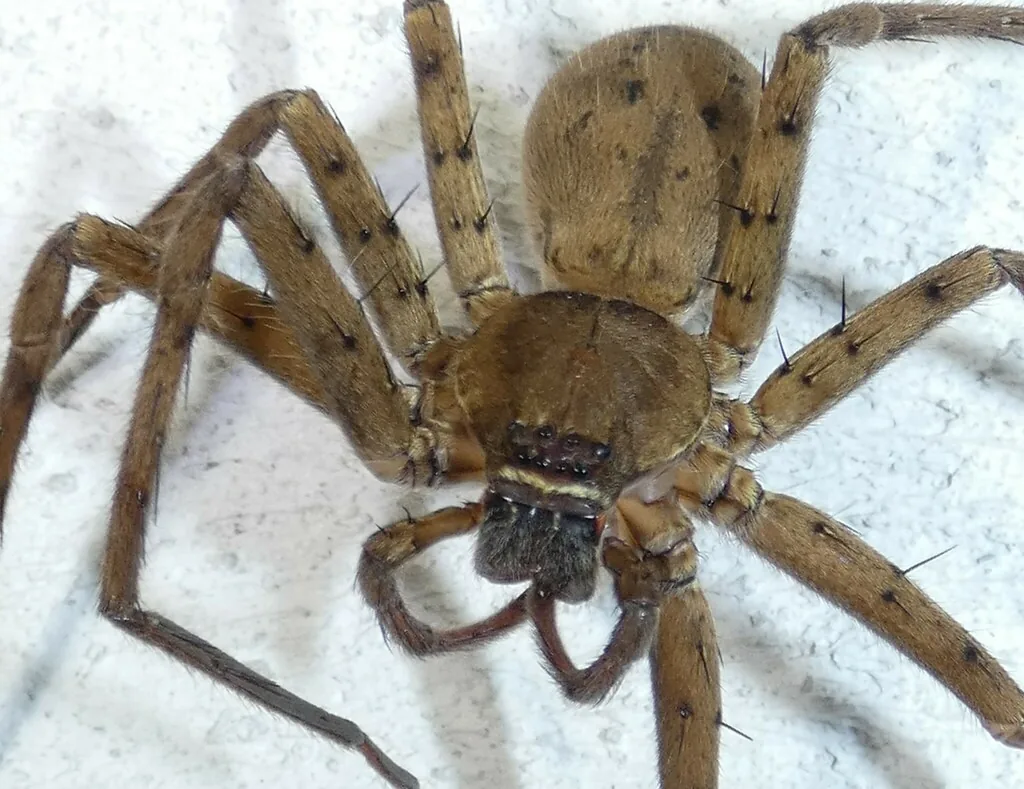
- Adults have a body about 1 inch long (2.2 to 2.8 cm) and a leg span of 3 to 5 inches. The body is brown, flattened and has very little pattern.[1]
- Each leg spine rises from a distinct black spot. Both sexes have a yellow to cream face and a wide band around the edge of the carapace (the head region), tan in females and cream in males. UF/IFAS adds that the legs carry erectile bristles but the spider is otherwise not conspicuously hairy.[1][2]
- Females have the larger body; males have longer legs and a dark stripe down the abdomen. UF/IFAS adds that males also have a light-bordered pale area behind the eyes and long palps with an enlarged last segment.[1][2]
- It is also called the giant crab spider, and the banana spider for its occasional appearance in shipments of bananas.[1]
Look-alikes
| Look-alike | How to tell them apart |
|---|---|
| Wolf spiders | Both are large hunting spiders whose eyes shine at night in a flashlight beam, but the huntsman has a flattened brown body and black spots at the base of its leg spines.[1] |
| Brown recluse | The huntsman is sometimes mistaken for a large brown recluse, but it is not related and is not dangerous. UF/IFAS says the brown recluse is in a different family, Sicariidae.[1][2] |
Where it lives
A species found throughout the tropics, it was probably introduced from Asia and lives in subtropical parts of Florida, Texas and California. GBIF records since 1990 come mostly from Florida, Hawaii and Texas, with a few from other states; worldwide, many come from Taiwan, Mexico, Singapore, Thailand, Japan and India. It can't live outdoors where winters freeze but turns up in greenhouses and heated buildings farther north, and in southern Florida it lives wild, for example in avocado groves. UF/IFAS adds coastal Georgia and South Carolina to its U.S. range, says it is presumed to have come from Asia, where many of its closest relatives live, and reports it established in the wild and common in avocado groves around Homestead.[1][3][4][2]
Biology and life cycle
Its flat body lets it squeeze into small cracks, and it is often found in houses, barns, sheds and under boards on the ground. In cold weather it moves indoors under furniture or cabinets, behind wall hangings, and into closets and garages.[1]
It does not spin a web to catch prey; it relies on speed and strong jaws, and it is valued in the tropics because it catches cockroaches and other household insects. UF/IFAS says venom from glands that run from the jaws back into the front body subdues the prey.[1][2]
Females carry a flat, disc-like egg sac about 1.5 cm across, holding more than 200 eggs, under the body. Young and adults of all ages are found throughout the year. UF/IFAS suggests the egg sac's size and shape probably keep the female relatively immobile while she carries it.[1][2]
At night its eyes reflect light, showing as blue spots on tree trunks and the ground, and UF/IFAS says it can be easily collected at night with a headlamp.[2]
Health risk
A careless handler can get a locally painful bite. In an Australian study of 168 confirmed huntsman-family bites (14 percent from Heteropoda), every bite hurt, but the pain lasted a median of 5 minutes; swelling occurred in 16 percent, effects beyond the bite site were minor and rare, and there were no skin ulcers or allergic reactions.[1][5]
Control
Prevention
In the same study, 76 percent of bites happened when the spider was picked up, got into clothing being put on, or was on an object someone picked up, so the simplest prevention is not to handle it.[5]
Traps and physical control
FDACS notes the spider is valued in warm countries because it catches cockroaches and other household insects, so one in a shed or garage can simply be left alone.[1]
If you are bitten
MedlinePlus's general first aid for insect and spider bites: wash the area with soap and water, apply ice wrapped in a washcloth 10 minutes on and 10 minutes off, and watch over the next several days for signs of infection such as increasing redness, swelling or pain.[6]
Call 911 for trouble breathing, swelling of the face or mouth, throat tightness or trouble swallowing.[6]
In the Australian study, the effects seemed to come from the bite wound itself rather than from venom, and four bites showed signs of local infection.[5]
Common questions
- What is the huge flat spider on my wall?
- In Florida, Texas, Hawaii or other warm areas, very likely a pantropical huntsman spider: a big, flat, plain brown spider with black spots at the base of its leg spines. UF/IFAS says that in Florida those spots and the flattened brown body set it apart from other large running spiders.[1][3][2]
- Does the huntsman spider bite?
- It can if handled. Bites are painful but usually brief, and in a clinical study swelling occurred in about one bite in six.[1][5]
- What family is the huntsman spider in?
- Sparassidae, the huntsman spider family. UF/IFAS notes some authors once put it in a family called Heteropodidae, but the name Sparassidae was stabilized in 1999.[2]
Sources
- Florida Department of Agriculture and Consumer Services, Division of Plant Industry (Entomology Circulars, via the Florida State Collection of Arthropods), “The giant crab spider, Heteropoda venatoria (Entomology Circular 205, G. B. Edwards, 1979).” thefsca.org/wp-content/uploads/2025/01/ent205.pdf (accessed 2026-11-11)
- University of Florida IFAS Extension (EDIS), “Pantropical Huntsman Spider, Heteropoda venatoria (Linnaeus), EENY-160/IN317 (G. B. Edwards Jr.; Featured Creatures).” ask.ifas.ufl.edu/publication/IN317 (accessed 2026-11-14)
- Global Biodiversity Information Facility (GBIF), “Heteropoda venatoria: U.S. occurrence records since 1990 by state (GBIF occurrence search).” api.gbif.org/v1/occurrence/search?taxonKey=2161710&country=US&hasGeospatialIssue=false&occurrenceStatus=PRESENT&year=1990%2C2026&facet=stateProvince&facetLimit=400&limit=0 (accessed 2026-11-11)
- Global Biodiversity Information Facility (GBIF), “Heteropoda venatoria: occurrence records since 1990 by country (GBIF occurrence search).” api.gbif.org/v1/occurrence/search?taxonKey=2161710&hasGeospatialIssue=false&occurrenceStatus=PRESENT&year=1990%2C2026&facet=country&limit=0 (accessed 2026-11-11)
- Toxicon, via PubMed, “A prospective study of definite bites by spiders of the family Sparassidae (huntsmen spiders) with identification to species level (Isbister and Hirst 2003).” pubmed.ncbi.nlm.nih.gov/12906887/ (accessed 2026-11-11)
- MedlinePlus, U.S. National Library of Medicine, “Insect bites and stings (Medical Encyclopedia).” medlineplus.gov/ency/article/000033.htm (accessed 2026-11-11)
- iNaturalist, “Heteropoda venatoria taxon page (order and family).” www.inaturalist.org/taxa/48765 (accessed 2026-10-06)