On this page
How to identify it
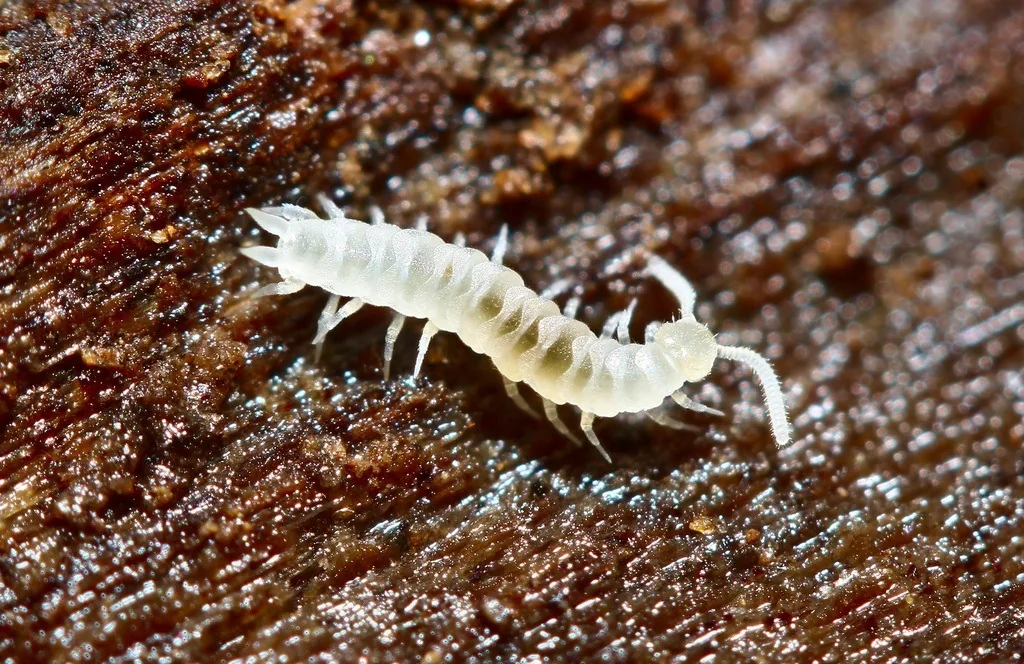
- They're slender and white, with twelve pairs of legs, fourteen body segments and a pair of antennae.[1]
- They run quickly when exposed to light.[1]
- Adults are slender and white with prominent, many-segmented antennae, about 1/8 to 1/4 inch long; they run fast when disturbed and vibrate their antennae.[5][2]
- All life stages live in the soil, usually in the upper few inches.[2]
Where it lives
They're associated mainly with moist, organically rich soil.[1]
Biology and life cycle
They feed on decaying as well as living plant material in the soil.[1]
Eggs are laid in clusters of 4 to 25 in the soil and hatch in 30 to 40 days; at 10oC the whole trip from egg to adult takes about 5 months.[5][4]
Fun fact: babies hatch with only six pairs of legs and add one more pair each time they molt until they reach adult size.[5][2]
There are one to two generations a year, and eggs, nymphs and adults can be found together most of the year, with egg-laying peaks in spring and fall.[2][5]
They move up and down in the soil: from about April through August they are found in rising numbers in the upper 6 to 8 inches, and cold or very dry weather sends them deep.[5][4]
They live in patchy hotspots and favor heavy clay or organically rich soil.[2][4][1]
Damage and signs
- They feed on roots of many crops and weeds and can damage seedlings before or after they emerge.[1]
- Feeding can slow the growth of larger plants; strawberries are among the crops damaged.[1]
- Signs include dead young roots, older roots that look gnarled with corky tissue around wounds, stunted plants and thin stands.[2]
- Damage matters less as plants get bigger, but root wounds can let plant pathogens in.[4]
Health risk
They feed on roots and organic matter; UC IPM mentions no risk to people.[1]
Control
Prevention
Garden symphylans are difficult to manage; flooding for three weeks can help where the soil holds water.[1]
Plant crops that tolerate symphylans, such as potato, bean and small grains, and set out transplants or larger transplants instead of sowing seed (Utah State says this doesn't work for broccoli and eggplant).[2][4]
Cut back on added manure and crop residue where symphylans are a problem, since they feed mostly on decaying organic matter.[4]
Traps and physical control
Rototilling dry soil vigorously just before planting may reduce numbers by abrading their soft bodies.[1]
Biological control
Predatory mites, ground beetles, true centipedes and fungal pathogens all attack symphylans. One soil mite, Pergamasus quisquiliarum, can eat up to 12 symphylans in a generation and breeds about five times faster.[4][5]
Pesticides
Insecticides are hard to make work because symphylans move deep into the soil to avoid treated areas. In a UC lab study, bifenthrin killed 100% of symphylans in treated soil after 72 hours. Use only a product whose label lists garden symphylan for the crop you are growing.[4][6][2]
More from Utah State University Extension
They favor heavy clay soils high in organic matter and turn up in patchy hotspots, from a few square feet to several acres, which makes them easy to miss.[2]
Where sources disagree
Legs and segments: UC IPM counts twelve pairs of legs and fourteen body segments; Utah State says 15 body segments and 10-12 pairs of legs; Oregon State's fast facts give 15 to 22 segments and 11 to 12 pairs, with fewer on young ones.[1][2][4]
Size: Oregon State's uspest page gives 1/8 to 1/4 inch for mature symphylans; its 2024 fast facts say not more than 1/3 inches when full grown.[5][4]
Common questions
- What are the tiny white bugs that run from light in my soil?
- They may be garden symphylans, which have 12 pairs of legs and run quickly when uncovered.[1]
- Are symphylans insects?
- No. They have 12 pairs of legs and 14 body segments, more than any insect.[1]
- How do I check my garden soil for symphylans?
- Dig and look, or set out bait: a cut potato placed on the soil draws them up, and research in Oregon found potato baits a reliable alternative to soil sampling. Utah State says noticeable damage is likely above about 5-10 per shovelful in susceptible crops like broccoli, squash, spinach and cabbage.[4][7][2]
- Will tilling get rid of symphylans?
- It helps. Tilling, especially vigorous tilling of dry soil just before planting, crushes their soft bodies. Oregon State notes tillage also harms the predators that eat symphylans, so time it for when symphylans are near the surface.[1][2][4]
Sources
- University of California Statewide IPM Program, “Garden Symphylans (Pests in Gardens and Landscapes).” ipm.ucanr.edu/PMG/GARDEN/VEGES/PESTS/gardensymphylans.html (accessed 2026-11-12)
- Utah State University Extension, “Garden Symphylans.” extension.usu.edu/planthealth/ipm/notes_ag/veg-garden-symphylans.php (accessed 2026-11-12)
- iNaturalist, “Scutigerellidae taxon page (order and family).” www.inaturalist.org/taxa/185594 (accessed 2026-11-12)
- Oregon State University, Oregon IPM Center, “Fast Facts: Symphylans (Jima, Kaur, Tumacder and Rondon).” agsci.oregonstate.edu/sites/agscid7/files/media/fact_sheet_symphylans_taj-final.pdf (accessed 2026-11-12)
- Oregon State University Integrated Plant Protection Center (uspest.org), “Garden Symphylan Life Cycle and Habits.” uspest.org/ipm/symp.html (accessed 2026-11-12)
- Journal of Economic Entomology, via PubMed, “Effects of direct and indirect exposure of insecticides to garden symphylan in laboratory bioassays (Joseph 2015, UC Cooperative Extension).” pubmed.ncbi.nlm.nih.gov/26470373/ (accessed 2026-11-12). Cited from the PubMed abstract.
- Journal of Economic Entomology, via PubMed, “Sampling considerations for garden symphylans in western Oregon (Umble and Fisher 2003).” pubmed.ncbi.nlm.nih.gov/12852643/ (accessed 2026-11-12). Cited from the PubMed abstract.