On this page
How to identify it
- Neotermes belongs to the family Kalotermitidae, along with drywood termites such as Cryptotermes and Incisitermes. Unlike those drywood termites, its colonies need high humidity and regular contact with free water, and unlike subterranean termites they don't forage in the soil.[2][1]
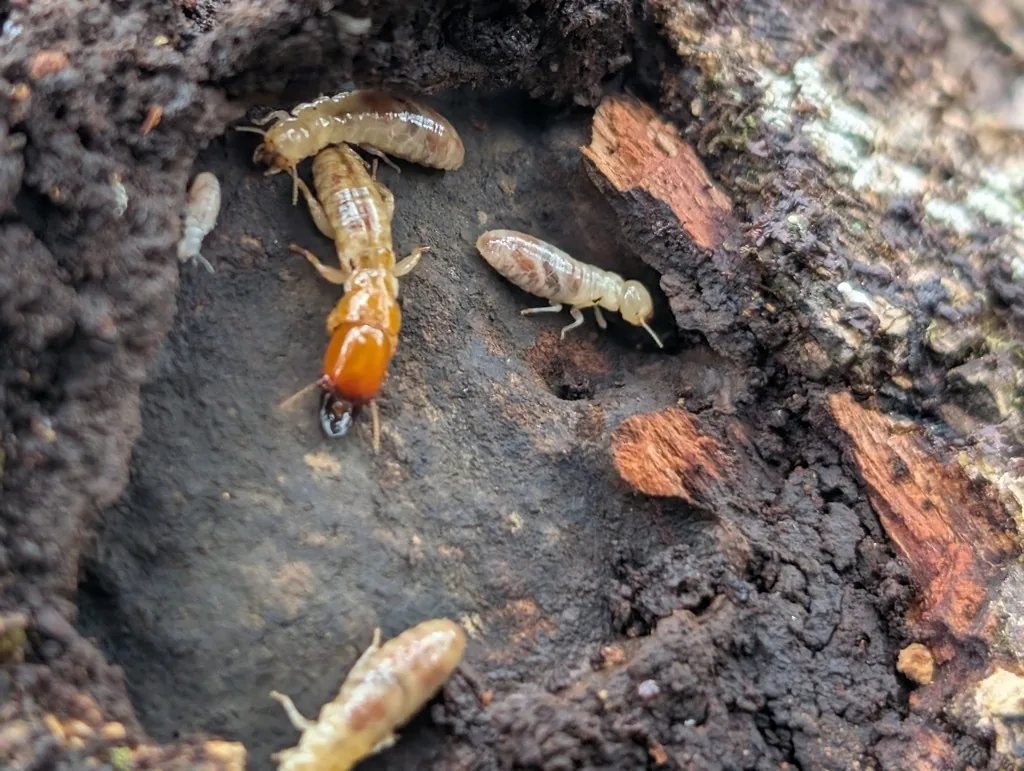
- Look for large, open galleries inside moist, decayed wood: UC IPM says dampwood termites live and feed in such galleries.[3]
- Winged adults are large, with two pairs of wings of about equal size that are lightly creased along the veins. Each forewing has five dark, enlarged veins near the base, and the enlarged median vein sets Neotermes apart from all other termites in Florida.[1]
- Telling the species apart: winged N. castaneus are reddish-brown with long (ca. 0.2-mm) hairs on the head and pronotum; N. jouteli and N. luykxi are reddish-orange with short hairs. N. jouteli is 14 to 16 mm long with wings, and N. luykxi 12 to 14 mm.[1]
- Soldiers vary a lot in size within a colony but are all large, 8.5 to 13.5 mm long, with at least two marginal teeth on the left mandible and a pronotum as wide as the head and much wider than long. N. castaneus soldiers have unpigmented eyes; N. jouteli and N. luykxi soldiers have darkened eyes and a club-shaped third antennal segment.[1]
- Like drywood termites they leave fecal pellets, but in their moist galleries the pellets lose their shape and form clumps or paste; the wetter the wood, the more shapeless they are.[1][4]
- When galleries full of live N. castaneus are opened, they give off a fecal, skatole-like odor.[1]
Look-alikes
| Look-alike | How to tell them apart |
|---|---|
| Subterranean termites | Dampwood termites live and feed inside moist wood, hollowing out large, open galleries; subterranean termites live in a network of galleries that extends into the ground. Finding dampwood termites points to a moisture problem or wood decay.[3] |
| Cuban subterranean termite (Prorhinotermes simplex) | A subterranean termite in a different family that, like Neotermes, often nests in fallen logs near the coast, and has sometimes been called 'the Florida dampwood termite'; that is why UF/IFAS notes Florida Neotermes have also been called southern dampwood termites. A 1972 USDA guide said it was known to attack building woodwork, but extremely rarely.[1][5] |
| Drywood termites (Cryptotermes, Incisitermes) | Same family, but drywood colonies don't need contact with free water and their pellets keep a distinct shape. Winged Neotermes are told apart from them, and from every other Florida termite, by the enlarged median vein in the forewing.[1] |
Where it lives
UF/IFAS says that in the eastern United States Neotermes are found only in Florida, where they are common in subtropical woodlands, mangrove forests and urban settings of the coastal peninsula and the Keys. N. castaneus is the most widespread, north to Merritt Island on the east coast and Pinellas County on the Gulf coast, with inland infestations in Orlando and along Lake Okeechobee; N. jouteli ranges from Vero Beach to the Keys, and N. luykxi from eastern Broward County to Key Largo. The AMNH termite treatise also lists N. castaneus from Bermuda, Brazil, Chile, Colombia, Cuba, Dominica, Guatemala, Haiti, Honduras, Jamaica, Montserrat, Nicaragua, Puerto Rico, Trinidad, the Turks and Caicos and Venezuela; N. jouteli from the Bahamas, Cuba, the Turks and Caicos and Mexico; and N. luykxi from the Bahamas and the Turks and Caicos. GBIF holds 9 U.S. records since 1990 each for N. castaneus and N. jouteli, all from Florida, and none for N. luykxi.[1][2][6][7][8]
Biology and life cycle
Dampwood termites live in moist wood, especially in stumps and fallen trees in forests, and need a lot of moisture.[3]
Colonies have reproductives (king, queen and winged alates), soldiers, which make up about 5% of the colony, and false workers that excavate and feed on wood for the colony. Colonies can reach several thousand termites, with galleries running many meters through the wood.[1]
A new colony starts when a winged pair sheds their wings and crawls into a crevice in a damp log or untreated fence post, a pruning scar or a tree hole, sealing the entrance behind them. The queen lays her first eggs a few weeks after mating, and it takes several years, with hundreds of termites, before the colony sends out its own winged adults.[1]
N. jouteli and N. luykxi fly in late spring or summer; N. castaneus flights peak in late fall or early winter. Flights are at dusk or at night, and the strong-flying alates are drawn to porch lights, indoor lights and video monitors, coming in through open doors and unscreened windows.[1]
N. castaneus prefers to nest in living trees and palms and can live there for years or decades before anyone notices, usually when a tree is pruned or damaged by a storm; it feeds on dead wood inside the trunk while avoiding the living cambium. The 1972 USDA Forest Service guide also records it in dead wood of trees, logs, stumps and branches and in living citrus trees.[1][5]
The USDA Forest Service guide says N. jouteli lives in nature in dead trees and in logs and branches lying on the ground.[5]
In a laboratory comparison of four termites, N. jouteli, from the wettest habitat, was the largest and held the highest share of body water, and it lost water faster than the two Cryptotermes species, which fits its life in wet wood.[9]
Damage and signs
- Dampwood termites in general infest decayed wood that stays moist through contact with the soil or a water leak, and hollow out large, open galleries in it.[3]
- In buildings, infestations are tied to free water: wood touching soil, wood exposed to roof leaks, or siding and trim wetted by rain or sprinklers. Once established, an infestation can extend into sound, dry wood several meters from the moisture source.[1]
- UF/IFAS rates them minor pests because so few conditions suit them, but damage can be severe after several years if an infestation is left alone. In trees, galleries may weaken trunks and branches without appearing to threaten the tree's survival, though the hollowing might let in decay fungi.[1]
Health risk
They feed on moist wood. UF/IFAS, UC IPM and the AMNH treatise don't mention any risk to people or pets.[1][3][2]
Control
Prevention
Fix the moisture. UC IPM treats dampwood termites as a sign of a moisture problem or wood decay, and UF/IFAS says removing the moisture controls structural infestations: once the source is gone, the colony gradually declines and dies of drying out.[3][1]
Keep wood out of contact with soil; UC IPM advises keeping wood beneath a building at least 12 inches above the soil.[3]
Remove wood-to-ground and wood-to-water contact, as for subterranean termites and wood decay. Wood pressure-treated with chromated copper arsenate (CCA) resists infestation.[1]
Pesticides
Where untreated wood can't be separated from a moisture source, UF/IFAS says chemical treatment may be needed. Water-soluble boron salts such as disodium octaborate tetrahydrate tend to be drawn into the wet, infested wood, but borates can harm plants; galleries in trees or structural wood can also be injected with insecticides suited to the site.[1]
When to call a professional
For termites inside a structure, UC IPM says a licensed professional inspection is needed before any treatment.[3]
Where the sources disagree
Size: the 1972 USDA Forest Service guide gives N. jouteli adults as yellowish or light chestnut brown and about 10 mm long; UF/IFAS gives winged N. jouteli as reddish-orange and 14 to 16 mm long including the wings.[5][1]
Buildings: the 1972 guide said N. jouteli occasionally occurs in moist foundation timbers and N. castaneus had not been found damaging building woodwork. UF/IFAS describes structural Neotermes infestations without singling out a species and shows N. jouteli damage in a beam removed from a house in Fort Lauderdale.[5][1]
Common questions
- Why do termites keep showing up in my wet wood siding?
- Dampwood termites need wood that stays wet. Leaks and soil contact keep wood moist and decayed enough for them, so the water source is the thing to fix.[3]
- Are there termites living in my tree?
- Possibly, in South Florida. N. castaneus prefers to nest in living trees and palms and is often found when a tree is pruned or storm-damaged; it has also been found in living citrus trees. UF/IFAS says the galleries may weaken trunks and branches but usually don't directly affect the tree's health.[1][5]
- I found large winged termites at my porch light in South Florida. Is my house infested?
- Not necessarily. UF/IFAS says winged dampwood termites found indoors usually come from a yard tree or woodland colony, only occasionally from an infestation in the building, and indoors they are unlikely to find the moist wood they need.[1]
Sources
- University of Florida IFAS Extension (EDIS), “Florida Dampwood Termites, Neotermes castaneus, N. jouteli and N. luykxi, EENY122/IN279 (R. H. Scheffrahn and N.-Y. Su; Featured Creatures).” ask.ifas.ufl.edu/publication/IN279 (accessed 2026-11-14)
- American Museum of Natural History, “Treatise on the Isoptera of the World, Volume 2: Basal Families (K. Krishna, D. A. Grimaldi, V. Krishna and M. S. Engel, 2013), Bulletin of the American Museum of Natural History 377.” digitallibrary.amnh.org/server/api/core/bitstreams/60e2fd34-31b3-45a9-b095-70aa5eaf6e23/content (accessed 2026-11-13). PDF from the AMNH Digital Library record https://digitallibrary.amnh.org/items/f1b1e9eb-f123-4b0c-a3da-82f2cff9235f; species entries for Neotermes castaneus, N. jouteli and N. luykxi.
- University of California Statewide IPM Program, “Pest Notes: Subterranean and Other Termites, Publication 7415 (May 2014).” ipm.ucanr.edu/legacy_assets/PDF/PESTNOTES/pntermites.pdf (accessed 2026-11-13)
- Insects (MDPI), via PubMed Central, “A Comparison of Morphology among Four Termite Species with Different Moisture Requirements (Zukowski and Su, Insects 2020;11:262).” pmc.ncbi.nlm.nih.gov/articles/PMC7291196/ (accessed 2026-11-14)
- USDA Forest Service, “Eastern Forest Insects, Miscellaneous Publication 1175 (W. L. Baker, February 1972; scanned copy).” archive.org/details/easternforestins1175bake (accessed 2026-11-14)
- Global Biodiversity Information Facility (GBIF), “Neotermes castaneus: U.S. occurrence records since 1990 by state (GBIF occurrence API).” api.gbif.org/v1/occurrence/search?taxonKey=2007335&country=US&hasGeospatialIssue=false&occurrenceStatus=PRESENT&year=1990%2C2026&facet=stateProvince&facetLimit=400&limit=0 (accessed 2026-11-13). 9 records, all Florida; fetched 2026-11-13.
- Global Biodiversity Information Facility (GBIF), “Neotermes jouteli: U.S. occurrence records since 1990 by state (GBIF occurrence API).” api.gbif.org/v1/occurrence/search?taxonKey=2007332&country=US&hasGeospatialIssue=false&occurrenceStatus=PRESENT&year=1990%2C2026&facet=stateProvince&facetLimit=400&limit=0 (accessed 2026-11-13). 9 records, all Florida; fetched 2026-11-13.
- Global Biodiversity Information Facility (GBIF), “Neotermes luykxi: U.S. occurrence records since 1990 by state (GBIF occurrence API).” api.gbif.org/v1/occurrence/search?taxonKey=2007331&country=US&hasGeospatialIssue=false&occurrenceStatus=PRESENT&year=1990%2C2026&facet=stateProvince&facetLimit=400&limit=0 (accessed 2026-11-13). 0 records; fetched 2026-11-13.
- Journal of Insect Science, via PubMed Central, “Cuticular Permeability, Percent Body Water Loss, and Relative Humidity Equilibria Comparisons of Four Termite Species (Zukowski and Su 2019).” pmc.ncbi.nlm.nih.gov/articles/PMC6790248/ (accessed 2026-11-14)
- Global Biodiversity Information Facility (GBIF), “Neotermes castaneus (Burmeister, 1839) (GBIF Backbone Taxonomy).” api.gbif.org/v1/species/2007335 (accessed 2026-11-13). ACCEPTED; order Blattodea, family Kalotermitidae; vernacular name Florida Dampwood Termite
- Global Biodiversity Information Facility (GBIF), “Neotermes jouteli (Banks, 1919) (GBIF Backbone Taxonomy).” api.gbif.org/v1/species/2007332 (accessed 2026-11-13). ACCEPTED; order Blattodea, family Kalotermitidae
- Global Biodiversity Information Facility (GBIF), “Neotermes luykxi Nickle & Collins, 1989 (GBIF Backbone Taxonomy).” api.gbif.org/v1/species/2007331 (accessed 2026-11-13). ACCEPTED; order Blattodea, family Kalotermitidae