On this page
How to identify it
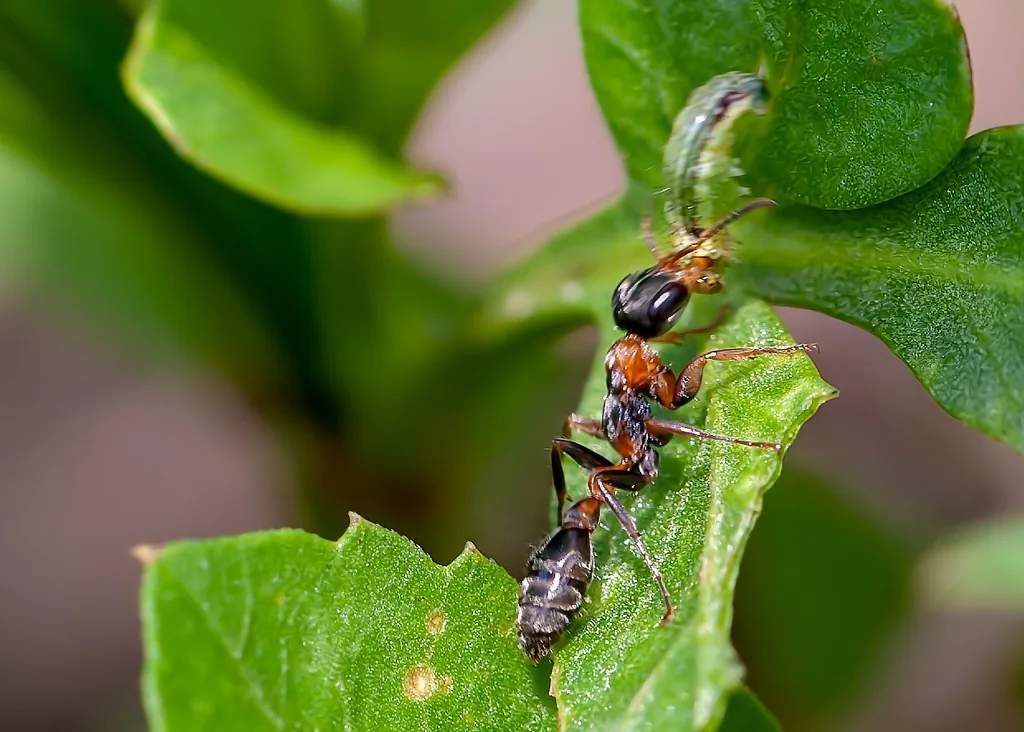
- Workers are large for an ant, about 8 to 10 mm (roughly 1/3 inch) long, with an elongate, wasp-like body.[1]
- Color varies by region, from mostly black to all orange-brown. Most specimens from the southeastern U.S. are two-toned: orange antennae, legs and front of the thorax, with a dark brownish-black head and abdomen. UF/IFAS says Florida specimens are mostly two-toned, with a black head and abdomen and an orange middle, a bright pattern that may warn predators of its sting.[1][3]
- The eyes are extremely large, more than half the length of the head, and the waist has two long segments.[1]
- The body is covered with fine silvery-white hairs plus longer erect hairs, and workers have a well-developed sting at the tip of the abdomen.[1]
- UF/IFAS describes the worker larva as about 6 mm (1/4 inch) long, slim and covered with short hairs; adult workers feed it firm, dry pellets placed in a pocket just behind its mouth.[3]
- Workers usually forage alone on plants, buildings and other structures. A 2010 Florida Entomologist review says their large eyes and apparently excellent vision let them dodge predators and collectors by dropping to the ground.[4]
Look-alikes
| Look-alike | How to tell them apart |
|---|---|
| Other twig ants (Pseudomyrmex) | All twig ants share the slender body, extremely large eyes, short antennal bases and sting that set the genus apart from other U.S. ants. The elongate twig ant is easily told from every other U.S. twig ant by its large size, orange and brown coloring and many long erect hairs.[1] |
Where it lives
Thought to be native to Mexico, it ranges from Argentina and Brazil north through the Caribbean and Texas. In the U.S. it occurs from Texas east to Florida and north to South Carolina in the Coastal Plain, with museum records from Alabama, California, Florida, Georgia, Hawaii, Louisiana, Mississippi, South Carolina and Texas. GBIF's 1990-2026 U.S. records come mostly from Florida and Texas, then Louisiana, Hawaii and Alabama. The 2010 review says it was first found in southeast Florida in 1960 (UF/IFAS places the first find in Dade County); by 2010 it was common from the Keys north through much of the state, with records from 40 Florida counties. A population turned up in Mississippi in 2009, Louisiana records all date from 1995 on, and in Hawaii it was first found on Oahu in 1976, with more than 20 reports from Oahu, Kaho'olawe and Maui.[1][5][3][4]
Biology and life cycle
It lives in trees and shrubs, nesting in hollow twigs, branches, stems and grasses in natural areas and in crevices of buildings in towns. UF/IFAS says it can dig its own cavity in soft material but often uses tunnels left by long-horned beetles, and in Florida it has nested in ant-acacias and in Brazilian peppertrees killed by freezes.[1][3]
Colonies are usually small, with one queen. UF/IFAS says the nest has only one small entrance. Workers lay no known scent trails; when a colony moves, workers carry nestmates, gripping them by the waist or head.[1][3]
It turns up in many habitats, from mangrove forest, thorn scrub and rainforest to disturbed places such as old fields, roadsides and second-growth forest. It sometimes nests in the hollow thorns of ant-acacias but gives those trees little protection. UF/IFAS calls it a generalist, nesting high in trees, in blades of grass and in shoulder-high shrubs, and says it defends its host plant by swarming and stinging intruders.[1][3]
Like several other tree-nesting ants, workers that fall can steer a gliding descent back toward a tree trunk using their large eyes; experiments on this species found that covering the small simple eyes (ocelli) didn't affect their gliding.[6]
Damage and signs
- It isn't a wood or plant pest. The Mississippi Entomological Museum lists it among southeastern pest ants because of its sting and frequent contact with people, and nests have been reported in wooden door frames of houses. UF/IFAS says it does little or no damage to ornamental plants or structures, though one survey found it nesting in wooden doors inside several homes.[1][3]
- Its status as an invasive species in the U.S. is unclear, but museum scientists consider it worth monitoring because it appears to be spreading in the Southeast. A Florida ant survey quoted in the 2010 review called it a possible ecological villain: much larger than any of Florida's seven native twig ants, very abundant in south and central Florida, more likely to crowd out several native carpenter ants, and possibly a threat to native butterflies and moths.[1][4]
Health risk
Workers can sting. On a peer-reviewed 1-to-4 sting pain scale, where a honey bee sting is a 2, the twig ant's sting rated 1 (minor pain). Twig ants (Pseudomyrmex) are among the ant genera reported to cause severe allergic or allergy-like reactions in people, and anyone allergic to stings can have a life-threatening reaction. The 2010 review says workers are not aggressive and generally sting only if trapped under clothing or swatted.[2][7][8][4]
Control
Prevention
Look for nests where it actually lives: hollow twigs, dead branches and grass stems outdoors, and building crevices or wooden door frames when workers keep turning up inside. UF/IFAS says management is not necessary, because it is usually met outdoors in small numbers.[1][3]
If someone is stung
Wash the sting with soap and water, then hold a cloth-wrapped ice pack on it, 10 minutes on and 10 minutes off. Try not to scratch, which can add swelling, itching and infection risk.[9][8]
Keep watching the person for an allergic reaction. Call 911 for wheezing or trouble breathing, swelling of the face or mouth, a tight throat or trouble swallowing, or weakness. People with a known severe sting allergy should carry their epinephrine auto-injector.[9][8]
Where the sources disagree
Sting: UF/IFAS calls it relatively painful and the 2010 review painful, while a peer-reviewed sting-pain survey rated it 1 (minor) on a 1-to-4 scale.[3][4][2]
Range: the 2010 review found no records from Alabama or Georgia, while the Mississippi Entomological Museum lists both among its U.S. records.[4][1]
Common questions
- Is this an ant or a wasp?
- An ant. Its slender body, huge eyes and orange-and-black colors look wasp-like, but it has the two-segmented waist and 12-segmented antennae of an ant.[1]
- How bad is a twig ant sting?
- In a peer-reviewed sting-pain survey it scored 1 on a 1-to-4 scale, below a honey bee sting. An allergic reaction is still possible, so watch for trouble breathing or swelling of the face and throat.[2][7][9]
- Where do twig ants nest?
- In hollow twigs, branches, plant stems and grasses, and sometimes in building crevices and wooden door frames.[1]
- Will an elongate twig ant sting if I leave it alone?
- Rarely. The 2010 Florida Entomologist review says workers aren't aggressive and generally sting only when trapped under clothing or swatted.[4]
Sources
- Mississippi Entomological Museum, Mississippi State University, “Pseudomyrmex gracilis (Joe A. MacGown, updated April 2016).” mem.org.msstate.edu/Researchtaxapages/Formicidaepages/genericpages/Pseudomyrmex.gracilis.htm (accessed 2026-11-14)
- Toxins (MDPI), via PubMed Central, “Schmidt JO (2019), Pain and lethality induced by insect stings: an exploratory and correlational study, Toxins 11(7):427.” pmc.ncbi.nlm.nih.gov/articles/PMC6669698/ (accessed 2026-11-14). Cited from the open-access full text, Table 1 (sting pain scale 1 to 4; PubMed 31330893).
- University of Florida IFAS Extension (EDIS), “Slender Twig Ant, Pseudomyrmex gracilis (Fabricius), EENY-418/IN752 (Featured Creatures).” ask.ifas.ufl.edu/publication/IN752 (accessed 2026-11-14)
- Florida Entomological Society (Florida Entomologist, via journals.flvc.org), “Worldwide spread of the graceful twig ant, Pseudomyrmex gracilis (Hymenoptera: Formicidae) (J. K. Wetterer), Florida Entomologist 93(4):535-540, 2010.” journals.flvc.org/flaent/article/download/76156/73814/76364 (accessed 2026-11-14)
- Global Biodiversity Information Facility (GBIF), “Pseudomyrmex gracilis (elongate twig ant): occurrence records in the U.S., 1990-2026 (GBIF occurrence search).” api.gbif.org/v1/occurrence/search?taxonKey=1327098&country=US&hasGeospatialIssue=false&occurrenceStatus=PRESENT&year=1990%2C2026&facet=stateProvince&facetLimit=400&limit=0 (accessed 2026-11-11). State counts are records reported (iNaturalist research-grade, museum specimens, surveys), not abundance.
- Integrative and Comparative Biology, via PubMed, “Yanoviak SP, Munk Y, Dudley R (2011), Evolution and ecology of directed aerial descent in arboreal ants, Integrative and Comparative Biology 51(6):944-956.” pubmed.ncbi.nlm.nih.gov/21562023/ (accessed 2026-11-11). Cited from the PubMed abstract.
- Annals of Allergy, Asthma and Immunology, via PubMed, “Klotz JH, deShazo RD, Pinnas JL, Frishman AM, Schmidt JO, Suiter DR, Price GW, Klotz SA (2005), Adverse reactions to ants other than imported fire ants, Annals of Allergy, Asthma and Immunology 95(5):418-425.” pubmed.ncbi.nlm.nih.gov/16312163/ (accessed 2026-11-11). Cited from the PubMed abstract.
- CDC, National Institute for Occupational Safety and Health, “Insects and Scorpions at Work.” www.cdc.gov/niosh/outdoor-workers/about/insects-and-scorpions.html (accessed 2026-11-11)
- MedlinePlus, U.S. National Library of Medicine, “Insect bites and stings (Medical Encyclopedia 000033).” medlineplus.gov/ency/article/000033.htm (accessed 2026-11-11)
- iNaturalist, “Pseudomyrmex gracilis taxon page (order and family).” www.inaturalist.org/taxa/1418419 (accessed 2026-11-11)