On this page
How to identify it
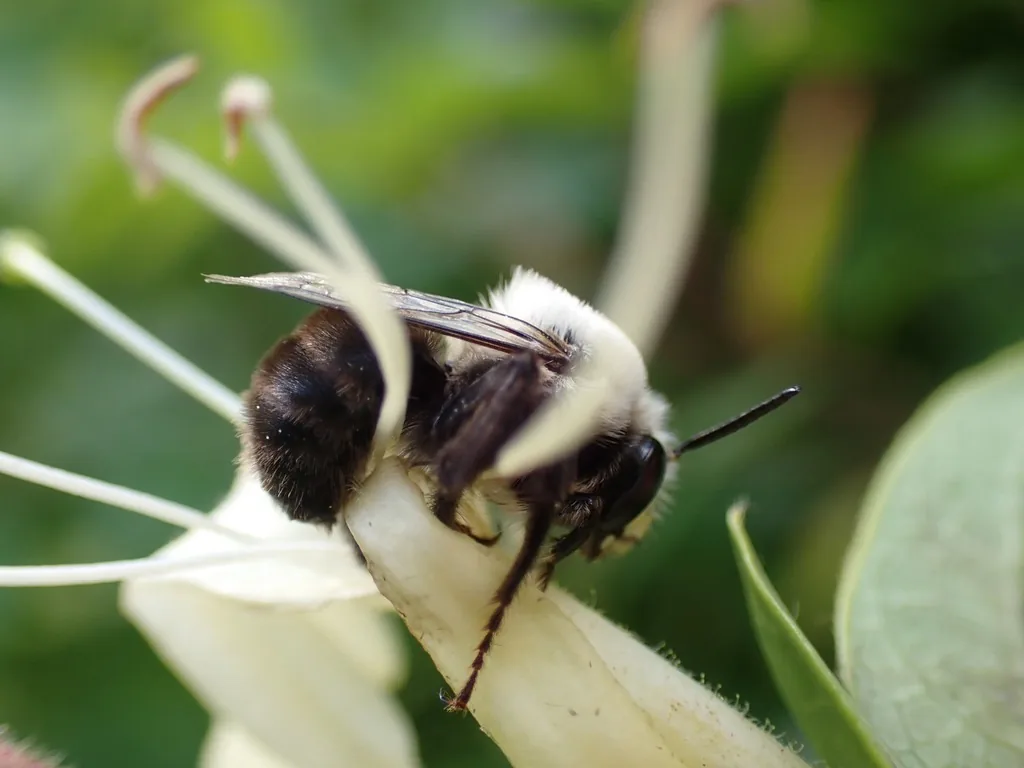
- Digger bees in its genus, Anthophora, are usually medium-sized and look like small, fast, sometimes grayish bumble bees. UF/IFAS says the head, legs and abdomen are lightly covered in brown-black hairs, the thorax in dense pale yellow-orange hairs, and the wings are nearly clear to slightly cloudy with brown-black veins.[1][2]
- Missouri's conservation department calls this species the abrupt digger.[1]
- The best clue is the nest site: many burrows side by side in vertical bare dirt, such as banks and the bases of bluffs, with mud chimneys over the entrances.[1]
- UF/IFAS gives females as 14.5 to 17 mm long and males as 12 to 17 mm. Males have a fringe of hairs on the edge of the yellow face, which earns them the name mustached mud bee and carries pheromones that attract females.[2]
- UF/IFAS says each turret marks a single nest. Turrets take about six hours to build and average about 8 cm long, smooth inside and rough outside; the tunnel below averages about 11 cm, with about seven urn-shaped cells dug into its sides.[2]
Look-alikes
| Look-alike | How to tell them apart |
|---|---|
| Ground-nesting bumble bees | Bumble bees are larger and live in colonies. Digger bees are solitary even when hundreds nest together: each female digs and stocks her own burrow.[1][3] |
| Mining bees | Other ground-nesting bees dig holes about 1/4 inch across in sunny, bare patches of lawn, sometimes with loose dirt piled around them rather than a mud chimney.[3][1] |
Where it lives
Eastern and central United States. GBIF lists about 2,360 US records since 1990 from 29 states and the District of Columbia, west to Texas, Oklahoma and Kansas and north to Wisconsin, Michigan and New York; most come from Texas, Virginia, North Carolina, Missouri and Maryland, and only about 15 from Florida. MDC shows a nest site along the Katy Trail in Missouri. UF/IFAS gives the range as Texas to the East Coast and Florida into Canada, and says Florida records have been uncommon since the 1980s.[4][1][2]
Biology and life cycle
Females line their earthen brood cells with an oily secretion from an abdominal gland (the Dufour's gland) and mix it into the pollen and nectar stored for each larva. There it turns solid and becomes food for the larvae, a use researchers compared to the royal jelly of honey bees. UF/IFAS says the lining starts as a clear liquid and hardens into a wax-like plate that waterproofs the cell.[5][2]
Adults feed on pollen and nectar.[1]
UF/IFAS says adults emerge from March to late June depending on region and climate, sometimes as late as August. Males come out about five days before females and outnumber them about two to one; mating takes place on a flower.[2]
UF/IFAS says a female lays one egg on a soupy mix of pollen and nectar in each cell and seals it with clay. The egg hatches in about five days, the larva feeds for about three weeks, and it spends about nine and a half months as a resting prepupa before becoming an adult the next spring or summer.[2]
UF/IFAS says nests are often in cliff banks, clay adobe walls and clay banks along creeks and rivers, sometimes under a bridge or tree, and females collect water to soften hard clay. One nest site was conservatively estimated at as many as five thousand cells.[2]
UF/IFAS says they forage in light rain at 11 to 39°C (51 to 102°F), usually foraging in the morning and building in the afternoon, and visit many kinds of flowers.[2]
Damage and signs
- Clemson notes that thin turf blamed on ground-nesting bees usually comes from poor growing conditions; the bees simply prefer the bare, sunny, well-drained spots that weak turf leaves.[3]
Health risk
Digger bees are not aggressive, and Clemson says female ground-nesting bees can sting but seldom do unless provoked or handled roughly. If someone is stung, scrape any stinger out with a straight edge instead of pinching it with tweezers, wash the spot with soap and water, and apply ice wrapped in a cloth. Call 911 for anyone with trouble breathing or other signs of a severe allergic reaction, and see an allergist after any bodywide reaction.[1][3][6][7]
Control
Prevention
Leave them be where you can. Ground-nesting bees are pollinators and only a short-term nuisance, and Clemson does not recommend insecticides for them. UF/IFAS calls chimney bees docile, beneficial pollinators that should not be considered a threat, and potential pollinators of crops such as cranberry, tomato, blackberry, asparagus, persimmon, clover and raspberry.[3][2]
To discourage nesting in a yard, thicken the turf, or mulch or plant a groundcover where grass won't grow.[3]
Florida records and nest-site research
In April 2010 a nesting group was found in open bags of colloidal clay in an open-air shed in Gainesville, Florida. The state's arthropod collection held no earlier specimen from that county, and its most recent Florida specimen dated from 1987, which the authors say suggests the bee may be locally rare and possibly in decline or threatened regionally.[8]
In the same study, dormant nest splits moved 10.3 km and 35.7 km from the original site produced bees that emerged the next year and nested in clay provided at the new sites, which the authors present as a possible way to manage this pollinator.[8]
A 2017 note gave the first report of chimney bees nesting in the root plates of uprooted trees. Previously reported sites were vertical riverbanks and man-made clay structures, and the authors suggest root plates may be a preferred nest site in forests.[9]
Common questions
- What are the little mud chimneys in the dirt bank in my yard?
- Likely digger bee nests; these bees often build mud chimneys over their burrow entrances, and the chimney bee nests in large groups on banks.[1]
- Do chimney bees sting?
- Rarely. Digger bees are not aggressive, and ground-nesting bee females tend to sting only when handled roughly or provoked. UF/IFAS says they are not defensive of their nests and do not typically sting, though they may bite if roughly handled.[1][3][2]
- Should I spray them?
- Clemson does not recommend insecticides for ground-nesting bees; they are pollinators and only a temporary nuisance.[3]
- Why do chimney bees build chimneys?
- No one reason is settled. UF/IFAS lists proposed purposes including protection from rain or parasites, keeping burrows from filling with debris or nearby digging, helping a bee recognize her nest, drawing other females to nest nearby, and acting as solar heaters.[2]
Sources
- Missouri Department of Conservation, “Apid Bees, Field Guide.” mdc.mo.gov/discover-nature/field-guide/apid-bees (accessed 2026-11-11)
- University of Florida IFAS Extension (EDIS), “Miner Bee, Chimney Bee, Anthophora abrupta Say, EENY-512/IN912 (Featured Creatures).” ask.ifas.ufl.edu/publication/IN912 (accessed 2026-11-14)
- Clemson Cooperative Extension Home & Garden Information Center, “Spring Has Sprung and So Have The (Ground-Nesting) Bees.” hgic.clemson.edu/spring-has-sprung-and-so-have-the-ground-nesting-bees/ (accessed 2026-11-11)
- Global Biodiversity Information Facility (GBIF), “Anthophora abrupta: US occurrence records since 1990 by state (GBIF occurrence search API).” api.gbif.org/v1/occurrence/search?taxonKey=5040217&country=US&hasGeospatialIssue=false&occurrenceStatus=PRESENT&year=1990%2C2026&facet=stateProvince&facetLimit=400&limit=0 (accessed 2026-11-11)
- Science, via PubMed, “Anthophora bees: unusual glycerides from maternal Dufour's glands serve as larval food and cell lining (Norden et al. 1980).” pubmed.ncbi.nlm.nih.gov/17759841/ (accessed 2026-11-11)
- MedlinePlus, U.S. National Library of Medicine, “Insect bites and stings (Medical Encyclopedia).” medlineplus.gov/ency/article/000033.htm (accessed 2026-11-11)
- CDC, National Institute for Occupational Safety and Health, “Insects and Scorpions at Work.” www.cdc.gov/niosh/outdoor-workers/about/insects-and-scorpions.html (accessed 2026-11-11)
- Florida Entomological Society (Florida Entomologist, via journals.flvc.org), “The potential management of a ground-nesting, solitary bee: Anthophora abrupta (Hymenoptera: Apidae) (J. R. Graham, E. Willcox, J. D. Ellis), Florida Entomologist 98(2):528-535, 2015.” journals.flvc.org/flaent/article/view/84875 (accessed 2026-11-14)
- Florida Entomological Society (Florida Entomologist, via journals.flvc.org), “The use of root plates for nesting sites by Anthophora abrupta may be common within forested habitats (J. Campbell et al.), Florida Entomologist 100(2):488-490, 2017.” journals.flvc.org/flaent/article/view/90540 (accessed 2026-11-14)
- iNaturalist, “Anthophora abrupta taxon page (order and family).” www.inaturalist.org/taxa/134150 (accessed 2026-11-11)