On this page
How to identify it
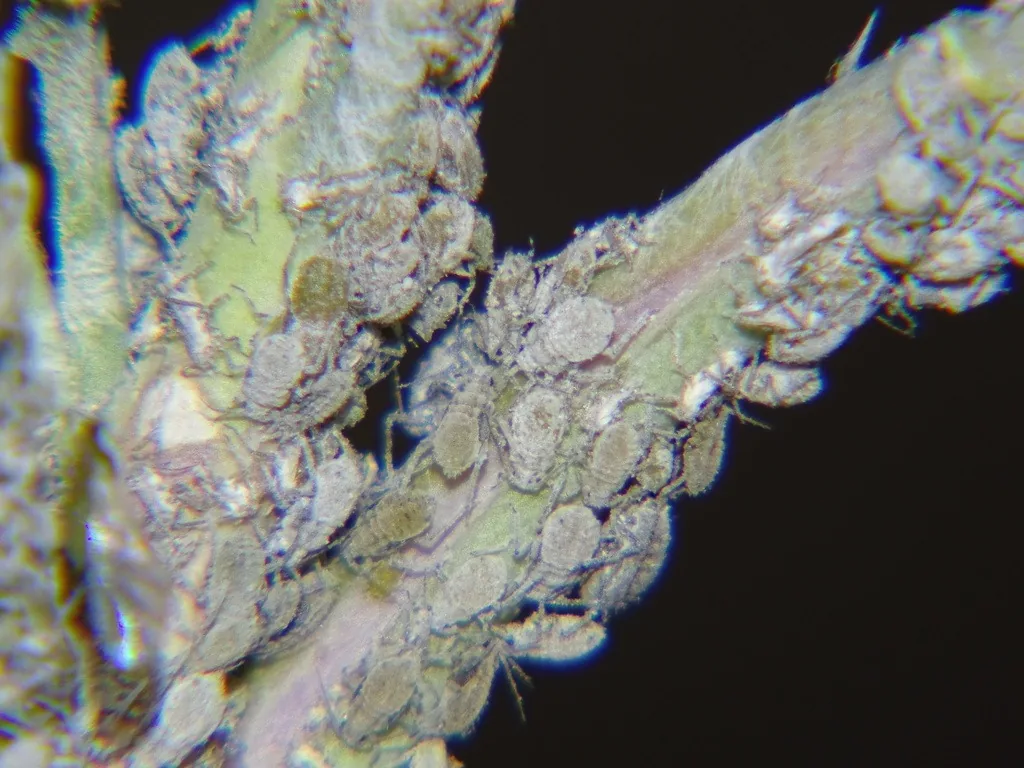
- They are gray-green but usually look gray or white because of the dusty wax covering their bodies; the wax also coats infested leaves. Only newly molted aphids and some young nymphs lack the wax and look brighter green. UF/IFAS adds that wingless adults have eight dark spots on the top of the abdomen under the wax, getting larger toward the rear.[1][5][2][4]
- Both adults and nymphs have dark heads and short cornicles (the two 'tailpipes' at the rear), shorter than the tail-like cauda. UF/IFAS notes that the genus name Brevicoryne loosely means 'small pipes,' and that its cornicles are shorter than those of other aphids except the turnip aphid; short cornicles plus the waxy coat set it apart from other aphids on the same plants.[1][3][5][4]
- Winged adults have a dark brown to black head and thorax and dark legs. UW-Madison gives adults as 2.0 to 2.5 mm long. UF/IFAS describes the winged form as smaller than wingless females and without their wax, with short wings, prominent veins and a yellow abdomen marked with dark spots and a dark band across the last segment.[2][5][1][6][4]
- Colonies are dense, often on leaf undersides, on young leaves and flower buds, and deep inside Brussels sprouts and cabbage heads.[1][3][2]
Look-alikes
| Look-alike | How to tell them apart |
|---|---|
| Turnip aphid | Turnip aphids carry only a thin, slightly visible layer of wax, much less than cabbage aphids. UF/IFAS calls the two difficult to tell apart: it gives cabbage aphids as 2.0 to 2.5 mm (0.08 to 0.1 in) long with a grayish waxy covering, and turnip aphids as 1.6 to 2.2 mm (0.06 to 0.09 in) with no such covering.[5][4] |
| Green peach aphid | Green peach aphids lack the heavy waxy powder, and their cornicles are longer than the cauda, not shorter. UF/IFAS adds that green peach aphids mainly attack cabbage before the head forms, while cabbage aphids attack at any stage.[5][4] |
| Other aphids | Of the aphids on cabbage-family crops, only the cabbage aphid is heavily covered in white waxy powder that also dusts the infested leaf.[5] |
Where it lives
Extension services treat it as a pest of cabbage-family crops from California and Utah to New England. In Texas, where at least five aphids attack these crops, it is usually not a major pest in South Texas. UF/IFAS says it is native to Europe, now found worldwide, widely distributed in the U.S. and more of a pest in the southern states; severe damage has been reported in Canada, the Netherlands, South Africa, India and China.[2][3][1][5][4]
Biology and life cycle
In New England, eggs laid on the undersides of brassica leaves in fall spend the winter there and hatch around April; aphids can also overwinter as nymphs in high or low tunnels and heated greenhouses. In much of California, females give birth to live young all year.[1][2][3]
In spring, winged females are blown into fields on the wind, so early infestations are patchy. Spring and summer generations are all females that reproduce without mating; males and egg-laying females appear in fall.[1][3]
When a colony gets crowded or the plant declines, winged adults are produced and fly off to colonize nearby plants. There are many overlapping generations a year.[3][1][2]
Populations grow faster in cool weather: reproduction is highest at 50 to 68 °F, and nymphs stop developing at 95 °F. Rain can wash the loosely attached aphids off, and insect-killing fungi are more common in wet weather.[1]
It feeds only on plants in the cabbage family (Brassicaceae), including weedy mustards around fields. UF/IFAS lists cauliflower, Brussels sprouts, broccoli, cabbage, oilseed rape, mustards, Chinese broccoli, Chinese cabbage, radish and kale among its hosts and calls it an especially big problem in broccoli and cabbage.[2][1][4]
UF/IFAS says that in warm climates such as Florida and Hawaii, females give birth to female nymphs without mating and no eggs are laid; in temperate areas, cooler weather or shorter days bring on males and egg-laying. Generations overlap, up to 15 in a crop season, and the life cycle takes 16 to 50 days, shorter at higher temperatures. The nymphal period lasts seven to ten days.[4]
Damage and signs
- Feeding leaves wrinkled, downward-curling, yellow leaves and slows growth. Large colonies after thinning or transplanting can stunt or kill small plants, and heavy infestations can keep cabbage from forming heads.[1][2][6]
- The biggest problem is often contamination: aphids, honeydew, sooty mold and wax in or near the harvested part of the crop can make it unmarketable. UF/IFAS notes that in Oregon, contamination of some broccoli heads can lead processors to reject an entire harvest.[2][1][5][4]
- It can transmit cauliflower mosaic and cabbage ring spot viruses, among others, passing them to new plants by brief probing. UF/IFAS calls it a vector of at least 20 plant viruses and says wingless aphids transmit them at a higher rate than winged ones.[1][4]
- UF/IFAS says continued feeding causes yellowing, wilting and stunting, and heavily infested plants become covered with masses of small, sticky aphids, which can lead to leaf death and decay. Ants feed on the honeydew and in turn protect the aphids from natural enemies.[4]
Health risk
It feeds only on plants; none of these sources reports any risk to people or pets.[2][1]
Control
Prevention
Check transplants before planting, and pull out infested plants early in the season; wingless cabbage aphids don't move much, so one badly infested plant often sits among clean ones. Reflective mulches, row covers and avoiding excess nitrogen also help. For home growers, UF/IFAS suggests reflective mulch to repel aphids and yellow pans filled with water to monitor them, and weekly scouting.[2][1][3][4]
Sanitation
Destroy or till in crop remnants right after harvest; fall crops left standing should be turned in before eggs hatch in April. Remove mustards and other brassica weeds around the garden. UF/IFAS adds plowing the field right after harvest, rotating with non-host crops, and not replanting where an infested crop was just removed.[2][1][3][4]
Biological control
The parasitic wasp Diaeretiella rapae leaves bronze 'mummies' in colonies, and lady beetles, syrphid fly larvae, lacewings and fungi also attack cabbage aphids, though they may not keep up in cool fall weather or reach aphids deep in heads. Flowering dill, cilantro and alyssum drew syrphid flies in UMass trials, but alyssum also attracted flea beetles. UF/IFAS says Diaeretiella rapae prefers half-grown nymphs and leaves a light brown, hard shell, but by the time the wasps are numerous enough to control aphids, numbers have usually passed damage thresholds; sweet alyssum has been tested as a nectar plant for beneficial insects in cabbage.[1][2][3][4]
Pesticides
Start early, before infestations get heavy, and get full coverage of leaf undersides, buds and new growth. Insecticidal soap gives partial control and can injure Brussels sprouts and cabbage at higher rates; azadirachtin, oils and soaps used together work better than any one alone. Read and follow the label. UF/IFAS stresses that sprays must thoroughly wet the plants because of the waxy coating, and notes Bacillus thuringiensis products don't work on aphids, though using them against caterpillars early spares the natural enemies that usually keep aphids in check.[2][1][4]
Many aphids have become resistant to some pyrethroids, carbamates and organophosphates, so choose products that are easier on natural enemies. UF/IFAS cites a Pakistan study in which field populations became resistant to pyrethroids and neonicotinoids, with resistance rising with regular use on vegetables.[3][4]
Where sources disagree
Winged adults: Texas A&M says winged cabbage aphids are slightly larger than wingless ones and carry much less wax, while UW-Madison describes the winged form as smaller and without wax.[5][6]
Mustards: UC IPM and UMass say it feeds on brassicas including weedy mustards, while Texas A&M says mustard and other leafy greens are rarely, if ever, infested in Texas.[2][1][5]
Turnip aphid wax: Texas A&M says turnip aphids carry a thin, slightly visible layer of wax; UF/IFAS says they have no such covering.[5][4]
Where it's worst: UF/IFAS says it is more of a pest in the southern states, while Texas A&M says it is usually not a major pest in South Texas.[4][5]
Overwintering eggs: UMass says eggs are laid on the undersides of brassica leaves; UF/IFAS says eggs overwinter in plant debris near the soil surface in temperate climates.[1][4]
Common questions
- What are the gray waxy bugs on my broccoli?
- Cabbage aphids, which form dense colonies coated in gray, waxy powder on cabbage-family plants.[1][2][5]
- When are they worst?
- In cool weather, especially late summer and fall on long-season crops such as Brussels sprouts; they reproduce fastest at 50 to 68 °F. UF/IFAS calls them serious pests under cool and dry conditions.[1][4]
- Do ants have anything to do with cabbage aphids?
- Yes. UF/IFAS says ants feed on the aphids' sugary honeydew and in turn protect them from natural enemies.[4]
Sources
- UMass Amherst Center for Agriculture, Food, and the Environment, “Cabbage Aphid (Vegetable fact sheet, updated 2025).” www.umass.edu/agriculture-food-environment/vegetable/fact-sheets/cabbage-aphid (accessed 2026-11-14)
- University of California Statewide IPM Program, “Cabbage Aphid (Cole Crops: Agriculture Pest Management Guidelines).” ipm.ucanr.edu/agriculture/cole-crops/cabbage-aphid/ (accessed 2026-11-14)
- Utah State University Extension, “Cabbage Aphid.” extension.usu.edu/vegetableguide/brassica/cabbage-aphids (accessed 2026-11-14)
- University of Florida/IFAS Extension (Featured Creatures), “Cabbage Aphid, Brevicoryne brassicae Linnaeus, EENY-577/IN1014.” ask.ifas.ufl.edu/publication/IN1014 (accessed 2026-11-14)
- Texas A&M AgriLife Extension, “Aphids on Cruciferous Crops: Identification and Management (B-6109).” texaslocalproduce.tamu.edu/files/2018/07/Aphids-on-Cruciferous-Crops-Identification-and-Management.pdf (accessed 2026-11-14)
- University of Wisconsin-Madison, Department of Entomology, “Aphids (UW Vegetable Entomology).” vegento.russell.wisc.edu/pests/aphids/ (accessed 2026-11-14)
- iNaturalist, “Brevicoryne brassicae taxon page (order and family).” www.inaturalist.org/taxa/326910 (accessed 2026-11-14)