On this page
How to identify it
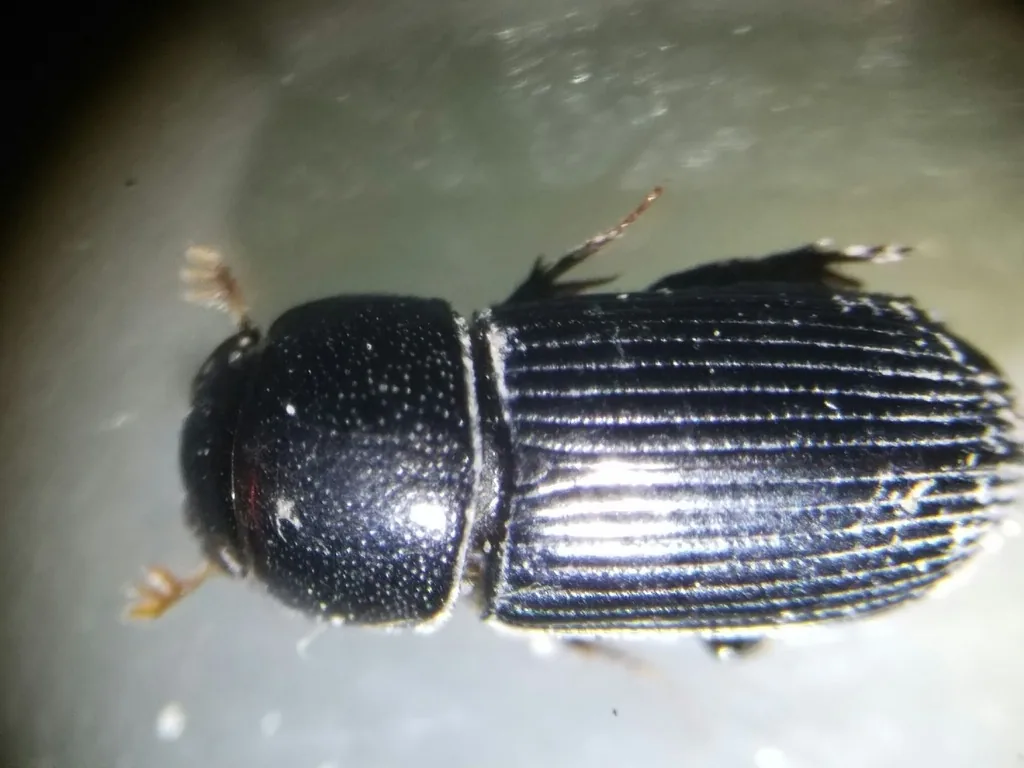
- Adults are shiny jet-black beetles only about 3/16 to 1/5 inch long, with clubbed antennae and parallel grooves along the wing covers.[1][2][5]
- Grubs are whitish and C-shaped with six legs and reddish to brown heads, often with a grayish rear end, but they stay small, about 1/4 to 1/3 inch when grown.[1][5][2]
- Under a magnifier, the last abdominal segment shows scattered bristles with no distinct pattern and a pair of pads at the very tip.[1][4]
Look-alikes
| Look-alike | How to tell them apart |
|---|---|
| Other white grubs (masked chafers, Japanese beetle, May/June beetles) | Ataenius grubs stay tiny, barely 5/16 inch, so finding larger grubs points to masked chafers, Japanese beetles or May and June beetles instead.[2][5] |
| Ground beetles | Some predaceous ground beetles look similar to ataenius adults, so check the size, grooved wing covers and clubbed antennae.[1] |
| Aphodius beetles | Aphodius adults are nearly identical small shiny black beetles but have a stair-step outline on the hind leg, where the ataenius leg looks smooth; Aphodius grubs carry a V-shaped pattern of hairs on the last segment. In Michigan, Aphodius grub damage peaks in June, a month before ataenius.[4][1] |
Where it lives
Found throughout North America and native to the United States; it can seriously damage golf course turf, though in Kansas it rarely causes damage despite large evening flights. Utah State lists it among the white grubs established in Utah.[2][4][6]
Biology and life cycle
Unlike most lawn grubs, it spends the winter as an adult, sheltered in the soil and under leaf and wood debris.[2][3][5][4]
Adults become active in early spring, and females lay eggs in thatch and soil in late spring and early summer.[2][3][5]
Grubs feed through June into early July, then pupate; in many years new adults lay eggs for a second generation in late July.[3][2][5]
Besides roots, the larvae also thrive on decomposing thatch.[2]
Host grasses include annual bluegrass, creeping bentgrass, Kentucky bluegrass and perennial ryegrass; in Michigan it prefers fairway turf, and damage shows on fairways but rarely on the adjacent irrigated rough.[1][5][4]
It is native to the United States; Michigan State says it was an accidental pest before the 1970s and has since become a serious golf course pest.[4]
Damage and signs
- Grub feeding causes irregular patches of brown or dead turf that look drought-stressed and can be confused with root diseases such as summer patch; turf may look wilted even when watered, most visibly when you face the sun.[1][4][5]
- Turf with heavy root loss peels off the soil easily and can be rolled back like a carpet, and damage can be worse where soil organic matter is high.[1][3][4]
- Each grub eats little root tissue, so it takes large numbers to cause visible injury.[2][4]
Health risk
Black turfgrass ataenius is a turf pest: the grubs feed on grass roots and thatch, and the concern is damage to golf and lawn turf.[1][2]
Control
Prevention
Check for grubs when you see damage or about two weeks after adults appear, cutting into the turf 2 to 4 inches deep and looking for tiny grubs in the thatch and top 2 inches of soil.[1][3][4]
Look for shiny black adults at outdoor lights around dawn, or flush them to the surface of short turf with a soapy drench.[1][3]
Treatment is usually needed only at high counts: UC suggests more than 40 grubs per square foot, and Kansas State and Utah State 30 to 50.[1][2][6]
Most damage occurs in turf stressed by overwatering, heat, heavy traffic or very low mowing, so aerate, raise the mowing height and water properly.[1]
Biological control
Beneficial nematodes are effective when applied while grubs are active; on two New Jersey golf courses, nematode treatments cut ataenius adults by 43 to 62 percent for more than two years. Utah State also lists Beauveria fungal spores.[1][7][5]
Rove beetles, ground beetles, ants and histerid beetles prey on the grubs and eggs, and milky spore disease turns up now and then, but on golf turf they are not always enough.[4]
Pesticides
If counts exceed the threshold, a grub insecticide labeled for turf may be needed; Utah State lists preventive diamide or neonicotinoid products. Follow the label for timing.[1][5]
Where sources disagree
Generations: Kansas State says two a year and Utah State up to two; UMass says a second generation follows in many years; Michigan State says one a year in Michigan, with adults flying in June and grub damage peaking in mid to late July.[2][5][3][4]
Treatment threshold: UC says more than 40 grubs per square foot; Kansas State and Utah State say 30 to 50; Michigan State says unstressed turf tolerates up to 50 (about five per cup-cutter plug) but less when stressed; UMass lists 15 to 80 larvae for unirrigated turf.[1][2][6][4][3]
Home lawns: UC says it occasionally invades them; Michigan State says it rarely infests or damages them; UMass says that in New England it matters only on golf courses and other very low-mown sports turf.[1][4][3]
Grub size: UC says up to 1/3 inch, Kansas State 5/16 inch, Utah State about 1/4 inch, and Michigan State less than 1/4 inch.[1][2][5][4]
Common questions
- What are the tiny shiny black beetles on my lawn in spring?
- They may be black turfgrass ataenius adults, which overwinter as beetles, become active in early spring, and are often seen on short turf on warm sunny days.[2][3][5]
- Do black turfgrass ataenius grubs damage home lawns?
- Occasionally. They are mainly a golf course pest of very short turf, and it takes large numbers to damage a lawn.[1][3][2][4]
Sources
- University of California Statewide IPM Program, “Black turfgrass ataenius (UC Guide to Healthy Lawns).” ipm.ucanr.edu/TOOLS/TURF/PESTS/inbta.html (accessed 2026-11-11)
- Kansas State University Research and Extension, “Turfgrass Insects (MF2901, April 2015).” bookstore.ksre.ksu.edu/pubs/MF2901.PDF (accessed 2026-11-11)
- UMass Amherst Center for Agriculture, Food, and the Environment, “Professional Turf IPM Guide, Section 4: Turf Insects, Damage and Scouting.” www.umass.edu/agriculture-food-environment/turf/professional-turf-ipm-guide/section-4-insect-management/turf-insects-damage-scouting (accessed 2026-11-11)
- Michigan State University Extension (MSU Libraries digital archive), “Ataenius and Aphodius (Turf for Golf Superintendents, E-2624, July 1997).” archive.lib.msu.edu/DMC/extension_publications/e2624/E2624-1997.PDF (accessed 2026-11-11)
- Utah State University Extension, “Common Turfgrass Pests of Utah: Black Turfgrass Ataenius.” extension.usu.edu/planthealth/files/pubs/common-turf-pests.pdf (accessed 2026-11-11)
- Utah State University Extension, “Turfgrass Cultural Practices and Insect Pest Management.” extension.usu.edu/planthealth/research/turfgrass-cultural-practices-and-insect-pest-management (accessed 2026-11-11)
- Journal of Invertebrate Pathology, via PubMed, “Long-term suppression of turfgrass insect pests with native persistent entomopathogenic nematodes (Koppenhöfer and Sousa 2024).” pubmed.ncbi.nlm.nih.gov/38705354/ (accessed 2026-11-11)
- iNaturalist, “Ataenius spretulus taxon page (order and family).” www.inaturalist.org/taxa/214536 (accessed 2026-11-11)