On this page
How to identify it
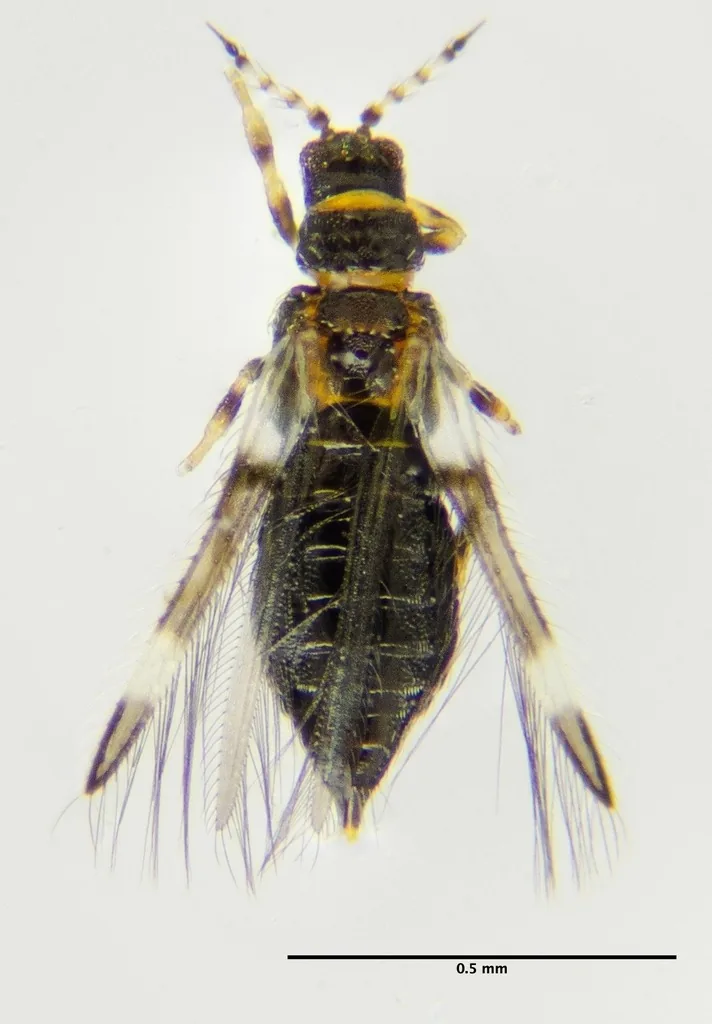
- Adults are about 1 mm (0.04 inch) long, and UF/IFAS gives an average of 1.1 mm for females. The body is uniformly dark, grayish black to dark brown, and to the naked eye they look blackish with bands.[1][3]
- UF/IFAS describes grayish brown forewings with two white cross bands, one at the base and one near the tip; UC IPM describes two dark and two pale bands. Either way the blackish body appears to carry white wing bands. The hind wings are uniformly grayish brown.[3][1][2]
- Under magnification the legs and antennae are also banded light and dark: the thighs are dark brown with pale tips, and the shins dark brown with yellow ends.[1][3]
- Larvae are yellow to orangish. Thrips can be identified to species reliably only by an expert examining microscopic features.[2]
- The antennae have eight segments. The third and fourth are yellow with a light brown tip half, and the last segments are long and needle-like.[3]
Look-alikes
| Look-alike | How to tell them apart |
|---|---|
| Western flower thrips | Also found in orange navels, but usually yellowish. Its dark form is larger and hairier, with longer, darker bristles, than bean thrips.[1] |
| Citrus thrips | May also be found in the navel, but it is usually yellowish rather than blackish and banded.[1] |
Where it lives
Native to North America and western Mexico. In the United States it has been reported from Alabama, Arizona, California, Florida, Idaho, Louisiana, Nevada, South Carolina, Texas, Washington and Wyoming, and it also occurs on the west coast of Canada. In California it is a problem in the San Joaquin Valley and the interior of Southern California. Although it has been carried inside exported navel oranges for more than 120 years, it has never established outside North America, and Australia and New Zealand treat it as a quarantine pest.[3][1][4][5]
Biology and life cycle
Adults spend the winter sheltered, then come out and multiply on weeds from March to September. In California, overwintered adults move to prickly lettuce and sow thistle in spring and complete two generations there from April to early June.[1][3]
Its life stages are the egg, two larval stages, a propupa and a pupa, followed by the adult. How fast it develops and how many eggs females lay depend strongly on temperature.[4]
Bean thrips is haplodiploid: fertilized eggs produce females and unfertilized eggs produce males, and UF/IFAS gives a sex ratio of 2:1, females to males. In laboratory crosses, virgin females kept alone produced no offspring at all, but virgin females kept with other virgin females produced sons.[5][3]
When weeds dry out and die, or the field crops they infest are harvested, adults move in September and October into citrus groves, seeking green vegetation and sheltered places to spend the winter.[1]
UF/IFAS lists a wide host range: crops including alfalfa, beans, clover, peas, almond, apple, peach, pear, prune, strawberry, cabbage and other cole crops, potato, tomato, avocado, Swiss chard, corn, cotton, grape, lettuce, olive, onion, oranges and persimmon, and weeds such as sow thistle, cheeseweed, filaree, horseweed, pigweed and California poppy. UC IPM names alfalfa, beans, cotton, grape, lettuce and tomato as nearby crops that raise the risk to orange navels.[3][1][2]
In a central California summer, eggs hatch in about seven days, the two feeding larval stages last ten days, and the pupal stage five days, so a generation takes about three weeks and there are six or seven generations from April to October. Mature larvae drop to the ground to pupate.[3]
Females insert their eggs into plant tissue in the early morning and late afternoon. Larvae feed mostly on the undersides of leaves, while adults are more common in flowers than on leaves.[3]
Adults are active between 50°F (10°C) and 117°F (47°C), most of all from 75°F to 90°F (24°C to 32°C). They live about 22 days on average on pears and beans, and mated females lived 20 days. A 60% natural mortality has been reported in California.[3]
Damage and signs
- On beans its main damage is brown, distorted leaves and seedling tips. Larvae and adults suck sap from leaves, flowers, fruit and stems; the feeding shows as silvering or bronzing of leaves and, when heavy, leads to leaf drop and plant death. Crowds of larvae do more harm than adults.[2][3]
- Bean thrips does not damage citrus fruit or breed on citrus. The problem is contamination: adults overwintering in the navels of oranges and some mandarins from November to March can be found in harvested fruit, which some trading partners do not accept, so fruit may have to be fumigated.[1]
- It was a serious crop pest in California in 1933 but soon lost that status; UF/IFAS suggests integrated pest management, newer insecticides and resistant varieties as possible reasons. In Florida it is common on beans at low numbers and only occasionally damaging. It remains economically important because some countries that import California oranges treat it as a quarantine pest: it was found in shipments of navel oranges to Australia in the 1996-1997 season.[5][3]
- On young fruit, feeding causes scars that downgrade it at the packinghouse, and black specks of excrement can mar the surface. On pears it causes sun-scald on immature fruit and lowers the tree's production the next season.[3]
Health risk
UF/IFAS and UC IPM describe it only as a plant feeder and a fruit contaminant; neither mentions bites or any other risk to people.[1][2][3]
Control
Prevention
Heavy rainfall can suppress bean thrips, so UF/IFAS says overhead irrigation would be useful in managing it.[3]
Sanitation
Keep orchards, fields and bordering areas free of weed hosts. Filaree, malva, prickly lettuce, Russian thistle, sowthistle, tree tobacco and grasses, especially perennial grasses, carry bean thrips that later move into citrus, and UF/IFAS notes that removing weeds in and around a field may reduce the thrips in the crop and their migration into it.[1][3]
Traps and physical control
Green sticky traps help detect migrating adults; in field trials green cards caught significantly more bean thrips than blue, white or yellow ones, though cards of any of these colors can show population trends.[1][6][3]
Biological control
Minute pirate bugs, convergent lady beetle larvae, hover fly larvae, lacewing larvae, predatory mites and predatory thrips, including the vespiform thrips, eat bean thrips larvae. A tiny parasitic wasp, Thripoctenus russelli, has been recorded as its most important natural enemy in California.[3]
Pesticides
UF/IFAS says insecticides with different modes of action can work when applied to foliage, but that information on insecticides registered for bean thrips is scarce.[3]
When to call a professional
Growers shipping navel oranges to countries that quarantine bean thrips follow export protocols, including certified fumigation of the fruit.[1]
For export fruit, research cited by UF/IFAS found that a combined ozone, vacuum and carbon dioxide treatment, or fumigation with ethyl formate mixed with carbon dioxide, controlled overwintering bean thrips on navel oranges without harming the fruit.[3]
Where the sources disagree
Range outside North America: UF/IFAS includes Mexico, the state of Bahia in Brazil and China in the range, while noting that its distribution elsewhere is uncertain. A 2020 review of Brazilian thrips withdrew bean thrips from Brazil's species list, and a 2012 study says it has never established outside North America.[3][7][5]
Native area: UC IPM and a 2023 study call it native to California and North America; UF/IFAS says North America and western Mexico.[1][4][3]
Common questions
- What are the tiny black specks moving in the navel of my orange?
- In California they may be bean thrips, which crawl into orange navels to spend the winter. They are about 1 mm long and look blackish with pale bands.[1]
- Do bean thrips damage oranges?
- No. UC IPM says bean thrips does not damage citrus fruit or reproduce on citrus; the concern is that the insects ride along in the navel of harvested fruit.[1]
- What is browning and twisting my bean seedlings?
- Bean thrips is one possibility. UC IPM lists brown, distorted leaves and seedling tips as its main damage on beans, and UF/IFAS describes larvae and adults sucking out leaf cells, leaving silvered or bronzed leaves that may drop. Because thrips species are hard to tell apart, an expert has to examine them under magnification to be sure.[2][3]
- Where does bean thrips live in the United States?
- UF/IFAS lists records from Alabama, Arizona, California, Florida, Idaho, Louisiana, Nevada, South Carolina, Texas, Washington and Wyoming. In Florida it is common on beans at low numbers and only occasionally damaging.[3]
Sources
- University of California Statewide IPM Program, “Bean Thrips, UC IPM Pest Management Guidelines: Citrus.” ipm.ucanr.edu/agriculture/citrus/bean-thrips (accessed 2026-11-14)
- UC Statewide IPM Program (UC IPM), “Thrips (Pest Notes).” ipm.ucanr.edu/home-and-landscape/thrips/ (accessed 2026-11-14)
- University of Florida/IFAS Extension (Featured Creatures), “Bean Thrips, Caliothrips fasciatus (Pergande, 1895), EENY-782/IN1364 (R. A. Khan, D. R. Seal and R. Adhikari).” ask.ifas.ufl.edu/publication/IN1364 (accessed 2026-11-14)
- Insects, via PubMed, “Effects of Temperature on the Developmental and Reproductive Biology of North American Bean Thrips, Caliothrips fasciatus (Hoddle, Milosavljevic and Amrich, 2023).” pubmed.ncbi.nlm.nih.gov/37504647/ (accessed 2026-11-14)
- Bulletin of Entomological Research, via PubMed, “Phylogeographic structure, outbreeding depression, and reluctant virgin oviposition in the bean thrips, Caliothrips fasciatus, in California (Rugman-Jones et al., 2012).” pubmed.ncbi.nlm.nih.gov/22676974/ (accessed 2026-11-14)
- Pest Management Science, via PubMed, “Selection of colour of sticky trap for monitoring adult bean thrips, Caliothrips fasciatus (Harman, Mao and Morse, 2007).” pubmed.ncbi.nlm.nih.gov/17125151/ (accessed 2026-11-14)
- Zootaxa, via PubMed, “The Panchaetothripinae (Thysanoptera, Thripidae) of Brazil, with one new Caliothrips species (Lima, O'Donnell and Miyasato, 2020).” pubmed.ncbi.nlm.nih.gov/33056065/ (accessed 2026-11-14)
- iNaturalist, “Caliothrips fasciatus taxon page (order and family).” www.inaturalist.org/taxa/307191 (accessed 2026-11-14)