On this page
How to identify it
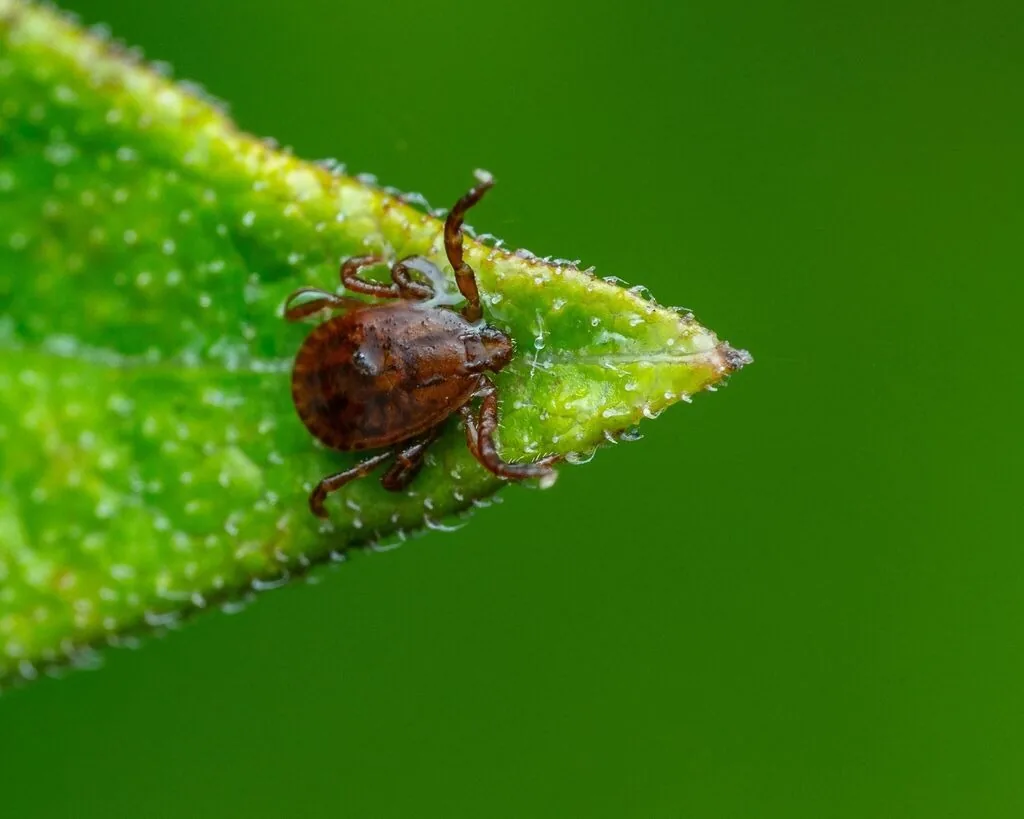
- Penn State describes adults as brown, about 0.1 inch long, without markings or distinct coloration. APHIS describes unfed ticks as light reddish-tan to dark reddish with brown, dark markings, and says a fed adult female turns grey-green with yellowish markings and swells to the size of a pea.[1][4]
- Larvae and nymphs are about the size of a sesame seed or smaller and easy to miss, but they can turn up in unusually high numbers on one animal.[4][1]
- On animals they have been seen feeding on the ears, brisket, back of the neck, shoulders, inner flanks, groin, armpits and around the anus.[1]
- APHIS says male ticks are rare, so nearly every one you find will be a female.[4]
- Two Haemaphysalis ticks are native to the United States, the rabbit tick and the bird tick, and each feeds almost only on its own kind of host. Penn State says a small Haemaphysalis found on cattle, deer or other such hosts is highly likely to be the Asian longhorned tick.[1]
Look-alikes
| Look-alike | How to tell them apart |
|---|---|
| Lone star tick (immature) | Nymphs of the two species look much alike and differ mainly in their mouthparts, so send specimens to a lab rather than relying on a photo.[1] |
| Rabbit tick and bird tick | These native Haemaphysalis ticks are similar but feed almost exclusively on rabbits or birds, not on livestock, deer, pets or people.[1] |
Where it lives
Native to eastern China, Japan, the Russian Far East and Korea, and also established in Australia, New Zealand and several western Pacific islands. In the United States APHIS says it has been collected across the eastern half of the country from New York south to Georgia and west to Missouri; the CDC listed 20 states as of April 12, 2024, and a Michigan report counted 21 eastern and midwestern states as of April 2025 before the first Michigan find that year.[4][3][2][7]
Biology and life cycle
U.S. populations are parthenogenetic: a single female can lay eggs without mating, so one introduced tick can start a large infestation. APHIS calls this one reason the tick invades new regions so well.[4][3][2][1]
It has three life stages, larva, nymph and adult, and each feeds on a separate host before dropping off.[1]
After her blood meal an adult female drops off the host and lays up to 2,000 eggs over two to three weeks.[1]
Hosts include cattle, horses, sheep, goats, deer, dogs, cats, pigs, bears, foxes, raccoons and rabbits; it has also been found on people.[1][2][3]
APHIS says the tick is generally active from March to November, though this varies by year. Thousands may be found at one time in grass, in shrubs or on a single animal.[4][2]
Damage and signs
- Heavy infestations can cause anemia in cattle, and a Michigan surveillance report adds exsanguination (severe blood loss).[1][7]
- It is the main vector of Theileria orientalis Ikeda, a blood parasite of cattle. APHIS reports that U.S. ticks transmitted it to cattle in the laboratory and that it has been detected in field-collected ticks; in Georgia, a Highland calf with anemia and lethargy became the state's first clinical case.[4][8][7]
- Where the tick is established in New Zealand and Australia it can cut dairy cattle production by 25 percent.[3]
- In a 2021 to 2025 survey of ticks from pastures and cows, Ohio ticks carried DNA of Babesia odocoilei and of Theileria orientalis Ikeda; Babesia DNA was also found in Pennsylvania ticks.[9]
Health risk
The CDC says it appears less attracted to people than native ticks such as the blacklegged and lone star ticks, though the first recognized U.S. human bite was reported from New York, where the tick was later found on nearby manicured lawns. In its native range it spreads germs that can seriously sicken people; whether U.S. ticks pass pathogens to people, and how often, is still being studied. A CDC laboratory study found it lost Lyme disease bacteria when it molted, so it is unlikely to spread Lyme disease, and APHIS says it is not a competent vector of Lyme or anaplasmosis bacteria. In the lab it can carry and pass on Rocky Mountain spotted fever bacteria, and in 2025 New Jersey health officials reported the first find of those bacteria in field-collected longhorned ticks.[2][13][12][4][11][10]
Control
Prevention
Check pets and livestock regularly and do a full-body tick check after time in tick habitat, including your own backyard; Penn State calls regular checks the most straightforward way to prevent disease.[1][5][4]
Wear clothing treated with 0.5 percent permethrin and use an EPA-registered repellent such as DEET, picaridin or IR3535 when you are in tick habitat. After coming in, tumble dry clothes on high heat for 10 minutes and shower within two hours.[1][5]
Sanitation
Keep grass short, control weeds and brushy areas, cut back tall growth along fence lines and remove woody debris from lawn and pasture edges. On pastures APHIS also lists thinning trees to reduce shade, removing understory and placing mulch barriers.[1][4]
Keep at least 9 feet between tick habitat and lawn or pasture to reduce tick contact.[1]
Traps and physical control
Remove an attached tick with fine-tipped tweezers close to the skin and pull back with steady, even pressure, without twisting or crushing it. Then clean the bite and your hands with soap and water, rubbing alcohol or hand sanitizer.[6][1]
Pesticides
Acaricides applied to woodland edges and grassy patches when ticks are seeking hosts are an option; Penn State lists a fungal biopesticide or pyrethroid or carbamate insecticides. Follow the label and state rules, since some products require a licensed applicator.[4][1]
When to call a professional
Ask your veterinarian or extension agent about tick treatments for livestock and about fipronil-based or similar products for dogs and cats.[4][1]
Where sources disagree
Color: Penn State says adults are plain brown with no markings; APHIS says unfed ticks are reddish-tan to dark reddish with brown markings.[1][4]
When it arrived: Penn State says it was originally reported in New Jersey in 2013 and found again in fall 2017; the CDC's 2018 report calls the August 2017 find on a New Jersey sheep the first U.S. detection outside quarantine, and APHIS dates the first report to November 2017 in Hunterdon County.[1][3][4]
Native range: Penn State says East and Central Asia; APHIS and the CDC list eastern China, Japan, the Russian Far East and Korea.[1][4][3]
Rocky Mountain spotted fever: the CDC's tick page says the bacteria have not yet been found in these ticks in nature, but a 2025 New Jersey Department of Health report describes the first find in field-collected longhorned ticks.[2][10]
Anaplasmosis: APHIS says the tick is not a competent vector of the anaplasmosis bacterium, while Pennsylvania surveillance found DNA of the human-disease variant in field-collected ticks, and an Ohio and Pennsylvania study found the bacterium's DNA in 3 of 563 ticks. The CDC says it is not yet known whether or how often U.S. ticks pass such pathogens to people.[4][14][9][2]
Common questions
- Why are there so many Asian longhorned ticks on one animal?
- U.S. females lay eggs without mating, so one tick can found a whole population and produce massive infestations on a single host.[3][1][4]
- Does the Asian longhorned tick spread Lyme disease?
- Probably not. In a CDC experiment the ticks picked up Lyme bacteria as larvae but none of 520 molted nymphs were infected, and APHIS says it is not a competent Lyme vector.[12][4][2]
- What should I do if I think I found one?
- Collect a few ticks, put them in 70 percent ethanol or seal them in a bag in the freezer, note the address, host and date, and send them to an identification lab or give them to your veterinarian. Penn State asks for specimens, not photos.[1][4]
- Can it make my cattle sick?
- Yes. Heavy infestations cause anemia, and the tick spreads Theileria orientalis Ikeda, a blood parasite that causes anemia in cattle. APHIS asks owners who suspect disease to contact their veterinarian.[1][4][8]
Sources
- Penn State Extension, “Asian Longhorned Tick, Haemaphysalis longicornis (updated May 21, 2026).” extension.psu.edu/asian-longhorned-tick (accessed 2026-11-11)
- Centers for Disease Control and Prevention, “Where Ticks Live.” www.cdc.gov/ticks/about/where-ticks-live.html (accessed 2026-11-11)
- Centers for Disease Control and Prevention, “Multistate Infestation with the Exotic Disease-Vector Tick Haemaphysalis longicornis, United States, August 2017-September 2018 (MMWR 67(47)).” www.cdc.gov/mmwr/volumes/67/wr/mm6747a3.htm (accessed 2026-11-11)
- USDA Animal and Plant Health Inspection Service, “Pest Alert: Asian Longhorned Ticks.” www.aphis.usda.gov/livestock-poultry-disease/cattle/ticks/asian-longhorned (accessed 2026-11-11)
- Centers for Disease Control and Prevention, “Preventing Tick Bites.” www.cdc.gov/ticks/prevention/index.html (accessed 2026-11-11)
- Centers for Disease Control and Prevention, “What to Do After a Tick Bite.” www.cdc.gov/ticks/after-a-tick-bite/index.html (accessed 2026-11-11)
- Journal of Medical Entomology, via PubMed, “Initial detection of Haemaphysalis longicornis in Michigan (Radersma et al. 2026).” pubmed.ncbi.nlm.nih.gov/42901700/ (accessed 2026-11-11)
- Veterinary Parasitology: Regional Studies and Reports, via PubMed, “First report of Theileria orientalis Ikeda genotype associated with disease in cattle, Georgia, USA (Maboni et al. 2025).” pubmed.ncbi.nlm.nih.gov/40518242/ (accessed 2026-11-11)
- American Journal of Veterinary Research, via PubMed, “Medical and veterinary pathogens detected in invading Asian longhorned ticks from Ohio and Pennsylvania (Eleftheriou et al. 2026).” pubmed.ncbi.nlm.nih.gov/41397358/ (accessed 2026-11-11)
- Journal of Medical Entomology, via PubMed, “First finding of Rickettsia rickettsii in Haemaphysalis longicornis in North America (Soliman et al. 2025).” pubmed.ncbi.nlm.nih.gov/40986409/ (accessed 2026-11-11)
- Journal of Medical Entomology, via PubMed, “The ability of the invasive Asian longhorned tick to acquire and transmit Rickettsia rickettsii under laboratory conditions (Stanley et al. 2020).” pubmed.ncbi.nlm.nih.gov/32338290/ (accessed 2026-11-11)
- Ticks and Tick-borne Diseases, via PubMed, “Failure of the Asian longhorned tick to serve as an experimental vector of Borrelia burgdorferi sensu stricto (Breuner et al. 2020).” pubmed.ncbi.nlm.nih.gov/31640938/ (accessed 2026-11-11)
- Clinical Infectious Diseases, via PubMed, “First recognized human bite in the United States by the Asian longhorned tick (Wormser et al. 2020).” pubmed.ncbi.nlm.nih.gov/31150055/ (accessed 2026-11-11)
- Zoonoses and Public Health, via PubMed, “First detection of human pathogenic variant of Anaplasma phagocytophilum in field-collected Haemaphysalis longicornis, Pennsylvania (Price et al. 2022).” pubmed.ncbi.nlm.nih.gov/34958171/ (accessed 2026-11-11)
- iNaturalist, “Haemaphysalis longicornis taxon page (order and family).” www.inaturalist.org/taxa/485044 (accessed 2026-11-11)