On this page
How to identify it
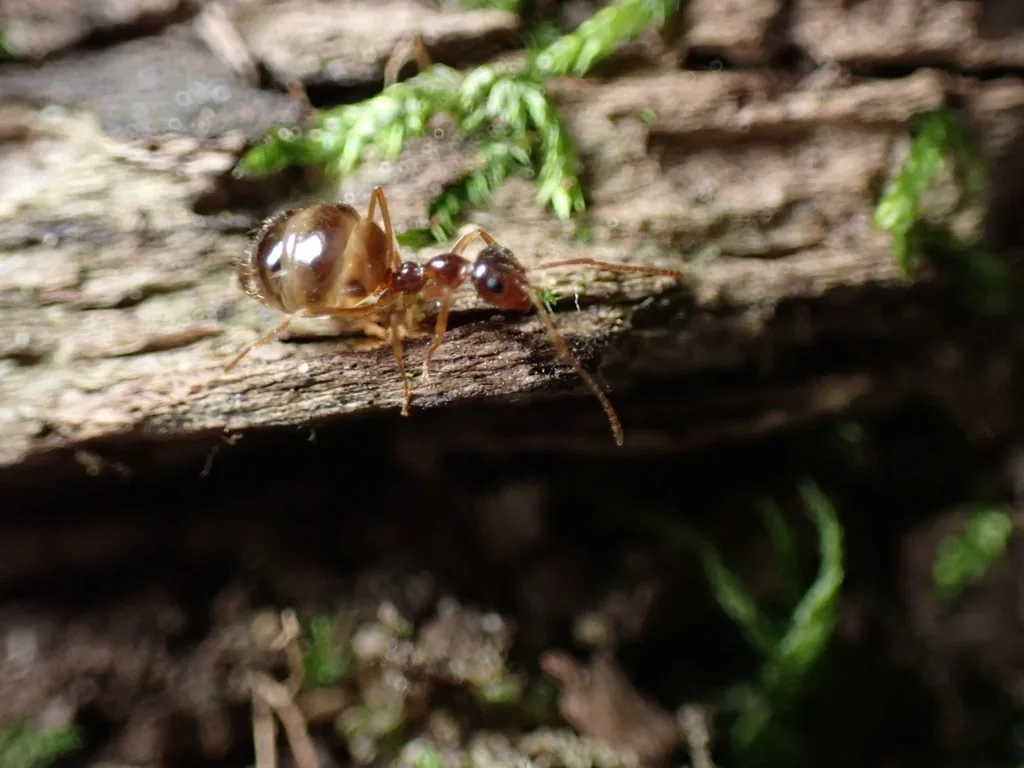
- Workers are all one size, about 2 to 4 mm (roughly 1/8 inch) long, smooth and shiny. Texas A&M describes them as dark brown to black, Minnesota as light to dark brown. UF/IFAS gives workers as 3.0 to 4.5 mm, with the head and abdomen sometimes darker than the midsection and legs, and UMaine gives 2.5 to 3.5 mm.[1][2][4][5]
- The best clue is the thorax: it is slender and sharply constricted in the middle, so it looks pinched into two parts when seen from the side. UF/IFAS calls this the most definitive feature: from the side the body looks like an hourglass or a peanut. Because it is the only Prenolepis species in North America, identification is straightforward.[1][2][4]
- It has a single node on the waist, 12-segmented antennae without a club, a first antennal segment much longer than the head, and a circle of hairs at the tip of the abdomen.[1][2]
- Some workers, called repletes, hold food for the colony; Texas A&M describes them hanging from the nest ceiling with the abdomen hugely swollen with honeydew. UF/IFAS and UMaine disagree with the honey idea: the swollen young workers, which UF/IFAS calls corpulents, are storing fat, not honey, and the swelling is reversible.[1][4][5]
- Queens look like workers but are larger, about 7 mm long. UF/IFAS gives queens as 7.0 to 8.5 mm and always light to medium reddish brown, and males as 3.0 to 4.0 mm and always black; the name imparis refers to that color contrast. UMaine gives queens as about 8 mm.[1][4][5]
Look-alikes
| Look-alike | How to tell them apart |
|---|---|
| Odorous house ant | Also small and brown to black, but its thorax is uneven rather than pinched in two, its single waist node is hidden, it has no circle of hairs at the tip of the abdomen, and it smells rotten when crushed.[6][1] |
Where it lives
Texas A&M gives its range as Ontario to Nebraska and south to Texas and Florida, plus New Mexico, California, Oregon and Washington. A genetic study across its range found five separate lineages: one in Florida, one across the southern U.S., one in the Midwest and Northeast, one in the western U.S., and one in southwestern Arizona and Mexico. GBIF holds records from more than 40 states, thousands from Canada and a few dozen from Mexico. UF/IFAS says it ranges coast to coast, from southern Ontario to northern Florida and south into Mexico; in Florida it reaches as far south as Citrus and northern Orange counties and is found throughout the panhandle.[1][7][8][4]
Biology and life cycle
Unlike most ants it stays active above ground in winter instead of hibernating, then spends a distinct dormant period underground in summer. It is often the only ant active in the colder months. UF/IFAS says it is most active at air temperatures of 45 to 60 °F and has been seen foraging near freezing. Northern colonies are active all year except summer, while Florida foragers are active only from November to early April.[1][3][4]
Lab tests show why: its critical low temperature lets it keep functioning at 0 to 2.5 °C, and its walking speed depends less on temperature than the Argentine ant's. In a study of woodland ants, its activity appeared to be limited by temperature.[9][10]
It nests in soil in open, well-shaded sites, rarely under logs or stones. Texas A&M has found nests in soil along slab expansion joints and whole colonies in potted plants; Minnesota says it does not nest indoors. In northern Florida, UF/IFAS reports nests reaching 3.6 meters deep, with no chambers shallower than 60 cm, nearly three times deeper than nests in Missouri and Ohio. UMaine associates it with oak woodlands and beech-maple woods.[2][1][4][5]
Workers tend aphids, scale insects and treehoppers for honeydew, their favorite food, and forage in trails. UF/IFAS adds that foragers gather at rotting fruit, take protein such as dead annelids, and aggressively defend a rich food find.[1][2][9][4]
Colonies are small, only a few thousand ants; Texas A&M says outdoor nest chambers hold several hundred to a thousand ants with numerous queens. Florida colonies have lived more than nine years, with workers living at least two, and no brood is kept over the winter. UF/IFAS says colonies with several queens may top 10,000 ants by 7 to 9 years old, and one brood of workers and winged ants is raised each year in late August to September.[1][4]
Winged ants fly from March to April according to Texas A&M, or April through May in Minnesota; most mating seems to happen on the ground. In the north a mated queen starts a colony alone, while in Florida several queens may found one together. UF/IFAS says the winged ants spend the winter in the nest and fly in early spring, usually late February to early April, making it the first North American ant to swarm each spring.[1][2][4]
Young workers emerge in autumn and spend the next 10 months inside the nest, fed mouth to mouth by foragers. UF/IFAS says they store more than twice their body weight in fat, then become foragers the next active season, so workers may live up to two years. UMaine says this stored fat feeds the colony while it stays sealed in the nest.[4][5]
Damage and signs
- When it comes indoors it feeds on and contaminates sugar, syrup, honey, cakes, bread, fruit and meat. Outdoors it can gnaw into flower buds and soft tissue of plants such as roses and oranges to get sap. UF/IFAS says it is not a pest species, though foragers and winged ants occasionally enter buildings; UMaine says they don't nest indoors but may come in during winter looking for sugary food.[1][4][5]
- Minnesota Extension rates it as an ant to tolerate where possible.[2]
Health risk
Texas A&M treats it as a household nuisance that contaminates food; neither extension source lists a sting or other health risk. UF/IFAS does not consider it a pest species.[1][2][4]
Control
Prevention
Check inside and outside the building to find all the colonies; outdoors, look for nest openings in open, shaded soil.[1][2]
Keep them out
Seal the cracks ants are using to get into the house, though with ants this small that isn't always practical. UF/IFAS recommends sealing possible entryways, especially around doors and windows.[2][4]
Pesticides
Advice differs. Minnesota says to tolerate it when possible and treat a nest only if the ants keep coming. Texas A&M, which sees it nesting indoors in Texas, describes crack-and-crevice treatment with residual products where ants disappear into cracks and says sweet baits are also an option. UF/IFAS goes further: it says pesticides are not needed and should not be used against this species.[2][1][4]
A cold-weather ant in research
In northern California the winter ant is the native ant best able to live alongside the invasive Argentine ant. The two split the year, with winter ants active mainly in the cold months and Argentine ants in the warm months.[9]
It also fights back: workers release a secretion from the Dufour's gland that killed 79% of Argentine ants in one-on-one lab trials, and they used it more often when outnumbered or near the nest.[11]
UF/IFAS notes that it disperses seeds of herbaceous plants in the southern Appalachian Mountains.[4]
Its closest relatives live on other continents: a sister species in southeastern Europe and 11 other Prenolepis species in subtropical and tropical Asia, plus a fossil species about 44 million years old in Baltic amber.[4]
Where the sources disagree
Worker size: Texas A&M gives 2 to 4 mm, UMaine 2.5 to 3.5 mm, and UF/IFAS 3.0 to 4.5 mm.[1][5][4]
Swollen workers: Texas A&M describes repletes swollen with honeydew; UF/IFAS and UMaine say the swelling is stored fat, and UF/IFAS says a 1987 study found it was lipid in enlarged fat bodies.[1][4][5]
Flight timing: Texas A&M says March to April and Minnesota April through May; UF/IFAS says usually late February to early April.[1][2][4]
Nesting indoors: Minnesota and UMaine say it doesn't nest indoors; Texas A&M says it can, in soil along slab expansion joints and in potted plants.[2][5][1]
Common questions
- Why am I seeing ants in winter?
- If they are small, shiny brown ants with a pinched thorax, they are likely winter ants, which stay active in cold weather when other ants don't and sometimes wander indoors looking for sweets.[1][2][3]
- Why are some of them so swollen?
- Those are repletes, workers that store food for the colony. Texas A&M describes their abdomens as greatly swollen with honeydew. UF/IFAS and UMaine say the swelling is actually stored fat, not honey, which UMaine says is where the name false honey ant comes from.[1][4][5]
- Should I spray for winter ants?
- Usually not. Minnesota says to tolerate them when possible and seal entry cracks; Texas A&M describes targeted crack-and-crevice treatment or sweet baits when they nest in or keep invading a building. UF/IFAS says pesticides are not needed for this species.[2][1][4]
Sources
- Texas A&M Urban and Structural Entomology Program, “Small Honey Ant, Prenolepis imparis.” urbanentomology.tamu.edu/urban-pests/ants/small_honey/ (accessed 2026-11-14)
- University of Minnesota Extension, “Ants.” extension.umn.edu/garden-and-home/home-maintenance/household-insects/ants (accessed 2026-11-14)
- Journal of Heredity, via PubMed, “Cash EI et al. (2025), Genome assembly of the winter ant, Prenolepis imparis, Journal of Heredity 116(3):354-362.” pubmed.ncbi.nlm.nih.gov/39657765/ (accessed 2026-11-14). Cited from the PubMed abstract.
- University of Florida/IFAS Extension (Featured Creatures), “Winter Ant, Prenolepis imparis (Say), IN1168.” ask.ifas.ufl.edu/publication/IN1168 (accessed 2026-11-14)
- University of Maine Cooperative Extension (Home and Garden IPM), “False Honey Ant.” extension.umaine.edu/home-and-garden-ipm/fact-sheets/common-name-listing/false-honey-ant/ (accessed 2026-11-14)
- Penn State Extension, “Odorous House Ant.” extension.psu.edu/odorous-house-ant (accessed 2026-11-14)
- Molecular Ecology, via PubMed, “Tonione MA et al. (2022), Phylogeography and population genetics of a widespread cold-adapted ant, Prenolepis imparis, Molecular Ecology 31(18):4884-4899.” pubmed.ncbi.nlm.nih.gov/35866574/ (accessed 2026-11-14). Cited from the PubMed abstract.
- Global Biodiversity Information Facility (GBIF), “Prenolepis imparis: occurrence records, 1990-2026 (GBIF occurrence search).” api.gbif.org/v1/occurrence/search?taxonKey=1323605&hasGeospatialIssue=false&occurrenceStatus=PRESENT&year=1990%2C2026&facet=country&facetLimit=400&limit=0 (accessed 2026-11-14). Counts by country are records reported (iNaturalist research-grade, museum specimens, surveys), not abundance.
- Journal of Thermal Biology, via PubMed, “Nelson RA, MacArthur-Waltz DJ, Gordon DM (2023), Critical thermal limits and temperature-dependent walking speed may mediate coexistence between the native winter ant (Prenolepis imparis) and the invasive Argentine ant (Linepithema humile), Journal of Thermal Biology 111:103392.” pubmed.ncbi.nlm.nih.gov/36585081/ (accessed 2026-11-14). Cited from the PubMed abstract.
- Oecologia, via PubMed, “Fellers JH (1989), Daily and seasonal activity in woodland ants, Oecologia 78(1):69-76.” pubmed.ncbi.nlm.nih.gov/28311903/ (accessed 2026-11-14). Cited from the PubMed abstract.
- PLoS One, via PubMed, “Sorrells TR et al. (2011), Chemical defense by the native winter ant (Prenolepis imparis) against the invasive Argentine ant (Linepithema humile), PLoS One 6(4):e18717.” pubmed.ncbi.nlm.nih.gov/21526231/ (accessed 2026-11-14). Cited from the PubMed abstract.
- iNaturalist, “Prenolepis imparis taxon page (order and family).” www.inaturalist.org/taxa/68142 (accessed 2026-11-14)