On this page
How to identify it
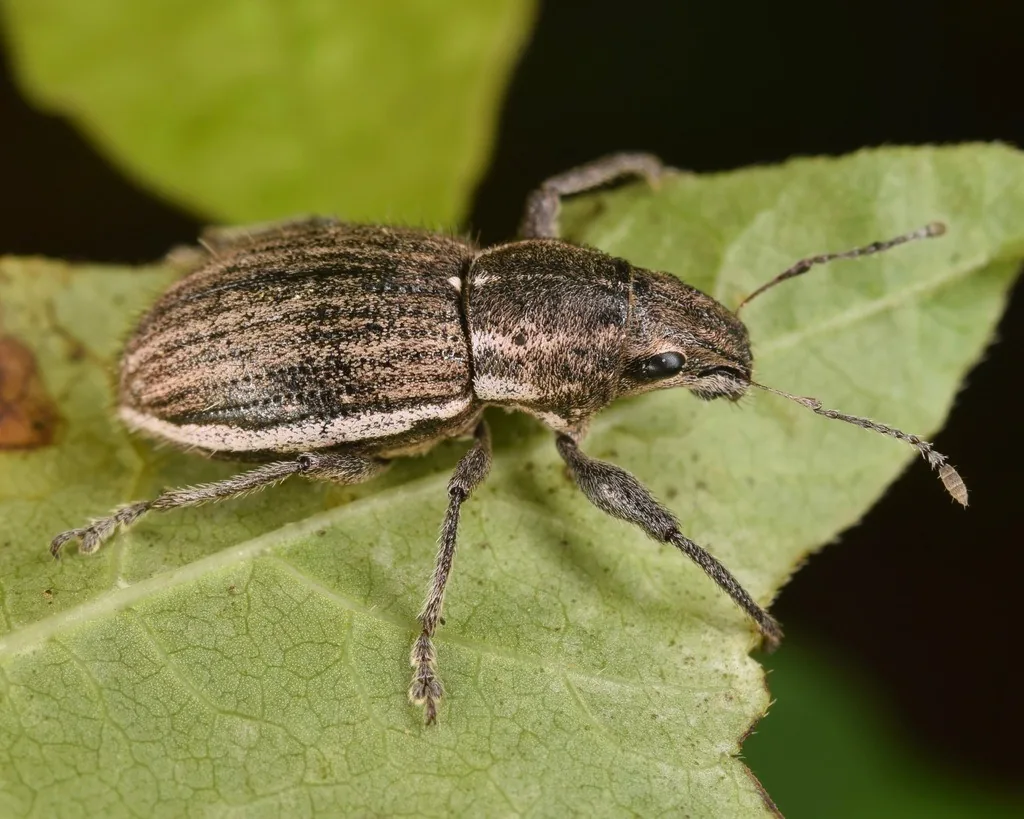
- Adults are light to dark gray or brown and about 1/2 inch long, with a short snout. A pale band runs along the outer edge of each wing cover (the white fringe), with two pale lines or blotches along each side of the head and thorax. UF/IFAS gives about 12 mm and places one pale line above and one below the eye on each side.[1][2][4]
- The body is densely covered with short pale hairs, longest on the wing covers.[2]
- The wing covers are fused and the hind wings are rudimentary, so they cannot fly. They can still walk a long way: up to 3/4 mile according to NC State, 0.4 to 1.2 km over an adult's life according to EFSA.[1][2]
- Larvae are C-shaped, creamy or yellowish-white, legless grubs with a light brown head, up to about 1/2 inch long. UF/IFAS says mature larvae are about 12 mm (1/2 inch) long with a strong swelling at the thorax, and pupae are about the same length and creamy white.[1][2][4]
- Eggs are about 0.9 by 0.6 mm, white when laid and turning light yellow after four to five days, according to UF/IFAS.[4]
Where it lives
It is native to eastern South America (Argentina, southern Brazil and Uruguay). In the United States it was first reported in Florida and Alabama in 1936, spread to Louisiana and Mississippi, and has since been recorded as far north as Illinois. GBIF holds 3075 U.S. records since 1990, the most from Virginia (388), Tennessee (313), North Carolina (285), Maryland (281) and Texas (252). It also reached Australia, New Zealand and South Africa. UF/IFAS says it was first collected in North America near Svea, Florida, in 1936 and is one of three species, with Naupactus minor and Naupactus peregrinus, that make up the whitefringed beetle complex in North America; whitefringed beetles are now widely distributed in the southern United States and also occur in New Zealand.[2][5][6][4]
Biology and life cycle
North American whitefringed beetles are all females that lay fertile eggs without mating. Males are very rare and known only from South America, and there may be several species lumped together under the name.[1][2]
Adults emerge from the soil from late spring through summer, with peak emergence in the southern U.S. usually in July. They live two or three months, and egg laying starts 5 to 25 days after emergence. UF/IFAS gives an emergence window of May to October.[1][2][4]
Eggs are laid in masses held together by a sticky coating that hardens as it dries, usually on or just below the soil surface or on stems and lower leaves. EFSA puts a mass at about 10 to 60 eggs. UF/IFAS adds that masses are also laid where hay, firewood, lumber and farm tools and machinery touch the soil.[1][2][4]
How many eggs a female lays depends on what she eats: NC State says 600 to 700, while studies summarized by EFSA found an average of 1,031 on peanut, 716 on soybean, 359 on alfalfa and none on sorghum. EFSA notes they do best on legumes.[1][2]
Summer eggs hatch in about 2 to 4 weeks, but late eggs can wait until spring, and in dry conditions eggs can stay dormant for up to 7 months. The grubs overwinter in the soil and pupate the next spring; there is one generation a year, though some grubs take two. UF/IFAS says eggs hatch anywhere from 11 to more than 100 days after laying, averaging 17 days for summer eggs and 100 days for winter eggs. Pupation runs from late April to late July in cells mostly 5 to 15 cm (2 to 6 inches) deep, though cells have been found 36 cm down, and the pupal stage lasts about 13 days in summer.[2][1][4]
Being all-female is part of their success. Argentine researchers list N. leucoloma among five parthenogenetic South American weevils that have invaded the United States, Australia, New Zealand, Mexico and South Africa, and say long-distance spread in commercial trade plus reproduction without mating raise their threat to crops.[5]
Here is a neat trick for a clone: a 2021 study found that these weevils switch on different sets of detection and detox genes depending on which host plant they eat, which may help a genetically uniform insect thrive on so many plants.[7]
In poor conditions, such as the dry summers and moist winters of parts of Western Australia, development can stretch to 2 years instead of about 12 months.[2]
Damage and signs
- They feed on a very wide range of plants, often given as 385 species, including trees, shrubs, ornamentals, and vegetable and field crops. EFSA notes the 385 figure traces to a 1950 USDA circular that never listed all the plants. UF/IFAS lists cotton, peanuts, okra, velvetbeans, soybeans, cowpeas, sweet potatoes, beans and peas as the most common hosts. Adults seem to prefer plants with large, broad, smooth leaves, and grubs also eat newly sprouted acorns and nuts and the roots of woody plants such as peach, pecan, tung, willow and pines.[1][2][4]
- Adults feed on leaf edges rather than chewing holes, leaving notched or saw-toothed margins, and large numbers can gather on one plant (200 or 300 per plant per NC State, up to 200 per EFSA). The serious damage comes from grubs feeding on roots and underground stems, which can make plants yellow, wilt and die. UF/IFAS says root damage ranges from scattered patches of a few dead or dying plants to nearly every plant in a field, with grubs stripping the outer tissue from tap roots or removing them partly or completely.[1][2][3][4]
- In root crops the grubs chew broad cavities in sweetpotato storage roots, much like white grubs, and EFSA says larvae can tunnel inside potato tubers.[3][2]
- They have also become pests of young pines planted on former cropland in the South. UF/IFAS says some Florida pine plantations on land once in soybeans, peanuts or cotton failed even three to four years after the last crop.[4]
- UF/IFAS says quarantines were enacted soon after the beetles were found, yet they kept spreading: about 409 acres of Florida crops were damaged in 1940, and over 4,000 acres by 1944.[4]
Health risk
A plant pest only. NC State, EFSA and Sweetpotato DiagNotes describe damage to plants; none reports bites, stings or any risk to people or pets.[1][2][3]
Control
Prevention
Eggs, grubs and pupae ride in soil and potting media and on roots of plants, and adults can be carried on foliage; EFSA considers potted plants and soil one of the main ways they spread over long distances. Check the root balls of new plants and avoid moving soil from infested beds.[2][5]
Notched leaf edges are a typical sign. If grubs are suspected, dig up the roots of failing plants; sifting soil samples in late winter, when grubs are relatively large, is a standard way to check. The large white grubs are easy to see in soil turned over at planting or harvest. UF/IFAS suggests sampling for grubs from August through May by sifting soil dug to about 15 cm (6 inches) deep.[2][3][4]
On farmland, UF/IFAS suggests planting oats or other small grains, which the beetles like much less because of their fibrous roots, limiting the acreage of summer legumes such as peanuts and soybeans, and keeping legume crops on a three- to four-year rotation. It notes that populations persist on a piece of land, which makes control difficult.[4]
Pesticides
NC State says most insecticides labeled for landscape use should give adequate control, and pyrethroids last longer; keep pyrethroids away from pools, ponds and streams because they are toxic to fish. Because the beetles reproduce without mating, NC State says selection for insecticide resistance is not likely. UF/IFAS notes that many older insecticides once used against them, such as DDT, dieldrin, aldrin and chlordane, are no longer legal to use, and refers growers to their local UF/IFAS Extension office for current recommendations.[1][4]
Where the sources disagree
Native range: UF/IFAS lists Argentina, Peru, Chile and Uruguay; EFSA says eastern South America (Argentina, southern Brazil and Uruguay).[4][2]
Egg mass size: UF/IFAS gives 11 to 14 eggs per mass; EFSA puts a mass at about 10 to 60 eggs.[4][2]
Common questions
- What are the gray beetles with white edges chewing my plants?
- Possibly whitefringed beetles, flightless weevils that notch leaf edges.[1][2]
- Can whitefringed beetles fly?
- No. Their wing covers are fused, but they can crawl long distances.[1][2]
- Why are my plants dying with chewed roots?
- Whitefringed beetle grubs feed on roots and underground stems; dig and check for C-shaped, legless grubs.[1][2]
- Are whitefringed beetles harmful to people or pets?
- No. The sources describe them only as plant pests; they do not bite or sting.[1][2][3]
- Are there really no males?
- Not in North America. Outside South America only females are known, and they lay fertile eggs without mating; males are very rare and reported only from the native range.[2][1]
- How far can a flightless beetle spread?
- On foot, up to 3/4 mile per NC State or 0.4 to 1.2 km over an adult's life per EFSA. Over long distances they travel as grubs and eggs in the soil of potted plants and in commercial trade.[1][2][5]
- Is the whitefringed beetle one species?
- Not quite. UF/IFAS says Naupactus leucoloma and two related species, Naupactus minor and Naupactus peregrinus, make up the whitefringed beetle complex in North America.[4]
Sources
- NC State Extension, “Whitefringed Beetles (PDIC Factsheet).” content.ces.ncsu.edu/whitefringed-beetles (accessed 2026-11-14)
- EFSA Journal 2020;18(4):e06104, via PubMed, “Pest categorisation of Naupactus leucoloma.” pubmed.ncbi.nlm.nih.gov/32874305/ (accessed 2026-11-14). Full text read via NCBI E-utilities (PMC7448086)
- Sweetpotato DiagNotes (J. O'Sullivan), hosted by Lucidcentral, “Whitefringed Beetle (Sweetpotato DiagNotes: a diagnostic key for sweetpotato problems).” keys.lucidcentral.org/keys/sweetpotato/key/Sweetpotato%20Diagnotes/Media/Html/TheProblems/Pest-Root&StemInsects/WhitefringedBeetles/whitefringed%20beetle%20home.htm (accessed 2026-11-14)
- University of Florida/IFAS Extension (Featured Creatures), “Whitefringed Beetles, Naupactus (=Graphognathus) spp., EENY294/IN572 (Featured Creatures).” ask.ifas.ufl.edu/publication/IN572 (accessed 2026-11-14)
- Environ Entomol 2013;42(4):677-87, via PubMed, “Potential geographic distributions and successful invasions of parthenogenetic broad-nosed weevils (Coleoptera: Curculionidae) native to South America.” pubmed.ncbi.nlm.nih.gov/23905730/ (accessed 2026-11-14)
- Global Biodiversity Information Facility (GBIF), “Naupactus leucoloma: U.S. occurrence records since 1990 by state (GBIF occurrence search).” api.gbif.org/v1/occurrence/search?taxonKey=1210765&country=US&hasGeospatialIssue=false&occurrenceStatus=PRESENT&year=1990%2C2026&facet=stateProvince&facetLimit=400&limit=0 (accessed 2026-11-14)
- PLoS One 2021;16(7):e0248202, via PubMed, “Host-specific gene expression as a tool for introduction success in Naupactus parthenogenetic weevils.” pubmed.ncbi.nlm.nih.gov/34329290/ (accessed 2026-11-14)
- iNaturalist, “Naupactus leucoloma taxon page (order and family).” www.inaturalist.org/taxa/333624 (accessed 2026-11-14)