On this page
How to identify it
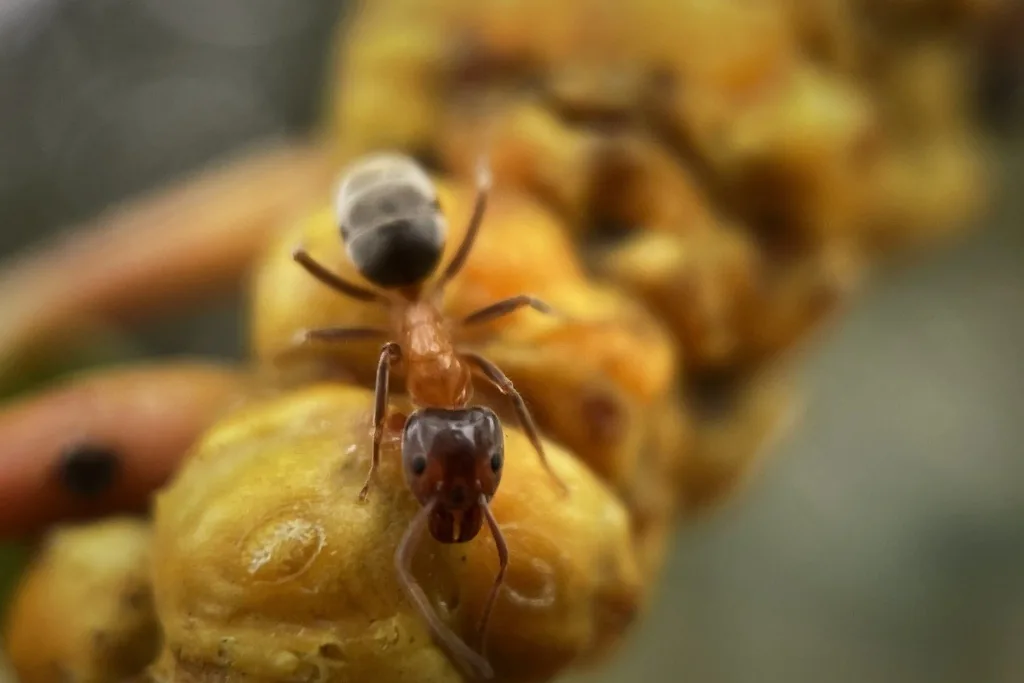
- Brownish-black head, yellowish-red thorax and a black abdomen covered in very fine hairs that look like velvet.[1]
- Workers come in many sizes, from 1/8 to 1/4 inch according to UC IPM (WSU gives 2 to 5 mm). The waist has a single node and the thorax is evenly rounded.[1][2][4]
- Two West Coast species are common: L. occidentale is two-toned, with a dark red thorax and black head and abdomen, while L. luctuosum, also called the pine tree ant, is dark brown to black.[4]
- When disturbed or crushed they give off a very distinct odor, described as coconut-like by WSU and rotten coconut-like by UC Riverside researchers, and they run with the abdomen raised.[2][4][3]
Look-alikes
| Look-alike | How to tell them apart |
|---|---|
| Carpenter ants | Homeowners and pest professionals often mistake velvety tree ants for carpenter ants, which share their mixed worker sizes, smooth, evenly rounded thorax and habit of excavating wood.[3][1] |
| Odorous house ant | Odorous house ants are also confused with them because both make a coconut-like odor from anal glands and run with the abdomen raised when disturbed.[4][3] |
Where it lives
Western United States and Mexico. UC Riverside researchers report L. occidentale along the coast from southern Washington to northern Mexico and commonly in urban southern California; L. luctuosum is restricted to mountain conifer forests in the southern part of its range, while L. occidentale lives in the lowlands. Their importance as structural pests may be greatly underreported in California, Oregon and Washington.[3][5]
Biology and life cycle
Colonies are usually tied to hollows in trees, stumps and logs and also nest under loose bark and rocks. UC Riverside researchers add that L. occidentale prefers crevices of oaks, alders, elms, cottonwoods and creosote, soil, and the bark of dead trees and rotten logs.[1][2][3]
Colonies have many queens. They eat other insects, scavenge dead animals and collect honeydew from aphids, mealybugs and scales, and they are partial to sweets.[4][1][2]
Foragers form massive trails more than 60 m long, some as long as 145 and 185 m, and travel mostly underground in very shallow galleries 1 to 2 cm deep or in leaf litter.[3]
In early summer foragers are active day and night; in late summer, when daytime temperatures exceeded 35 degrees C, they foraged only at night.[3]
In lab tests, the mountain species L. luctuosum survived heat and dry air better than L. occidentale, which may explain its broader distribution.[5]
Fun fact: in Mexico the larvae of a relative, Liometopum apiculatum, are eaten as escamoles and considered a delicacy.[6]
Damage and signs
- Indoors they nest in wall voids, damp areas near water leaks and in or under insulation, and they damage insulation and wood by tunneling. They don't eat wood as termites do, but they hollow it out to nest and may cause considerable damage.[1][2]
- WSU considers them nuisance pests because large numbers infest structures and forage on household foods, and also wood-destroying organisms because they infest wood.[4]
- Structural infestations bring a foul odor.[1]
Health risk
Most ants rarely bite, but UC IPM calls the velvety tree ant an aggressive biter, and Utah State notes they inflict a painful bite and spray secretions onto intruders when disturbed.[2][1]
Control
Prevention
Step 2, dry things out: repair water leaks, keep the area ventilated and replace badly damaged wood.[1]
Keep them out
Step 1, cut off the bridges: trim back tree branches and shrubs that touch the building and seal exterior cracks and holes so workers can't get in.[1]
Sanitation
Step 3, clean up trails indoors: vacuum ant trails or wipe them with soapy water, and remove food residues and sweet spills; UC IPM says indoor sprays aren't usually necessary.[2]
Pesticides
Step 4, bait outdoors: Utah State notes ant baits may be necessary. UC IPM recommends baits placed near ant trails and nest openings outdoors, with active ingredients such as boric acid or borates, fipronil, avermectin (abamectin) or hydramethylnon; sprays give only temporary control.[1][2]
Velvety tree ant foragers prefer sweet baits: in UC Riverside tests they took sucrose, glucose and honey solutions and also solid anchovy protein baits, and the researchers concluded that liquid baits with 25% sucrose would be effective if suitable toxicants were identified.[3]
When to call a professional
If you hire a pest control company, UC IPM suggests asking for baits and spot treatments rather than perimeter treatments or monthly sprays.[2]
Common questions
- What ant smells like coconut when you squish it?
- In the West, often the velvety tree ant: WSU describes a coconut-like odor and UC Riverside researchers a rotten coconut-like odor. The odorous house ant makes a similar smell.[4][3]
- Do velvety tree ants bite?
- Yes. Unlike most ants, which rarely bite, velvety tree ants are aggressive biters and bite painfully when disturbed.[2][1]
- Are they carpenter ants?
- No, though they are often mistaken for carpenter ants because both have workers of mixed sizes, a smooth rounded thorax and a habit of excavating wood.[3][1]
- Do they damage houses?
- They can. They tunnel in damp wood and insulation and may cause considerable damage; WSU classes them as wood-destroying organisms.[1][2][4]
Sources
- Utah State University Extension (Integrated Pest Management), “Velvety Tree Ant, Liometopum spp. (Structural and Nuisance Pests).” extension.usu.edu/planthealth/ipm/notes_nuisance/velvety-tree-ant.php (accessed 2026-11-12)
- University of California Statewide IPM Program (UC IPM), “Ants (Pest Notes 7411).” ipm.ucanr.edu/PMG/PESTNOTES/pn7411.html (accessed 2026-11-12)
- Journal of Entomological Science 49(1), 2014 (Hoey-Chamberlain & Rust, UC Riverside), “Food and Bait Preferences of Liometopum occidentale (Hymenoptera: Formicidae).” urban.ucr.edu/sites/default/files/2020-05/food_and_bait_preferences_of_liometopum.pdf (accessed 2026-11-12)
- Washington State University Extension, “Identification and Habits of Key Ant Pests of Washington (EM033E).” wpcdn.web.wsu.edu/wp-puyallup/uploads/sites/415/2014/12/antpests.pdf (accessed 2026-11-12)
- Journal of Insect Science 14:249, 2014 (Hoey-Chamberlain & Rust), via PubMed, “The survivorship and water loss of Liometopum luctuosum and Liometopum occidentale exposed to different temperatures and relative humidity.” pubmed.ncbi.nlm.nih.gov/25525111/ (accessed 2026-11-12)
- Food Research International 109, 2018 (Gonzalez-Escobar et al.), via PubMed, “Microbiota of edible Liometopum apiculatum ant larvae reveals potential functions related to their nutritional value.” pubmed.ncbi.nlm.nih.gov/29803476/ (accessed 2026-11-12)
- iNaturalist, “Liometopum occidentale taxon page (order and family).” www.inaturalist.org/taxa/68993 (accessed 2026-10-06)