On this page
How to identify it
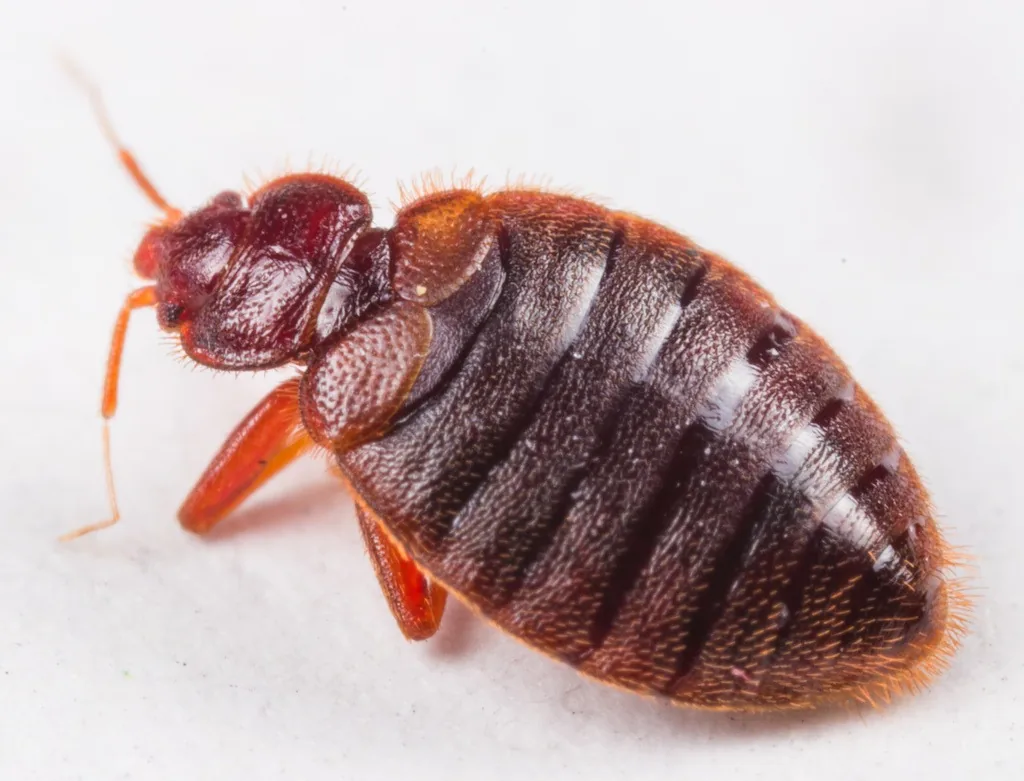
- Without magnification it looks like any bed bug: CDC describes bed bugs as small, flat, wingless, reddish-brown insects 1 to 7 mm long.[4]
- Specialists measure the plate behind the head: it is less than 2.5 times as wide as long in the tropical bed bug, and wider than that in the common bed bug.[1]
- The side edges of that plate are less upturned than on the common bed bug.[1]
- Adults also have more tiny tenent hairs on the pads of their lower legs than the common bed bug and grip vertical surfaces better.[6]
Look-alikes
| Look-alike | How to tell them apart |
|---|---|
| Common bed bug | The common bed bug has a relatively wider plate behind the head with more upturned edges, and UC IPM says it is most common in northern temperate climates rather than the tropics.[1][2] |
| Bat bug | Bat bugs have hairs on the plate behind the head longer than the eye is wide; on bed bugs those hairs are shorter. Seeing this takes a hand lens or microscope.[2] |
Where it lives
Found mainly in tropical and subtropical areas within about 30 degrees of the equator. In the U.S., published records come from Florida: several counties in the 1930s and 1940s, an Orlando hotel in 1989, and a Brevard County home in 2015.[1]
Biology and life cycle
Like other bed bugs, it feeds on blood at night while people sleep, hides in cracks and crevices near beds, and spreads in luggage, bags, folded clothes, bedding and furniture.[4][2][7]
In a Malaysian study at about 79°F (26°C) with human blood meals, females laid up to 50 eggs in a lifetime over 11 to 14 egg-laying cycles, and feeding more often raised egg output. Eggs hatched in 5 to 7 days.[7]
Nymphs went through five stages: the first four took 3 to 4 days each and the last 4 to 5 days, and they needed more than five blood meals to molt successfully. Unmated females lived up to almost 7 months.[7]
Heat kills it at lower temperatures for eggs than for adults: within an hour, eggs died at 39°C (about 102°F), first-stage nymphs at 44°C (about 111°F) and adults at 46°C (about 115°F). It survived longest at 20°C (68°F) and high humidity.[8]
Far less has been published on managing it than on the common bed bug, according to a 2023 study.[10]
Damage and signs
Health risk
CDC says bed bugs are not known to spread disease, but bites can cause itching and loss of sleep, and heavy scratching can lead to skin infection. Some people show no marks at all; insomnia and anxiety are possible, and allergic reactions, rarely including anaphylaxis, can occur. See a healthcare provider if you think you are having an allergic reaction.[4]
Control
Sanitation
Keep clutter down so hiding places are easier to find and treat.[2]
Traps and physical control
Combine vacuuming, steam or heat and sealing hiding places with any insecticide. Sources differ on laundry: UC IPM mentions washing bedding at a high temperature, while the EPA says washing alone generally won't kill bed bugs and recommends a hot dryer for 30 minutes. The EPA says heat-treated items or rooms should reach at least 120°F for 90 minutes.[2][5]
Steam and diatomaceous earth worked against this species in Chinese dormitory trials. In one, 44% of infested rooms had no bed bugs after 14 weeks and trap counts fell 94.1%; in a 37-week study, steam or steam plus diatomaceous earth eliminated 97 to 100% of infestations. A 1-second burst of steam killed every exposed bug, but 10 seconds through a fabric cover killed 89%.[10][11]
Pesticides
Bed bug resistance to insecticides is increasingly common, and a 2017 review lists several resistance mechanisms in both species, including kdr mutations. All six tropical bed bug infestations found in a European survey carried two kdr-associated mutations.[2][13][9]
When to call a professional
UC IPM says confirmed bed bug infestations should be managed by trained professionals, and the EPA suggests consulting a pest management professional for inspection and treatment.[2][5]
Get the species identified. Researchers in Korea say telling the two species apart matters for choosing traps and testing for resistance, and in 2024 they published DNA tests that identify both species even from dead specimens.[14]
Why monitoring traps can miss it
The EPA recommends bed bug interceptors to confirm that an infestation is gone.[5]
In a 2017 test of four smooth-sided pitfall monitors, adult tropical bed bugs escaped from all of them, while common bed bugs did not; few or no nymphs of either species escaped. Adult tropical bed bugs also gripped vertical surfaces harder and had more tiny hairs on their leg pads.[6]
A 2026 study found taller inverted bowls caught more tropical bed bugs than a commercial plastic interceptor, and coating the inner walls with fluoropolymer resin, talc or diatomaceous earth kept every bug from escaping.[12]
Common questions
- Is the tropical bed bug harder to get rid of?
- It responds to the same tools, but it can climb out of some smooth-sided monitoring traps that hold common bed bugs, and populations in many places carry insecticide-resistance mutations. Steam and diatomaceous earth with follow-up checks worked in field trials.[6][9][11]
- How do I know which bed bug I have?
- Not by eye. It takes a microscope to compare the plate behind the head, or a DNA test, so the sample has to go to an identification lab.[1][14]
Sources
- Florida Entomological Society (Campbell, Koehler, Buss and Baldwin, University of Florida), “Recent Documentation of the Tropical Bed Bug (Hemiptera: Cimicidae) in Florida Since the Common Bed Bug Resurgence, Florida Entomologist 99(3): 549-551 (2016).” doi.org/10.1653/024.099.0333 (accessed 2026-10-06)
- University of California Statewide IPM Program, “Pest Notes: Bed Bugs, Publication 7454 (May 2013).” ipm.ucanr.edu/legacy_assets/PDF/PESTNOTES/pnbedbugs.pdf (accessed 2026-11-11)
- iNaturalist, “Cimex hemipterus taxon page (order and family).” www.inaturalist.org/taxa/936185 (accessed 2026-11-11)
- Centers for Disease Control and Prevention, “About Bed Bugs.” www.cdc.gov/bed-bugs/about/index.html (accessed 2026-11-11)
- U.S. Environmental Protection Agency, “Controlling Bed Bugs Using Integrated Pest Management (IPM).” www.epa.gov/bedbugs/controlling-bed-bugs-using-integrated-pest-management-ipm (accessed 2026-11-11)
- Journal of Economic Entomology, via PubMed, “Kim DY, Billen J, Doggett SL, Lee CY (2017), Differences in climbing ability of Cimex lectularius and Cimex hemipterus (Hemiptera: Cimicidae), Journal of Economic Entomology 110(3):1179-1186.” pubmed.ncbi.nlm.nih.gov/28334370/ (accessed 2026-11-11). Cited from the PubMed abstract.
- Medical and Veterinary Entomology, via PubMed, “How YF, Lee CY (2010), Fecundity, nymphal development and longevity of field-collected tropical bedbugs, Cimex hemipterus, Medical and Veterinary Entomology 24(2):108-116.” pubmed.ncbi.nlm.nih.gov/20202109/ (accessed 2026-11-11). Cited from the PubMed abstract.
- Journal of Medical Entomology, via PubMed, “How YF, Lee CY (2010), Effects of temperature and humidity on the survival and water loss of Cimex hemipterus (Hemiptera: Cimicidae), Journal of Medical Entomology 47(6):987-995.” pubmed.ncbi.nlm.nih.gov/21175045/ (accessed 2026-11-11). Cited from the PubMed abstract.
- Medical and Veterinary Entomology, via PubMed, “Balvin O, Sasinkova M, Martinu J, et al. (2021), Early evidence of establishment of the tropical bedbug (Cimex hemipterus) in Central Europe, Medical and Veterinary Entomology 35(3):462-467.” pubmed.ncbi.nlm.nih.gov/33948981/ (accessed 2026-11-11). Cited from the PubMed abstract.
- Journal of Economic Entomology, via PubMed, “Kong D, Han D, Zhai R, et al. (2023), A case study on tropical bed bug, Cimex hemipterus (Hemiptera: Cimicidae) infestation and management in dormitories, Journal of Economic Entomology 116(1):5-11.” pubmed.ncbi.nlm.nih.gov/35511752/ (accessed 2026-11-11). Cited from the PubMed abstract.
- Pest Management Science, via PubMed, “Kong D, Xie Y, Wang Z, et al. (2024), Efficacy of steam and diatomaceous earth dust against the tropical bed bug Cimex hemipterus (F.) under laboratory and field conditions, Pest Management Science 80(10):5026-5034.” pubmed.ncbi.nlm.nih.gov/38847149/ (accessed 2026-11-11). Cited from the PubMed abstract.
- Pest Management Science, via PubMed, “Ye T, Zeng L, Tian Y, et al. (2026), Assessment of some characteristics of pitfall-style traps in trapping the tropical bed bug, Cimex hemipterus (Hemiptera: Cimicidae), Pest Management Science 82(7):6129-6136.” pubmed.ncbi.nlm.nih.gov/41845471/ (accessed 2026-11-11). Cited from the PubMed abstract.
- Parasites & Vectors, via PubMed, “Dang K, Doggett SL, Veera Singham G, Lee CY (2017), Insecticide resistance and resistance mechanisms in bed bugs, Cimex spp. Parasit Vectors 10:318.” pubmed.ncbi.nlm.nih.gov/28662724/ (accessed 2026-11-11)
- Parasites & Vectors, via PubMed, “Han JH, Choi J, Cho S, Lee SH, Kim JH (2024), Development of molecular diagnostic protocols for simultaneous identification of common bed bugs (Cimex lectularius) and tropical bed bugs (Cimex hemipterus), Parasites & Vectors.” pubmed.ncbi.nlm.nih.gov/39402589/ (accessed 2026-11-11). Cited from the PubMed abstract.