On this page
How to identify it
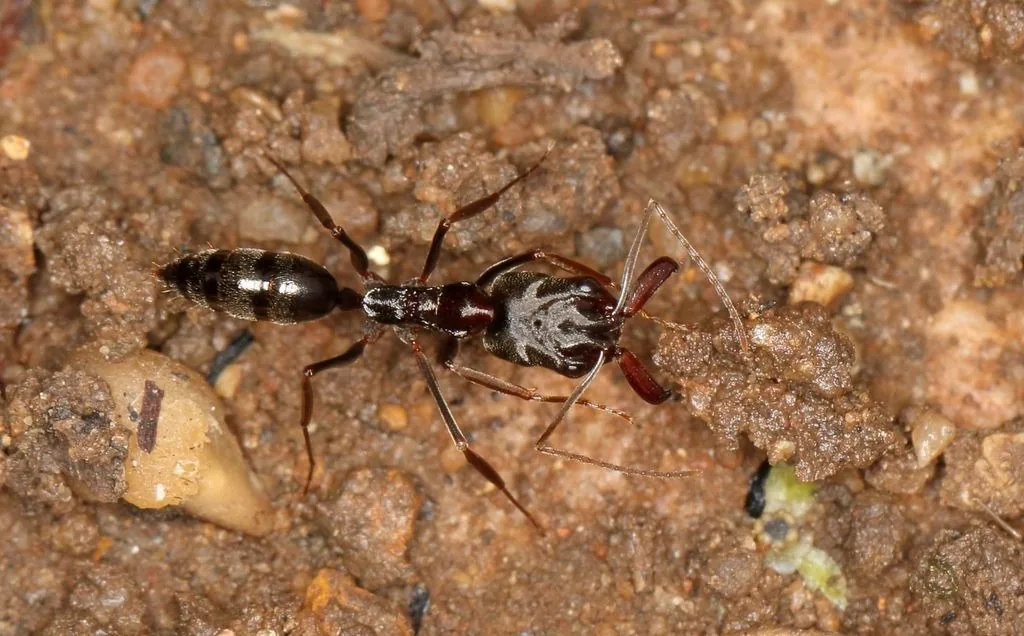
- Workers are large ants with long, snapping jaws, a single pointed node at the waist and an obvious sting. Mississippi State's two fact sheets give different sizes: about 1/4 inch long in one and over 1/3 inch in the other.[1][2]
- They are shiny and dark reddish brown.[1]
- Long jaws are held wide open and snap shut with great force; the antennae are unusually long so they can reach past the jaws.[2][1]
- A snap against a surface can fling the ant upward 2 to 3 inches or backward 5 to 8 inches, so it seems to jump.[1][2]
- Males are yellowish, wasp-like and winged and have no sting; winged females do sting.[1]
- A fun fact: in a related trap-jaw ant, the jaws close at 35 to 64 meters per second in about 0.13 thousandths of a second, with a strike force that can exceed 300 times the ant's body weight, enough to launch it into the air.[4]
Look-alikes
Where it lives
Native to South America and first found in Mobile, Alabama, in 1956. It is well established in Mobile, parts of Florida and the New Orleans area, and in southern Mississippi counties. A 2014 review recorded it as new to North America and documented its spread.[2][1][5]
Biology and life cycle
Colonies are loose and small, usually a few hundred workers, nesting in leaf litter, mulch, decaying wood and tree cavities in both urban and natural settings.[1][2]
They are hunters that catch small insects in their jaws; kicking the soil and leaf litter at a tree base can make workers rush out.[2][1]
Young larvae have sticky pads on their backs that let workers hang them from the ceilings of brood chambers.[2]
Winged reproductives swarm from late June through early August in Mississippi.[1]
Damage and signs
Health risk
The sting is often described as a bit more painful than a honey bee sting but is not long-lasting. Workers may grip the skin with their jaws and sting several times. Odontomachus is among the ant groups documented to cause serious allergic reactions in people. Anyone with trouble breathing or face or throat swelling after a sting needs emergency care (call 911).[2][1][6][7]
Control
Prevention
If you find what may be trap-jaw ants outside their known range, Mississippi State Extension asks to hear about it; send a photo to your local Extension office.[2]
Take care when raking leaf litter or moving mulch and rotting wood near tree bases; that is where these ants nest and where gardeners usually run into them.[2][1]
Pesticides
Liquid pyrethroid sprays applied to nests and the area around them, including trailing areas, are effective; Mississippi State also reports dinotefuran working.[1][2]
Ready-to-use hose-end sprays are a convenient option; examples Mississippi Extension names include bifenthrin plus zeta-cypermethrin, gamma-cyhalothrin, cyfluthrin and permethrin.[2]
Granular insecticides and ant bait granules usually don't work as well on these active hunters.[1]
Common questions
- Can trap-jaw ants really jump?
- Yes, in a way. Snapping their jaws against the ground throws them several inches, which helps them escape predators.[2][1]
- Are trap-jaw ants dangerous?
- They sting quickly to defend the nest, and the sting is painful but not long-lasting. Trap-jaw ants are among the ants that can cause serious allergic reactions, so people with sting allergies should be careful and get emergency help for any breathing trouble or swelling.[2][1][6][7]
- What should I do if a trap-jaw ant stings me?
- Wash with soap and water and use ice wrapped in a cloth, 10 minutes on and 10 minutes off; an antihistamine or anti-itch cream can help. Call 911 for signs of a severe allergic reaction and use the person's epinephrine kit if they have one.[7]
- Why didn't ant bait work on trap-jaw ants?
- Because they are active hunters, granular baits and granules work poorly, so Mississippi State recommends treating the nest and surrounding area directly with a liquid pyrethroid.[1][2]
Sources
- Mississippi State University Extension, “Pest Snapshot: Two-Spined Trap-Jaw Ant (Odontomachus haematodus), Publication 4123.” extension.msstate.edu/publications/pest-snapshot-two-spined-trap-jaw-ant-odontomachus-haematodus (accessed 2026-11-12)
- Mississippi State University Extension, “Bug's Eye View: Trap-jaw Ant, Vol. 7, No. 27 (2021).” extension.msstate.edu/newsletters/bugs-eye-view/2021/trap-jaw-ant-vol-7-no-27 (accessed 2026-11-12)
- iNaturalist, “Odontomachus haematodus taxon page (order and family).” www.inaturalist.org/taxa/1418851 (accessed 2026-11-12)
- Proceedings of the National Academy of Sciences, via PubMed, “Multifunctionality and mechanical origins: ballistic jaw propulsion in trap-jaw ants (Patek et al. 2006).” pubmed.ncbi.nlm.nih.gov/16924120/ (accessed 2026-11-12). Cited from the PubMed abstract.
- Zootaxa, via PubMed, “A review of the Nearctic Odontomachus with a treatment of the males (MacGown et al. 2014).” pubmed.ncbi.nlm.nih.gov/24871027/ (accessed 2026-11-12). Cited from the PubMed abstract.
- Annals of Allergy, Asthma and Immunology, via PubMed, “Adverse reactions to ants other than imported fire ants (Klotz et al. 2005).” pubmed.ncbi.nlm.nih.gov/16312163/ (accessed 2026-11-12). Cited from the PubMed abstract.
- MedlinePlus, U.S. National Library of Medicine, “Insect bites and stings (Medical Encyclopedia 000033).” medlineplus.gov/ency/article/000033.htm (accessed 2026-11-12)