On this page
How to identify it
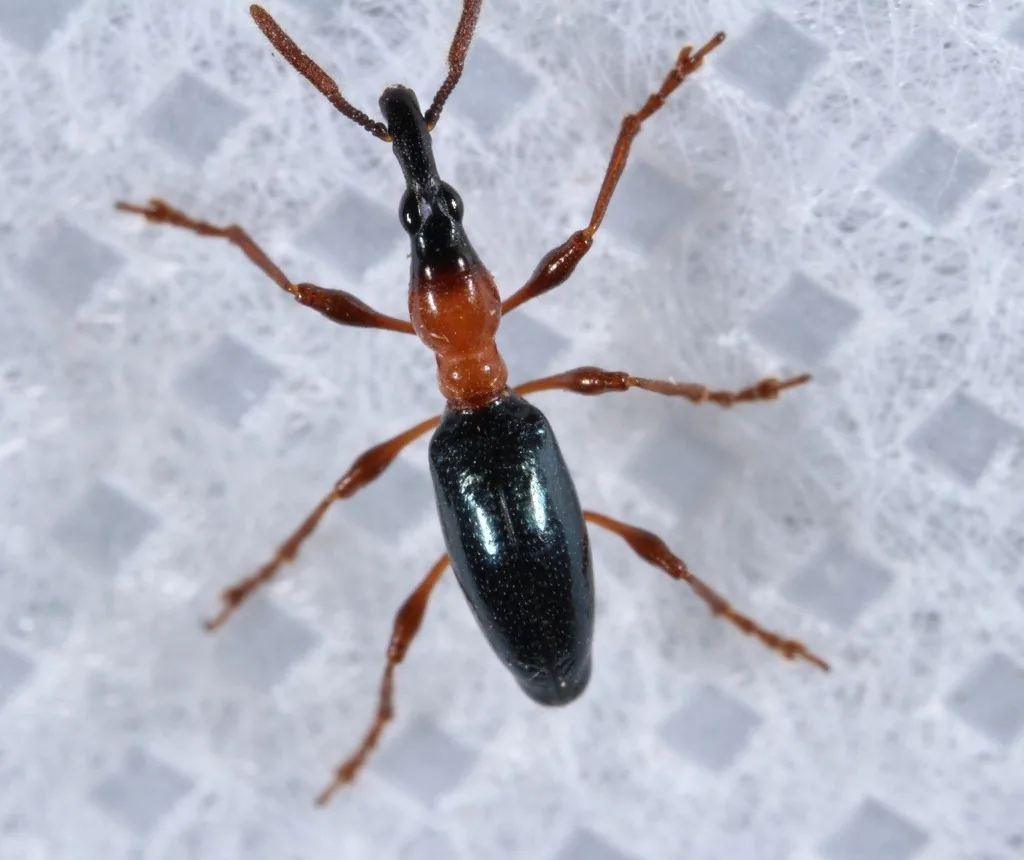
- Adults are ant-like snout beetles about 1/4 inch long, with dark-blue wing covers and a red-orange thorax and legs. They drop to the soil when disturbed. UF/IFAS describes a black head, orange to reddish-brown antennae, thorax and legs, and a metallic blue abdomen and wing covers, with a slightly curved snout about as long as the thorax. Adults measure 5.5 to 8.0 mm and are quick to play dead if disturbed.[1][9]
- Larvae are fat, legless and dirty white, about 3/8 inch long with a pale-brown head, tunneling inside roots and stems. UF/IFAS says the larva goes through three instars and packs its winding tunnels with fecal material.[1][9]
- Infested roots show small holes scattered over the surface, especially at the stem end, and tunnels packed with frass.[1]
- The oval, creamy white eggs are about 0.7 mm (0.03 in) long and are sealed into the root or stem with a plug of fecal material, which makes them hard to see. The pupa is about 6.5 mm (0.26 in) long, white at first and turning grayish.[9]
Where it lives
Found in tropical and subtropical regions worldwide. In the U.S. it is a serious problem in some coastal areas from North Carolina to Texas, is rarely found as far north as New Jersey, and is under quarantine in parts of San Diego County, California; California's quarantine also lists Hawaii. UF/IFAS says it was first noted in the U.S. in Louisiana in 1875, then in Florida in 1878 and Texas in 1890, probably arriving by way of Cuba, and that it is also found in Hawaii and Puerto Rico.[1][6][3][4][9]
Biology and life cycle
Females make holes in stems and fleshy roots near the soil surface, lay an egg in each and cover it with a jellylike secretion; each female lays about 120 eggs on average. UF/IFAS says most eggs go in near where the stem meets the root, and adults sometimes crawl down cracks in the soil to reach the roots.[1][9]
Larvae hatch in under a week and feed inside for 2 to 3 weeks, then pupate near the soil line. Pupae become adults in about a week, often emerging about four days later, and adults live 2.5 to 3 months in summer and up to 8 months in winter.[1]
It keeps feeding and breeding in stored sweet potatoes through winter, more slowly below 60°F, with as many as eight generations a year. In the tropics outbreaks run year-round.[1][6]
UF/IFAS says a complete life cycle takes one to two months, with 35 to 40 days common in summer. Generations overlap; it estimates about five a year in Texas and at least eight in Louisiana. Adults don't diapause in winter but shelter and stay inactive until the weather improves, and all stages can be found year-round where host material is available.[9]
Adults are secretive and mostly active at night, often feeding on the undersides of leaves. They fly rarely, in short, low flights, yet UF/IFAS reports dispersal of 150 m per day, faster when no suitable hosts are around.[9]
Damage and signs
- Damage often isn't evident until harvest; infested roots turn bitter and are unfit for people or livestock. UF/IFAS says vine yellowing shows only after a heavy infestation, so early problems are easily missed. Infested roots are often riddled with cavities, spongy and dark, and even light feeding gives them a bitter taste and terpene odor; larval tunnels also let soil-borne pathogens in.[1][9]
- Sweet potato and related wild plants such as morning glory are its only hosts; quarantines also regulate Ipomoea, Convolvulus and Calystegia morning glories. UF/IFAS says it feeds on the morning glory family (Convolvulaceae), mainly Ipomoea, and names railroad vine and morning glory as wild hosts.[1][4][5][9]
- Its hidden habits, fast reproduction and adaptability make it hard to control, and it is a quarantine pest worldwide.[6]
- UF/IFAS cites reported losses of 5% to 97% where the weevil occurs. Larvae also mine the vines, which can darken, crack or collapse; adults chew small holes in the roots, but their damage is less severe than the larvae's.[9]
Health risk
A plant feeder; it makes sweet potatoes bitter and inedible, but none of the sources describes any risk to people.[1][2]
Control
Prevention
Plant certified, weevil-free slips from known sources; if you can't get them, examine each seed root and destroy any that are infested.[1][2]
Don't move sweet potatoes, slips or morning glories out of infested or quarantined areas; North Carolina and California both restrict them.[2][3]
Deep-rooted varieties are less exposed than shallow-rooted ones. In a 2019 field study, dry cypress, eucalyptus or alfalfa (lucerne) mulch reduced weevils reaching plants and root damage, which may matter most when dry soil cracks.[1][7]
Keep the soil moist. UF/IFAS says dry, cracked soil favors the weevils, and irrigation also favors the fungal diseases that kill them.[9]
Sanitation
Rotate crops, destroy volunteer plants and crop leftovers, and control morning glory near the planting. UF/IFAS stresses removing discarded and unharvested roots, which can support large populations, controlling Ipomoea weeds, and locating new fields away from earlier crops and sweet potato storage.[1][2][9]
Traps and physical control
Traps baited with a male-specific pheromone lure detect the weevil; in North Carolina, state plant pest specialists will trap home and demonstration plots at no cost. UF/IFAS says weevils will apparently travel up to 280 m to a pheromone source, and that the pheromone also shows potential for mating disruption and mass trapping.[2][9]
Biological control
UF/IFAS says strains of the insect-killing nematodes Steinernema carpocapsae and Heterorhabditis bacteriophora get into soil and roots and kill weevil larvae; in southern Florida soils they stayed active for up to four months and sometimes reduced damage more than insecticides. Beauveria bassiana fungus strains can also work when the soil is moist enough.[9]
Pesticides
Commercial growers can treat roots after harvest to protect storage; follow your state's current recommendations. UF/IFAS adds that storage in controlled atmospheres, mainly low oxygen and high carbon dioxide, is very effective at killing weevils but needs good storage conditions.[1][9]
Quarantines
California bars sweet potato plants, slips, roots and morning glories grown, packed or stored in Alabama, Arkansas, Florida, Georgia, Hawaii, Louisiana, Mississippi, South Carolina, Tennessee, Texas and parts of North Carolina, unless they are certified as treated or from a noninfested county; seed roots need a permit. The posted quarantine page is dated 2008.[3]
Within California, part of San Diego County is under an interior quarantine: host plants and roots may leave it only with an official certificate, or with a sales receipt when bought at retail.[4]
Alabama's quarantine rule states the weevil is established in Alabama and regulates sweet potato roots, plants and vines and other Ipomoea and Convolvulus plants from listed counties and parishes in other states.[5]
North Carolina keeps a quarantine area in Brunswick and New Hanover counties; the state set 12,411 traps in sweet potato fields in 2024 and caught no weevils.[2][3]
Where sources disagree
Which areas are regulated: California's rule treats all of Georgia, Louisiana, Mississippi, South Carolina and Texas as quarantined, while Alabama's rule lists only certain counties or parishes in those states and all of Florida.[3][5]
North Carolina status: NC State says the weevil, found in eastern North Carolina in 1967, is now largely under control there, while NCDA&CS still surveys and regulates its quarantine area.[1][2]
Egg output and life span: NC State says each female lays about 120 eggs on average and adults live 2.5 to 3 months in summer, while UF/IFAS says two to four eggs a day, or 75 to 90 over an adult life span of about 30 days, though lab studies have reported a mean of 122 and a range of 50 to 250.[1][9]
Common questions
- What's tunneling my sweet potatoes?
- Often sweetpotato weevil larvae, which tunnel inside roots and leave small holes near the stem end.[1]
- Can weevils start from planting stock?
- Yes. Infested slips and seed roots spread it, so plant certified weevil-free stock.[1][2]
- Can I take sweet potatoes from Florida or Texas into California?
- Not freely. California's quarantine admits them only if certified as treated or from a noninfested county; check with the California Department of Food and Agriculture first.[3]
- Why do my sweet potatoes taste bitter?
- Weevil feeding is one possible cause. UF/IFAS says even low levels of feeding set off a chemical reaction that gives roots a bitter taste and terpene odor, and NC State says infested roots are unfit for people or livestock.[9][1]
Sources
- NC State Extension, “Pests of Sweetpotato (Insect and Related Pests of Vegetables).” content.ces.ncsu.edu/insect-and-related-pests-of-vegetables/pests-of-sweetpotato (accessed 2026-11-11)
- North Carolina Department of Agriculture and Consumer Services, Plant Industry Division, “Sweetpotato Weevil Program.” ncagr.gov/divisions/plant-industry/plant-protection/entomological-services/sweetpotato-weevil-program (accessed 2026-11-11)
- California Department of Food and Agriculture, “Plant Quarantine Manual 3257: Sweet Potato Weevil (state exterior quarantine).” pi.cdfa.ca.gov/pqm/manual/htm/306.htm (accessed 2026-11-11)
- California Department of Food and Agriculture, “Plant Quarantine Manual 3429: Sweet Potato Weevil (state interior quarantine).” pi.cdfa.ca.gov/pqm/manual/htm/412.htm (accessed 2026-11-11)
- Alabama Department of Agriculture and Industries, Plant Protection, “Ala. Admin. Code ch. 80-10-5, Sweet Potato Weevil Quarantine.” agi.alabama.gov/plantprotection/wp-content/uploads/sites/12/2026/08/Code-80-10-5-Sweet-Potato-Weevil-Quarantine.pdf (accessed 2026-11-11)
- Insects, via PubMed, “Recent Advances in Sustainable Management of Cylas formicarius (Li et al. 2026).” pubmed.ncbi.nlm.nih.gov/41898907/ (accessed 2026-11-11)
- Scientific Reports, via PubMed, “Organic mulches reduce crop attack by sweetpotato weevil (Cylas formicarius) (Rehman et al. 2019).” pubmed.ncbi.nlm.nih.gov/31619690/ (accessed 2026-11-11)
- iNaturalist, “Cylas formicarius taxon page (order and family).” www.inaturalist.org/taxa/305678 (accessed 2026-11-11)
- University of Florida IFAS Extension, EDIS, “Sweetpotato Weevil, Cylas formicarius (Fabricius), EENY-027/IN154 (Featured Creatures).” ask.ifas.ufl.edu/publication/IN154 (accessed 2026-11-14)