On this page
How to identify it
- Adults are tiny delicate flies about 2 mm long, light brown to light orange.[1][2]
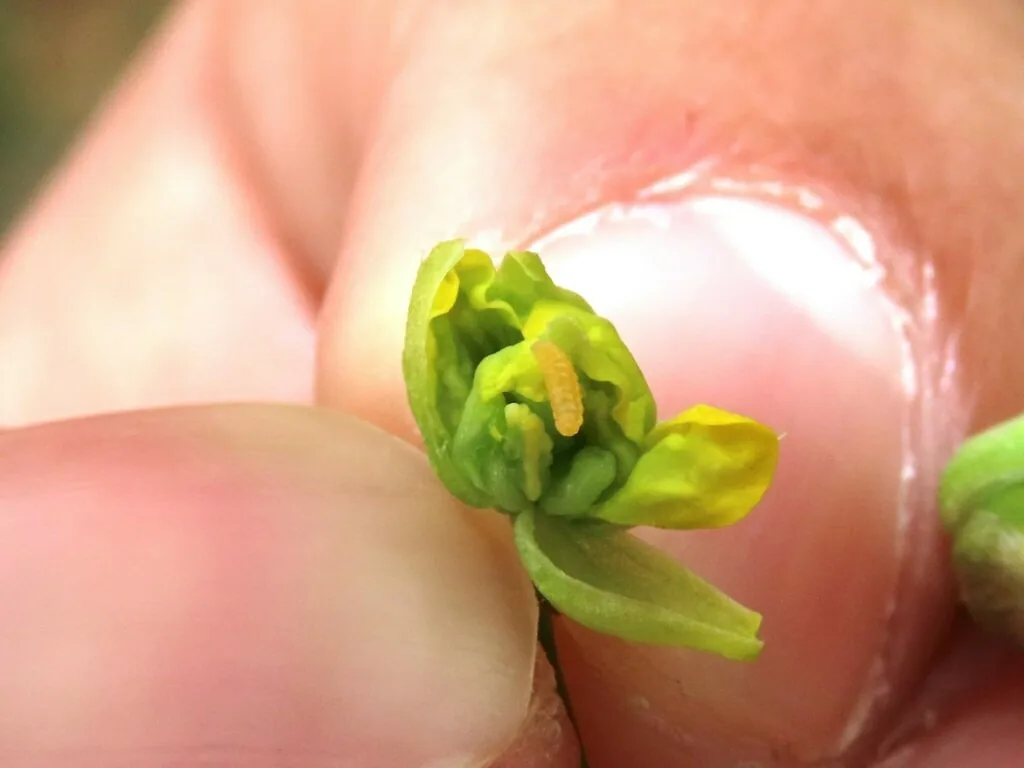
- Larvae are 1 to 4 mm, creamy white when young and lemon yellow when mature, hidden in the growing point.[1]
- The key sign is brown, corky scarring near the growing point, with distorted leaves and multiple or missing heads.[1]
Where it lives
An invasive fly, it was first found in Minnesota in 2016 at community gardens in Hennepin and Ramsey counties; the Minnesota Department of Agriculture has confirmed it at more community garden sites in those counties since 2017 and reports only 10 km of documented spread in six years. It is established in Manitoba. Illinois Extension reports it was first detected in the U.S. in New York in 2004 and has since been found in Michigan, Ohio, Minnesota, Wisconsin and Illinois.[1][3][2]
Biology and life cycle
It overwinters in the top few centimeters of soil where brassicas grew and can stay dormant for several seasons.[1]
Adults live one to five days; larvae feed 7 to 15 days, then drop to the soil; there can be two to five generations a year.[1]
Damage and signs
- Feeding distorts and scars leaves and stems and can prevent broccoli from forming a crown or cause multiple heads.[1]
Health risk
It attacks brassicas; no cited source describes any risk to people or pets.[1][2][3]
Control
Prevention
Don't start transplants in soil that may hold swede midge pupae.[1]
Where confirmed, don't plant brassicas in the same spot for one to three years.[1]
When to call a professional
Report suspected swede midge in Minnesota to the Minnesota Department of Agriculture. The department says confirming a new location needs adult flies, either reared from infested plants or caught on pheromone-baited sticky traps.[1][3]
More from Illinois Extension
Swede midge reached North America in 2000, when it was found in Canada, and was first detected in the U.S. in New York in 2004; adults are weak fliers, so it spreads mainly on moved plants, and it doesn't carry plant diseases.[2]
Regulatory status
The Minnesota Department of Agriculture says there are no regulations related to swede midge.[3]
Where the sources disagree
How it spreads: Minnesota Extension says it is moved by wind, so damage often shows first at field or garden edges next to buildings or tree lines; Illinois Extension says adults are weak fliers likely spread on moved transplants; the Minnesota Department of Agriculture says it is not a strong flier but does move several hundred meters, and that infested transplants are a high-risk pathway.[1][2][3]
Larval feeding time: Minnesota Extension says larvae feed for about 7 to 15 days; Illinois Extension says they take 7 to 21 days.[1][2]
Size: Minnesota Extension and Illinois Extension give adults as about 2 mm and larvae as 1 to 4 mm; the Minnesota Department of Agriculture gives adults as about 1 to 2 mm and full-size larvae as 2 to 4 mm.[1][2][3]
Common questions
Sources
- University of Minnesota Extension, “Swede midge (Yard and garden insects).” extension.umn.edu/garden-and-home/yard-and-garden/yard-and-garden-insects/swede-midge (accessed 2026-11-13)
- University of Illinois Extension, “Swede Midge.” extension.illinois.edu/insects/swede-midge (accessed 2026-11-13)
- Minnesota Department of Agriculture, “Swede Midge.” www.mda.state.mn.us/plants-insects/swede-midge (accessed 2026-11-13)
- Global Biodiversity Information Facility (GBIF), “Contarinia nasturtii (Kieffer, 1888) (GBIF Backbone Taxonomy).” api.gbif.org/v1/species/5082160 (accessed 2026-11-13)