On this page
How to identify it
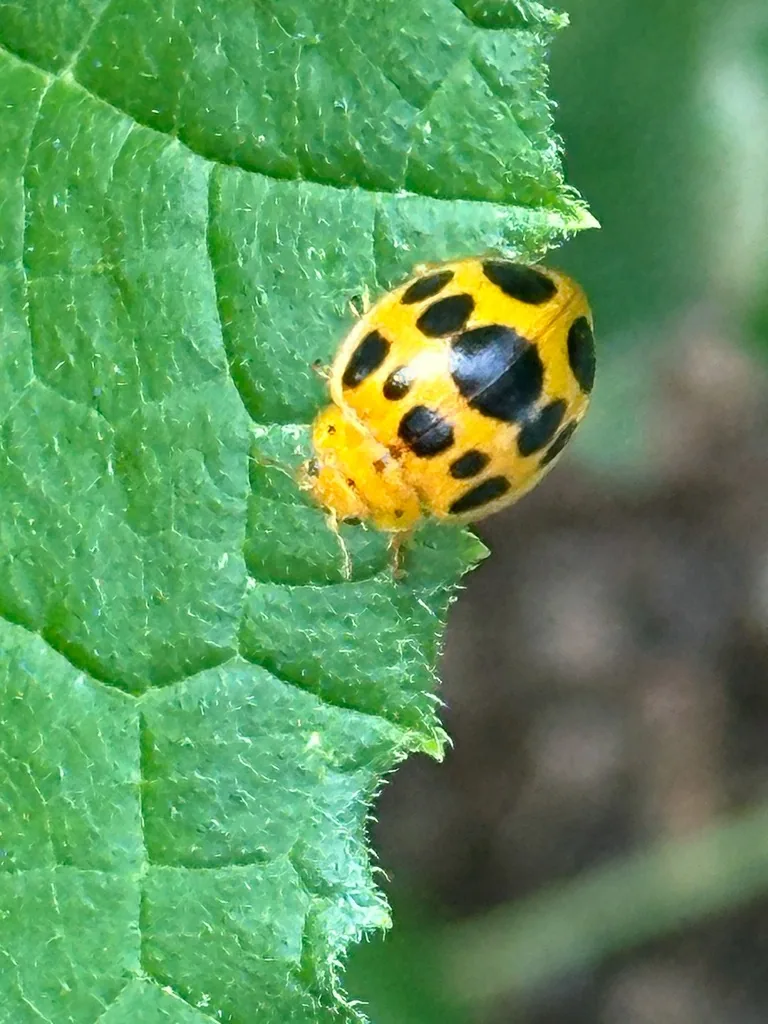
- Adults are dome-shaped, round from above and flat underneath, and yellow to orange or copper-colored, like the familiar beneficial lady beetles.[2][1]
- The wing covers carry 14 black spots, roughly in three rows across the back, with four smaller spots on the thorax behind the head.[1]
- Larvae are yellow, rounded-oblong and covered with branched spines. They feed on the undersides of leaves.[1][2][3]
Look-alikes
| Look-alike | How to tell them apart |
|---|---|
| Mexican bean beetle | A close relative in the same genus with very similar larvae. Its adults carry 16 black spots rather than 14, are smaller, and feed on beans and other legumes rather than squash.[1][4][5] |
| Beneficial lady beetles | Squash beetle adults look like the familiar beneficial lady beetles; the spiny larvae and the leaf damage on squash family plants give them away.[2][1] |
| Squash bug | A true bug, not a beetle, with a very different body shape, life cycle and way of feeding, even though both turn up on squash.[1][3] |
Where it lives
Reported from many states between Texas and Massachusetts and said to be most common along the Atlantic Seaboard; it is not found in Wisconsin. Extension services in Georgia, South Carolina and Delaware write about it as a garden pest.[3][1][2][4]
Biology and life cycle
Adults spend the winter under tree bark or leaf litter at field edges and move to cucurbits in June, after the plants leaf out.[3][4]
Eggs are laid in July on leaves or vines. The UW-Milwaukee Field Station puts it at up to 400 eggs per female, in clusters of about 45.[3][4]
Larvae feed for about four weeks, then pupate on the undersides of leaves. New adults come out in August and feed until about September before leaving the garden to find winter shelter.[4][3]
Adults and larvae eat the soft tissue between the leaf veins. Before feeding, the beetle chews a trench around the patch it is about to eat.[3]
The pupae carry oily droplets on their hairs that deter ants. Chemists at Cornell found the secretion is made of large ring-shaped polyamine compounds plus acetate forms of vitamin E (tocopheryl acetates).[3][6][7]
Damage and signs
- Chewing leaves the leaves skeletonized and lace-like, especially at the edges, a pattern called windowpaning, on squash, zucchini, cucumber and pumpkin.[1]
- Adults may also chew the skins of squash and melons once fruit forms, which can leave cosmetic scars.[1][3]
- It rarely wipes out a planting the way squash bugs or squash vine borers can, but heavily skeletonized leaves make less food for the plant, so yields drop and stressed plants are more open to disease and other pests.[1][3]
Health risk
These extension and university sources treat it only as a plant pest and list no risk to people or pets.[1][2][4]
Control
Prevention
Populations are usually small, so in a small squash patch hand removal is usually enough.[4]
Keep them out
Where it shows up every year, cover squash with floating row cover at planting and remove it once the plants begin to flower.[1]
Traps and physical control
Check leaf undersides early and often. Crush egg clusters and larvae, and pick off adults or drop them into a cup of soapy water.[1][4]
Where sources disagree
Size next to the Mexican bean beetle: UGA Extension calls the Mexican bean beetle only slightly smaller, while University of Delaware Extension says squash beetle adults are about twice as large.[1][4]
How much harm it does: University of Delaware Extension says populations are usually quite small, while UGA's Fulton County agent sees it as a major pest on squash every year.[4][1]
Common questions
- Why is a ladybug eating my squash?
- It is probably a squash beetle, one of two lady beetles that eat vegetable crops. The other is the Mexican bean beetle, which feeds on beans.[2][1]
- How do I tell it from a Mexican bean beetle?
- Count the spots and look at the host plant. Squash beetles have 14 spots and feed on squash family plants; Mexican bean beetles have 16 and feed on beans.[1][5]
- Should I spray for squash beetles?
- Usually not. Crushing eggs and larvae, picking off adults and covering young plants until bloom are the steps these extension sources recommend for home gardens.[4][1]
Sources
- University of Georgia Cooperative Extension, Fulton County, “What to Do About Squash Beetles? Squash Those Beetles!.” site.extension.uga.edu/fultonag/2025/06/what-to-do-about-squash-beetles-squash-those-beetles/ (accessed 2026-11-11)
- Clemson Cooperative Extension Home & Garden Information Center, “What Is It? Wednesday: Squash Beetles.” hgic.clemson.edu/what-is-it-wednesday-squash-beetles/ (accessed 2026-11-11)
- University of Wisconsin-Milwaukee Field Station, “Squash Lady Beetle (Bug of the Week).” uwm.edu/field-station/bug-of-the-week/squash-lady-beetle/ (accessed 2026-11-11)
- University of Delaware Cooperative Extension, “Non-Chemical Pest Control Options for Managing Insect Pests on Cucurbits.” udel.edu/content/dam/udelImages/canr/pdfs/extension/factsheets/Non-chemical-pest-control-options-for-managing-insect-pests-on-Cucurbits.pdf (accessed 2026-11-11)
- Cornell University New York State IPM Program, “Mexican Bean Beetle (Epilachna varivestis) Vegetable IPM Fact Sheet.” cals.cornell.edu/integrated-pest-management/outreach-education/fact-sheets/mexican-bean-beetle-epilachna-varivestis-vegetable-ipm-fact-sheet (accessed 2026-11-11)
- Science, via PubMed, “Schroder, Farmer, Attygalle, Smedley, Eisner and Meinwald (1998), Combinatorial chemistry in insects: a library of defensive macrocyclic polyamines.” pubmed.ncbi.nlm.nih.gov/9665888/ (accessed 2026-11-11)
- Experientia, via PubMed, “Attygalle, Smedley, Eisner and Meinwald (1996), Tocopheryl acetates from the pupal exocrine secretion of the squash beetle, Epilachna borealis (Coccinellidae).” pubmed.ncbi.nlm.nih.gov/8698100/ (accessed 2026-11-11)
- iNaturalist, “Epilachna borealis taxon page (order and family).” www.inaturalist.org/taxa/154559 (accessed 2026-10-06)