On this page
How to identify it
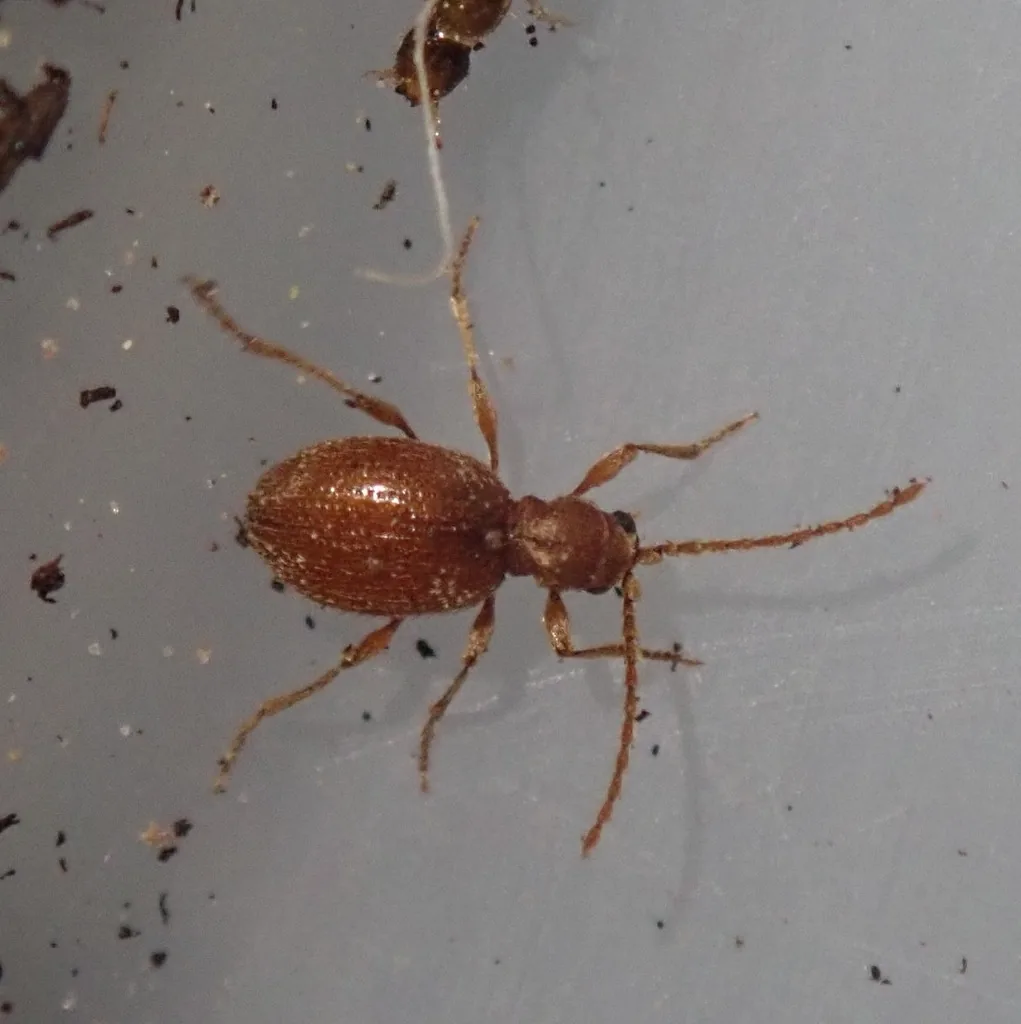
- Small beetles with long, thin legs and long antennae that give them a spider-like look. The hairy spider beetle is about 1/7 inch long and the golden spider beetle 3 to 4.5 mm. UF/IFAS gives adults as 1 to 5 mm long, with legs and antennae usually long, thin and covered with hairs.[6][3][1][2][10]
- A large, rounded abdomen sits behind a much narrower thorax. UF/IFAS says the body is usually oval, sometimes globular or elongate, the head is usually hidden from above, and the prothorax is narrower than the wing covers; the antennae are threadlike, with their bases close together.[3][1][10]
- The hairy spider beetle is reddish brown with four irregular white patches. The whitemarked spider beetle looks much like it, the female more boldly marked than the narrower male, and the brown spider beetle is similar again but has no white markings on its wing covers. Across the group, UF/IFAS says colors run from pale brownish yellow to reddish brown to almost black, some species are two-toned, and in some species males and females look quite different. In the whitemarked spider beetle, UF/IFAS says females have two golden patches at the base of the pronotum and two white patches on each wing cover, which sometimes merge into bands, while males have erect golden hairs on either side of the pronotum's midline.[6][10][11]
- The American spider beetle is shiny and nearly globe-shaped, its relative Gibbium psylloides looks much like it, and the golden spider beetle is covered in silky golden-yellow hairs.[6][3]
- Larvae are curled, C-shaped whitish grubs with a brown head; both larvae and adults feed in the infested material. UF/IFAS gives larvae as 3 to 5 mm long and dirty white, with three pairs of well-developed legs.[2][3][10]
Look-alikes
| Look-alike | How to tell them apart |
|---|---|
| Spiders | Spider beetles only look spider-like because of their long legs and rounded bodies; they are beetles, with hard wing covers and segmented antennae.[2][3] |
| Rice weevil | Grain weevils have the head drawn out into a snout, and their larvae develop inside whole kernels; spider beetle larvae feed loose in food and debris.[2] |
Where it lives
Spider beetles are widespread; the golden spider beetle alone is listed from North America, Central and South America, Europe, Asia and Australasia. USDA says the hairy and whitemarked spider beetles occur in the northern U.S., the hairy spider beetle being occasionally destructive in states next to Canada's Prairie Provinces, while Gibbium psylloides is reported only from the far southern U.S. GBIF's public U.S. records since 1990 for the whitemarked spider beetle are few, about 130, from 25 states on the map, most from New Mexico and Massachusetts. UF/IFAS says spider beetles occur throughout the world, especially in colder regions, where they may stay active even at freezing temperatures, and that the whitemarked spider beetle is distributed worldwide.[3][6][9][10][11]
Biology and life cycle
The hairy spider beetle lays about 40 eggs in flour, feed or other cereal products, and the golden spider beetle 20 to 40. Across the group, UF/IFAS says females may lay up to 100 eggs on or near the larval food, though most species lay fewer.[6][3][10]
Development is slow: Missouri Extension and USDA both put egg to adult at about 3-1/2 months under favorable conditions, and the golden spider beetle's larval stage alone can last up to 250 days.[2][6][3]
Full-grown hairy spider beetle larvae spin silken pupal cases covered with bits of the food they live in.[6]
Spider beetles withstand cold but need easy access to water.[1]
Hairy spider beetle adults show up in warehouses in spring. The golden spider beetle is nocturnal, hides in dark cracks by day, and lives up to about nine months as an adult. UF/IFAS notes that some species can fly.[6][3][10]
Damage and signs
- They feed on grain products, flour, feed, seeds, dried fruit, spices, fishmeal, dried meat, feathers, rodent droppings and other insects. UF/IFAS adds wool and hair to the list.[1][6][3][10]
- They are among the most common beetles in moldy, old food, and old bird nests can also harbor them. Because they eat so many plant and animal materials, UF/IFAS says the source of an infestation may be difficult to locate.[1][3][10]
- Larvae may bore into packaging to pupate, contaminating products with droppings and silk.[3]
- In sticky traps from 1,581 New Jersey apartments, beetles made up 23% of the nuisance arthropods caught, and 82% of those beetles were stored-product beetles, a group that includes spider beetles.[7]
- Beyond kitchens, ptinid beetles damage dried goods in warehouses and collections in libraries and museums.[8]
Health risk
The harm from spider beetles is to food rather than people: they contaminate products with droppings and silk, and UC IPM notes that pantry pests can also bring in microbes that rot food.[3][4]
Control
Prevention
Store flour and other grain products in tightly sealed containers, and clear out old or disused food regularly.[1][3][2]
Keep food cupboards dry and ventilated, and reduce the cracks and crevices where the beetles hide.[3][2]
Sanitation
Sanitation is the main fix, since spider beetles are typically a pest only where sanitation is very poor.[1]
Check every susceptible item, including spices, birdseed, pet food and even prescription drugs and cosmetics, and throw out infested items in tightly sealed bags taken to an outside trash bin.[2]
Vacuum debris from cracks and corners of storage areas, then scrub with hot water and detergent.[1][2]
Traps and physical control
Items worth saving can be heated or frozen, though recommendations differ: Washington State University says 120 to 130 F for two to three hours, while Missouri Extension says 130 F for at least 30 minutes or a deep freezer at 0 F for at least four days.[1][2]
Pesticides
Washington State University recommends no insecticide for spider beetles; Missouri Extension lists an optional crack-and-crevice pyrethroid treatment after a thorough cleaning. In warehouses and archives, ptinid beetles are usually controlled with phosphine fumigation or heat, and researchers report rising phosphine resistance in many species.[1][2][8]
Where the sources disagree
Development time: Missouri Extension and USDA put egg to adult at about 3-1/2 months under favorable conditions, while UF/IFAS says it ranges, by species, from less than two weeks to over three months.[2][6][10]
Family: this page follows the family Ptinidae, as iNaturalist does, while UF/IFAS's stored-product pages place spider beetles in the subfamily Ptininae of the family Anobiidae.[5][10][11]
Common questions
- Why do I see spider beetles in winter?
- Spider beetles withstand cold temperatures, so a cool pantry or storeroom doesn't stop them; what they need is easy access to water and old food. UF/IFAS says they are found especially in colder regions and may stay active even in freezing temperatures.[1][10]
- Are spider beetles actually spiders?
- No. They are beetles; the name comes from their long legs and spider-like shape.[2][3]
- I cleaned the pantry and still see them. Why?
- They also feed on rodent droppings, feathers, dead insects and old bird nests, so the source may be somewhere other than the pantry. UF/IFAS makes the same point: because they eat so many plant and animal materials, the source can be hard to find.[1][3][10]
Sources
- Washington State University Extension, “Spider beetle (PestSense fact sheet).” pestsense.cahnrs.wsu.edu/fact-sheet/spider-beetle/ (accessed 2026-11-11)
- University of Missouri Extension, “G7370: Stored Product Pests (revised September 2017).” extension.missouri.edu/publications/g7370 (accessed 2026-11-11)
- Natural History Museum, London, “Golden spider beetle (Niptus hololeucus) identification guide.” www.nhm.ac.uk/take-part/identify-nature/common-insect-pest-species-in-homes/golden-spider-beetle-niptus-hololeucus-identification-guide.html (accessed 2026-11-11)
- University of California Statewide IPM Program, “Pest Notes: Pantry Pests, Publication 7452.” ipm.ucanr.edu/home-and-landscape/pantry-pests/ (accessed 2026-11-11)
- iNaturalist, “Ptinus fur taxon page (order and family).” www.inaturalist.org/taxa/131939 (accessed 2026-11-11)
- USDA Agricultural Research Service, “Stored-Grain Insects (Agriculture Handbook No. 500).” www.ars.usda.gov/ARSUserFiles/2863/pdfdocuments/StoredGrainInsects.pdf (accessed 2026-11-11)
- Journal of Economic Entomology, via PubMed, “Diversity and prevalence of nuisance arthropods detected by sticky traps in apartments in New Jersey (Wang et al. 2023).” pubmed.ncbi.nlm.nih.gov/37329262/ (accessed 2026-11-11). Cited from the PubMed abstract.
- Microbiology Spectrum, via PubMed, “The bacterial microbiome in spider beetles and deathwatch beetles (Hendricks et al. 2025).” pubmed.ncbi.nlm.nih.gov/40207924/ (accessed 2026-11-11). Cited from the PubMed abstract.
- Global Biodiversity Information Facility (GBIF), “Ptinus fur: occurrence records in the U.S., 1990-2026 (GBIF occurrence search).” api.gbif.org/v1/occurrence/search?taxonKey=1095795&country=US&hasGeospatialIssue=false&occurrenceStatus=PRESENT&year=1990%2C2026&facet=stateProvince&facetLimit=400&limit=0 (accessed 2026-11-11). State counts are records reported (iNaturalist research-grade, museum specimens, surveys), not abundance.
- University of Florida, Entomology and Nematology Department (UF/IFAS), “A spider beetle, Gibbium aequinoctiale (Stored Product Pests image gallery).” entnemdept.ufl.edu/projex/gallery/dl/stored_product_pests/text/spider_beetle.htm (accessed 2026-11-14)
- University of Florida, Entomology and Nematology Department (UF/IFAS), “Whitemarked spider beetle, Ptinus fur (Stored Product Pests image gallery).” entnemdept.ufl.edu/projex/gallery/dl/stored_product_pests/text/whitemarked_spider_beetle.htm (accessed 2026-11-14)