On this page
How to identify it
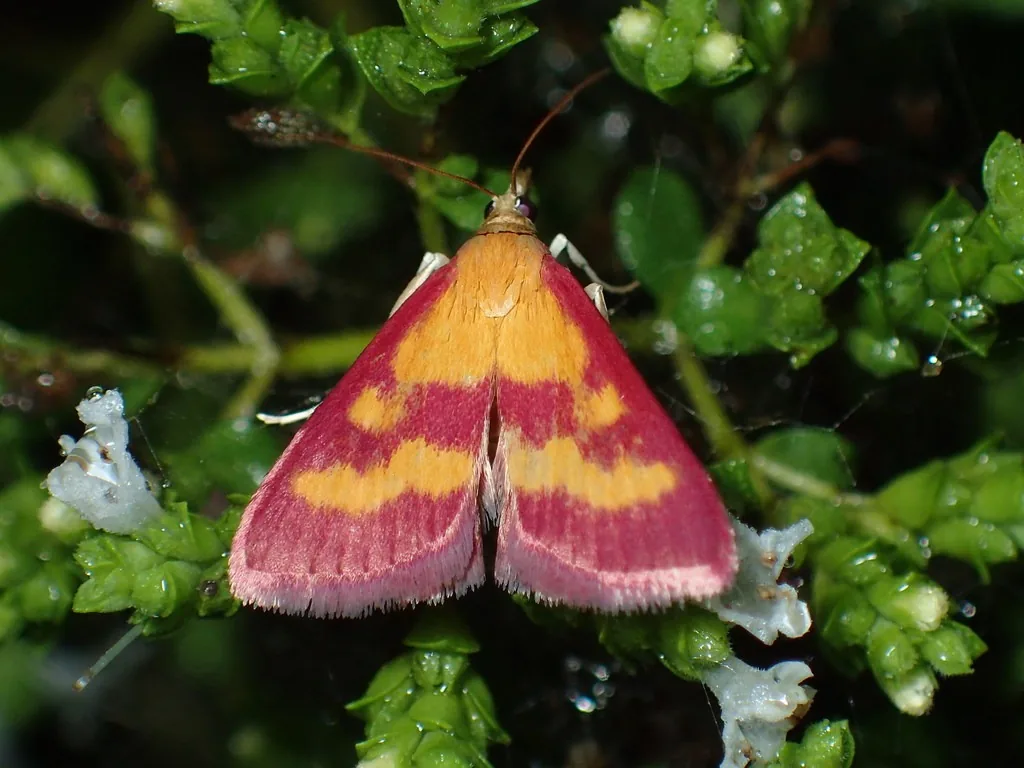
- Moths have a wingspan of about 3/4 inch and sit in a triangular shape. NC State describes reddish-purple wings with brownish-yellow bands, sometimes brown instead of purple; Clemson calls them pinkish and yellow.[1][2]
- Caterpillars are small and slender, pale brown to green, with rows of black spots down the back and sides. Pupae are dark brown and found in the webbing.[1][2]
- Infestations show as masses of dead leaves held together by webbing studded with frass pellets, often on the upper parts of branches.[1][2]
Look-alikes
| Look-alike | How to tell them apart |
|---|---|
| Spider webbing | Clemson notes spider webs are sometimes mistaken for an early infestation; look for the spotted caterpillars.[2] |
| Mint-loving pyrausta (Pyrausta acrionalis) | NC State says this relative feeds on mints (Mentha) rather than rosemary and has deep rose to violet forewings with yellow borders.[1] |
Where it lives
NC State calls it a native species. Clemson reports it on rosemary throughout the Charleston, South Carolina, area for over 10 years, and Texas A&M AgriLife's El Paso County program recorded it on rosemary in El Paso, Texas, in 2016.[1][2][3]
Biology and life cycle
Little has been published on its biology. NC State says the moths fly from June to August, there are probably several generations a year in North Carolina, and the caterpillars have only been reported on rosemary. They spin loose webbing as they feed, and frass collects in it.[1][2]
Damage and signs
- It can damage the foliage on over half of a rosemary plant and likely leads to its decline and death if not managed.[2]
- Damage shows on the upper parts of branches. Clemson says the cultivar 'Tuscan Blue' is routinely but not severely infested, while 'Chef's Choice' has had much less to no damage, depending on the year.[2]
Health risk
It feeds on rosemary. NC State, Clemson and Texas A&M AgriLife describe plant damage only and don't mention any risk to people or pets.[1][2][3]
Control
Traps and physical control
Prune away and dispose of infested, webbed branches.[2]
Pesticides
Bacillus thuringiensis (Bt) products labeled for caterpillars kill only caterpillars but may need several applications in heavy infestations. For rosemary grown for cooking, NC State suggests insecticidal soap or Bt.[2][1]
Common questions
Sources
- NC State Extension, “Southern Purple Mint Moth (PDIC Factsheet).” content.ces.ncsu.edu/southern-purple-mint-moth (accessed 2026-11-13)
- Clemson Cooperative Extension Home & Garden Information Center, “Question of the Week: Southern Purple Mint Moth.” hgic.clemson.edu/question-of-the-week-southern-purple-mint-moth/ (accessed 2026-11-13)
- Texas A&M AgriLife Extension, El Paso County Urban Programs, “Lepidoptera-Crambidae-Pyrausta laticlavia-Southern Purple Mint Moth (record, May 30, 2016).” elp.tamu.edu/ipm/bugs/moths/lepidoptera-crambidae-pyrausta-laticlavia-southern-purple-mint-moth-c/ (accessed 2026-11-13)
- Global Biodiversity Information Facility (GBIF), “Pyrausta laticlavia Grote & Robinson, 1867 (GBIF Backbone Taxonomy).” api.gbif.org/v1/species/1890885 (accessed 2026-11-13)
- iNaturalist, “Pyrausta laticlavia taxon page (order and family).” www.inaturalist.org/taxa/204081 (accessed 2026-10-06)