On this page
How to identify it
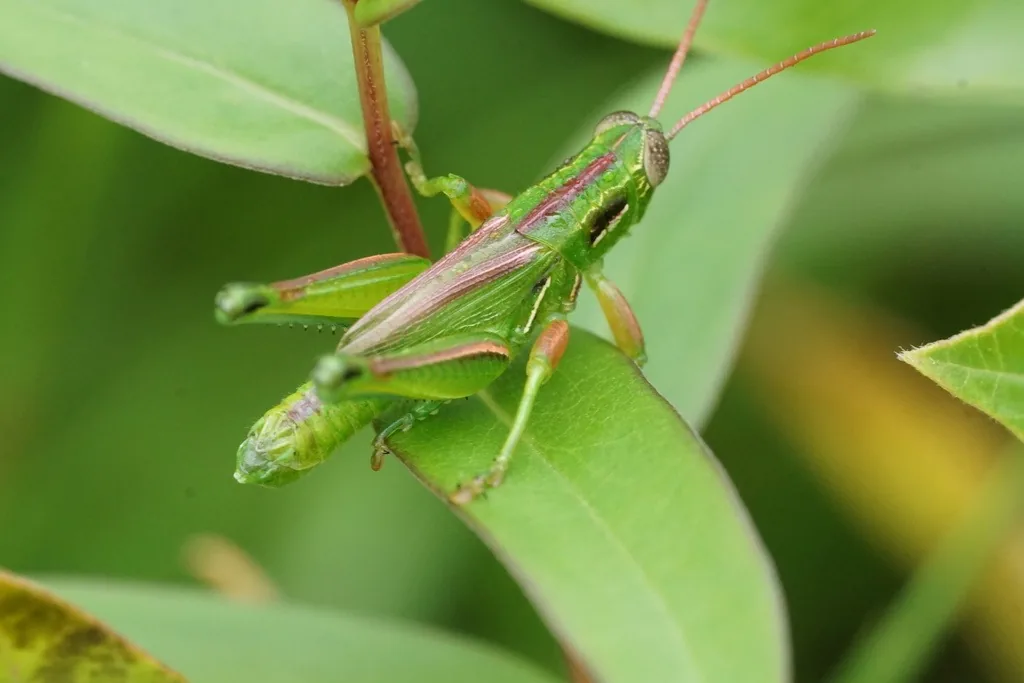
- Adults are green, medium-sized spur-throated grasshoppers, with white and black areas on the sides of the pronotum.[1][2]
- A pale line starts on the back of the head and continues down the middle of the top of the pronotum.[1]
- The hind femora are green with cream and dark chevrons and a ring near the knee, which the ARS fact sheet describes as pink and the Nebraska guide as orange to red. The front and middle femora are pink and green.[1][2]
- The hind tibiae are light blue; in females the tips are often light green.[1][2]
- Males' wings reach the end of the abdomen, while females' fall just short. The hind wings are clear.[1][2]
- Nebraska specimens measured 18 to 24 mm for males and 20 to 31 mm for females. Two subspecies occur there: one mostly in the western half of the state with distinct white lines on the hind femur and larger white areas on the pronotum, and one most common in the east with weaker white markings.[2]
- Nymphs are green with many dark spots and usually a cream line down the middle of the back; their antennae are dark with cream-colored rings.[1]
Look-alikes
| Look-alike | How to tell them apart |
|---|---|
| Cudweed grasshopper (Hypochlora alba) | Cudweed grasshopper nymphs, also green spur-throated grasshoppers that turn up in rangeland samples, are pale green with green antennae; snakeweed grasshopper nymphs are medium green with black antennae ringed in pale bands.[1] |
Where it lives
It has a wide range in North America but a patchy distribution, because it lives only where its host plants grow; it is less common in the East than in the West. GBIF records are most numerous from Colorado, Arizona, Texas, Oklahoma, Utah, New Mexico, California and Nebraska, with smaller numbers from Canada and Mexico. In Nebraska it has been recorded from much of the state, especially in grasslands with snakeweeds.[1][8][2]
Biology and life cycle
All of its host plants are forbs, mostly in the composite family. Common hosts include broom and threadleaf snakeweed, Missouri goldenrod, western ragweed, Douglas and gray rabbitbrush and burroweed, and at least 34 forbs have been recorded in its diet. In preference tests it chose snakeweeds over rabbitbrush and burroweed.[1][2]
It also takes trace amounts of grasses, flower petals, pollen, fungi and other arthropods.[1]
It spends most of its life on its host plant, roosting in the shrub through much of the day and feeding in short bouts of less than three minutes on leaf edges, stem tissue and flower buds.[1]
Hatching comes two to three weeks after that of the bigheaded grasshopper: in mid-June in eastern Wyoming and about six weeks earlier in New Mexico.[1]
Nymphs take about 55 days and five stages to mature, 12 to 15 days longer than ground-dwelling range grasshoppers, apparently because perching in the shrub keeps them cooler.[1]
In Nebraska, nymphs appear in spring and adults are most common from mid-July to September.[2]
In northern New Mexico, mating and egg-laying run from late June into early September. Females lay at the base of the host plant, in bare ground or a clump of short grass, about 1 inch deep, in a tough-walled pod about 1/2 inch long that holds ten tan eggs.[1]
It has one generation a year and appears to overwinter as an embryo in the egg, 1 inch down in the soil.[1]
Host quality matters: in the laboratory, females fed only broom snakeweed laid about six eggs each, while those fed threadleaf snakeweed laid 28.[1]
It can disperse over long distances; in Colorado it lives up to about 7,600 feet, but strays have turned up in the mountains as high as 11,500 feet.[1]
Researchers have found that it consists of two distinct genetic lineages, each tied to particular host plants.[2]
Populations feeding on different host plants are genetically distinct: grasshoppers on velvety goldenrod (Solidago mollis) and on broom snakeweed formed separate genetic groups, even where the two plants grow side by side.[6]
Fun fact: a parasitic nematode, Mermis nigrescens, wiped out one population of the eastern subspecies living in a low, wet site on Missouri goldenrod; infected grasshoppers never developed mature ovaries or testes.[7]
Damage and signs
- The plants it eats have little or no forage value for livestock and compete heavily for soil moisture, holding back better forage plants. Some of its preferred hosts, the snakeweeds, are poisonous, and cattle, horses, sheep and goats that eat enough spring shoots and seedlings can become ill, with pregnant animals aborting.[1]
- In New Mexico its feeding killed many threadleaf snakeweed seedlings and one-year-old plants, and at high densities it eats all the leaves and much of the outer stem tissue of older plants, contributing to their early death. The ARS fact sheet reports a New Mexico study of whether it could serve as a biological control agent against broom snakeweed.[1][2]
- In caged trials near Corona and Folsom, New Mexico, five grasshoppers per plant killed 91% of the broom snakeweed and cut its biomass by 75%, and even one per plant killed 53%. Each grasshopper removed 45 to 85 mg of snakeweed a day, and where most snakeweed was removed, grass standing crop rose 23% that year and 44% the next.[4]
Health risk
It feeds on range forbs and shrubs; the ARS fact sheet and the Nebraska guide treat it as a beneficial species and describe no risk to people.[1][2]
Control
Prevention
Leave it alone. The ARS fact sheet calls it a beneficial insect, and the Nebraska guide considers it beneficial, because it feeds on weedy forbs and especially on snakeweeds that are toxic to cattle.[1][2]
Biological control
Ranchers interested in it as a snakeweed biocontrol should know that birds eat it: in an Arizona study, snakeweed grasshopper adults and nymphs were more numerous on plots caged against birds, and the authors suggest bird predation may limit its use as a biocontrol agent.[5]
Where sources disagree
Knee color: the ARS fact sheet describes the ring near the hind knee as pink, and the Nebraska guide as orange to red.[1][2]
Value as a weed control: caged New Mexico trials show it can kill most broom snakeweed at high densities, but grass gains came only at the highest density, and an Arizona study found birds keep its numbers down in the open.[4][5]
Common questions
- Is the snakeweed grasshopper a pest?
- No. It is considered beneficial, because it feeds on rangeland weeds of little forage value, especially snakeweeds, which are poisonous to livestock, and its feeding can kill snakeweed plants.[1][2]
- What does the snakeweed grasshopper eat?
- Forbs, mostly in the composite family: snakeweeds above all, plus rabbitbrush, burroweed, Missouri goldenrod, western ragweed and others, with only traces of grass.[1][2]
- How do I recognize a snakeweed grasshopper?
- Look for a green grasshopper with light blue hind tibiae, a pink, orange or red ring near each hind knee, cream and dark chevrons on the hind femur and a pale line down the top of the head and pronotum.[1][2]
- Will it eat my garden?
- It is unlikely to be a garden pest: all of its host plants are forbs, mostly in the composite family, and it takes only traces of grass. The sources describe it on rangeland shrubs such as snakeweed and rabbitbrush, not on vegetables.[1][2]
- Can it really control snakeweed?
- At high numbers, yes: in New Mexico cages, three to five grasshoppers per plant killed most broom snakeweed. Grass only increased where most snakeweed was removed, and bird predation may limit how well it works in open range.[4][5]
Sources
- USDA Agricultural Research Service, Northern Plains Agricultural Research Laboratory, “Snakeweed Grasshopper, Hesperotettix viridis (Thomas): species fact sheet, Grasshoppers: Their Biology, Identification and Management.” www.ars.usda.gov/plains-area/sidney-mt/northern-plains-agricultural-research-laboratory/pest-management-research/pmru-docs/grasshoppers-their-biology-identification-and-management/id-tools-apps/fact-sheets/melanoplinae-subfamily/fs-snakeweed/ (accessed 2026-11-12)
- University of Nebraska-Lincoln Extension, “The Grasshoppers (Orthoptera: Acrididae and Romaleidae) of Nebraska, EB3 (M. L. Brust, W. W. Hoback and R. J. Wright).” extensionpubs.unl.edu/publication/eb3/2009/pdf/view/eb3-2009.pdf (accessed 2026-11-12)
- iNaturalist, “Hesperotettix viridis taxon page (order and family).” www.inaturalist.org/taxa/155244 (accessed 2026-11-12)
- Journal of Range Management 49(5), 1996 (Thompson, McDaniel and Torell), via Rangelands Gateway, “Feeding by a native grasshopper reduces broom snakeweed density and biomass.” rangelandsgateway.org/dlio/20356 (accessed 2026-11-12). Cited from the abstract.
- Environmental Entomology 27(1), 1998 (Gardner and Thompson), summary in the Montana State University Library Range Science Information System, “Influence of avian predation on a grasshopper (Orthoptera: Acrididae) assemblage that feeds on threadleaf snakeweed.” arc.lib.montana.edu/range-science/item/424 (accessed 2026-11-12). Cited from the library's article summary.
- Molecular Ecology 14(7), 2005 (Sword, Joern and Senior), via PubMed, “Host plant-associated genetic differentiation in the snakeweed grasshopper, Hesperotettix viridis (Orthoptera: Acrididae).” pubmed.ncbi.nlm.nih.gov/15910337/ (accessed 2026-11-12). Cited from the PubMed abstract.
- Journal of Nematology 3(4), 1971 (Mongkolkiti and Hosford), via PubMed, “Biological control of the grasshopper Hesperotettix viridis pratensis by the nematode Mermis nigrescens.” pubmed.ncbi.nlm.nih.gov/19322391/ (accessed 2026-11-12). Cited from the PubMed abstract.
- Global Biodiversity Information Facility (GBIF), “Hesperotettix viridis: occurrence records.” www.gbif.org/species/1709906 (accessed 2026-11-12). State and country counts from the GBIF occurrence API, read 2026-11-12.