On this page
How to identify it
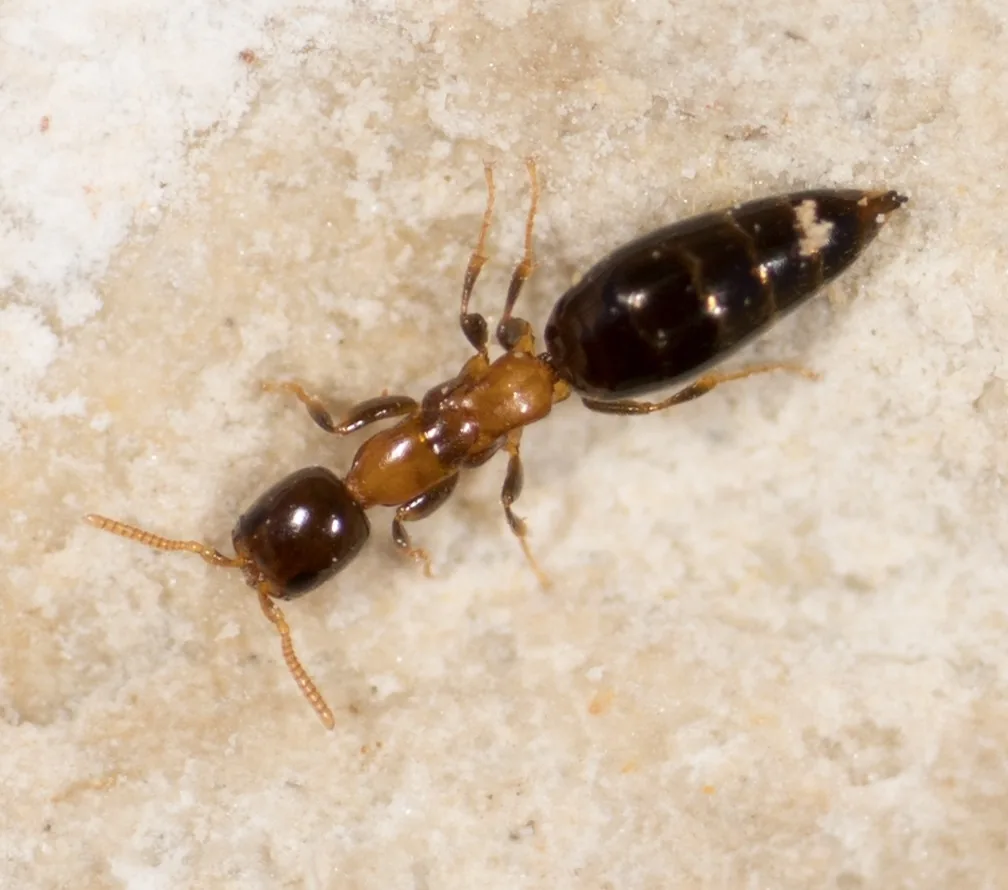
- They're 1.5 to 6 mm (0.05 to 0.25 inch) long, flattened and ant-like, with a large, boxy head and a long, tapered abdomen.[1]
- Most are wingless females, though both sexes can be winged or wingless.[1]
- S. carolinensis is light to dark reddish brown; S. macrogaster has cream patches on the thorax; S. ventura has a light red head and thorax and a dark brown abdomen.[1]
- In Italy, where most reported cases come from, the species usually blamed is S. domesticus: ant-like, brownish black and 2 to 4 mm long. Its females are wingless, and the winged males die soon after mating.[2][1]
Where it lives
Three species occur in North America: S. carolinensis from Connecticut and Illinois to Georgia and Louisiana, S. macrogaster from Virginia to Texas and southward, and S. ventura in California. GBIF has only 84 U.S. records of the genus since 1990, most from Florida, and more from New Zealand than from the United States.[1][3][4]
Biology and life cycle
They parasitize wood-boring beetle larvae, including longhorn beetles, metallic wood borers, death-watch beetles and bark beetles.[1]
Females cooperate to subdue large larvae and help raise each other's young, laying 5 to 120 eggs per host.[1]
Females can live up to seven months; an unmated female can raise sons, mate with them and then produce daughters.[1]
A female S. domesticus stings a beetle larva over several days until it is paralyzed, then lays 30 to 60 eggs on its back; the young feed on the living host and the mother stays with them.[2]
In China several Sclerodermus species attack longhorn and metallic wood-boring beetles and are mass-reared to control those forest pests.[5][1]
Damage and signs
- Large infestations can send dozens of wasps a day into living space as females search for new hosts.[1]
- Females sting when picked up with bare fingers or trapped under or between clothing.[1]
- Most known infestations are in Europe, especially Italy. Penn State's review reports only one U.S. case, a home infested by S. macrogaster.[1][6]
- Cases turn up elsewhere too: in Brazil, a woman with two bouts of intensely itchy lesions found eight Sclerodermus females in her bed.[7]
- Related flat wasps, Epyris californicus and Cephalonomia gallicola, have become similar nuisances in the western United States, and a 2025 dermatology review covers sting lesions from both Sclerodermus and Cephalonomia worldwide.[1][8]
Health risk
A sting usually brings immediate, intense pain, sometimes burning, followed by red, raised and very itchy bumps or welts. Some people feel unwell, with fever, nausea or dizziness, and allergic (anaphylactic) reactions have been reported. When the reaction stays local, the lesions often clear on their own in about 3 to 14 days.[2]
Control
Traps and physical control
Stings stop only when the infestation is found and removed; infested furniture or cabinetry can simply be taken out of the home.[1][2]
When to call a professional
When beetles and wasps are in rafters or framing, repeated insecticide treatments or fumigation by a licensed pest control operator may be needed.[1]
More from the research literature
A 2014 case report from Italy notes that Sclerodermus wasps hunt the larvae of anobiid powderpost beetles, which tunnel in furniture such as chairs, beds, wardrobes and sofas and in house structures such as beams and door and window frames. People have been stung while sitting on an old chair, putting on clothes taken from a wardrobe, or lying in bed, and in the reported case the source was a worm-eaten sofa bought from a used-furniture dealer.[2]
If you are stung
Wash the sting with soap and water, then hold ice wrapped in a washcloth on it for 10 minutes, off for 10 minutes, and repeat. An antihistamine or anti-itch cream can help. Watch the spot for signs of infection over the next several days.[9]
Call 911 for trouble breathing or wheezing, swelling of the face or mouth, throat tightness or trouble swallowing, weakness, or turning blue.[9]
Expect symptoms to keep coming back until the infested wood is dealt with. Case reports note that antihistamines and corticosteroid creams don't relieve symptoms if the wasps aren't controlled, while after pest control fever went away within 3 days and skin lesions improved in 7 to 10 days.[2]
Common questions
- What tiny wasp is stinging me indoors?
- If old furniture or wood framing has wood-boring beetles, it may be Sclerodermus, which hunts those beetle larvae.[1]
- How are Sclerodermus stings treated?
- Doctors in published case reports used corticosteroid creams and oral antihistamines for the symptoms, together with treating or removing the infested furniture; without that, symptoms tend to persist. Get emergency care for trouble breathing or swelling of the face or mouth.[2][9]
Sources
- Penn State Extension, “Sclerodermus, a Small Wasp that Occasionally Infests Homes.” extension.psu.edu/sclerodermus-a-small-wasp-that-occasionally-infests-homes (accessed 2026-11-11)
- Peer-reviewed literature (PubMed Central), “A case of stings in humans caused by Sclerodermus sp. in Italy (Papini, 2014).” pmc.ncbi.nlm.nih.gov/articles/PMC3973378/ (accessed 2026-11-11)
- Global Biodiversity Information Facility (GBIF), “Sclerodermus (genus): U.S. occurrence records since 1990 by state (GBIF occurrence search).” api.gbif.org/v1/occurrence/search?taxonKey=4404783&country=US&hasGeospatialIssue=false&occurrenceStatus=PRESENT&year=1990%2C2026&facet=stateProvince&facetLimit=400&limit=0 (accessed 2026-11-11). Exact count at access: 84 U.S. records since 1990 (Florida 36; New York 8; California 6; Georgia 6; Virginia 4).
- Global Biodiversity Information Facility (GBIF), “Sclerodermus (genus): occurrence records since 1990 by country (GBIF occurrence search).” api.gbif.org/v1/occurrence/search?taxonKey=4404783&hasGeospatialIssue=false&occurrenceStatus=PRESENT&year=1990%2C2026&facet=country&limit=0 (accessed 2026-11-11). Exact counts at access: 454 records since 1990; New Zealand 212, United States 84, Tanzania 25, France 24.
- Insects, via PubMed, “Comparing the Developmental Biology and Brood Size of Four Sclerodermus Species (Situ et al. 2025).” pubmed.ncbi.nlm.nih.gov/41148881/ (accessed 2026-11-11)
- Journal of Medical Entomology, via PubMed, “A Review of Sclerodermus Latreille, 1809 (Hymenoptera: Bethylidae) Infestations and Report of the First Case in North America North of Mexico (Skvarla 2018).” pubmed.ncbi.nlm.nih.gov/29471402/ (accessed 2026-11-11)
- Anais Brasileiros de Dermatologia, via PubMed, “Domestic infestation by Sclerodermus sp. with associated skin manifestation (Almeida et al. 2018).” pubmed.ncbi.nlm.nih.gov/30066771/ (accessed 2026-11-11)
- Clinical and Experimental Dermatology, via PubMed, “Human ectoparasitoses caused by flat wasps of the genera Sclerodermus and Cephalonomia (Masini et al. 2025).” pubmed.ncbi.nlm.nih.gov/39888595/ (accessed 2026-11-11)
- MedlinePlus, U.S. National Library of Medicine, “Insect bites and stings (Medical Encyclopedia).” medlineplus.gov/ency/article/000033.htm (accessed 2026-11-11)
- iNaturalist, “Sclerodermus taxon page (order and family).” www.inaturalist.org/taxa/212140 (accessed 2026-10-06)